Letter, 1 page
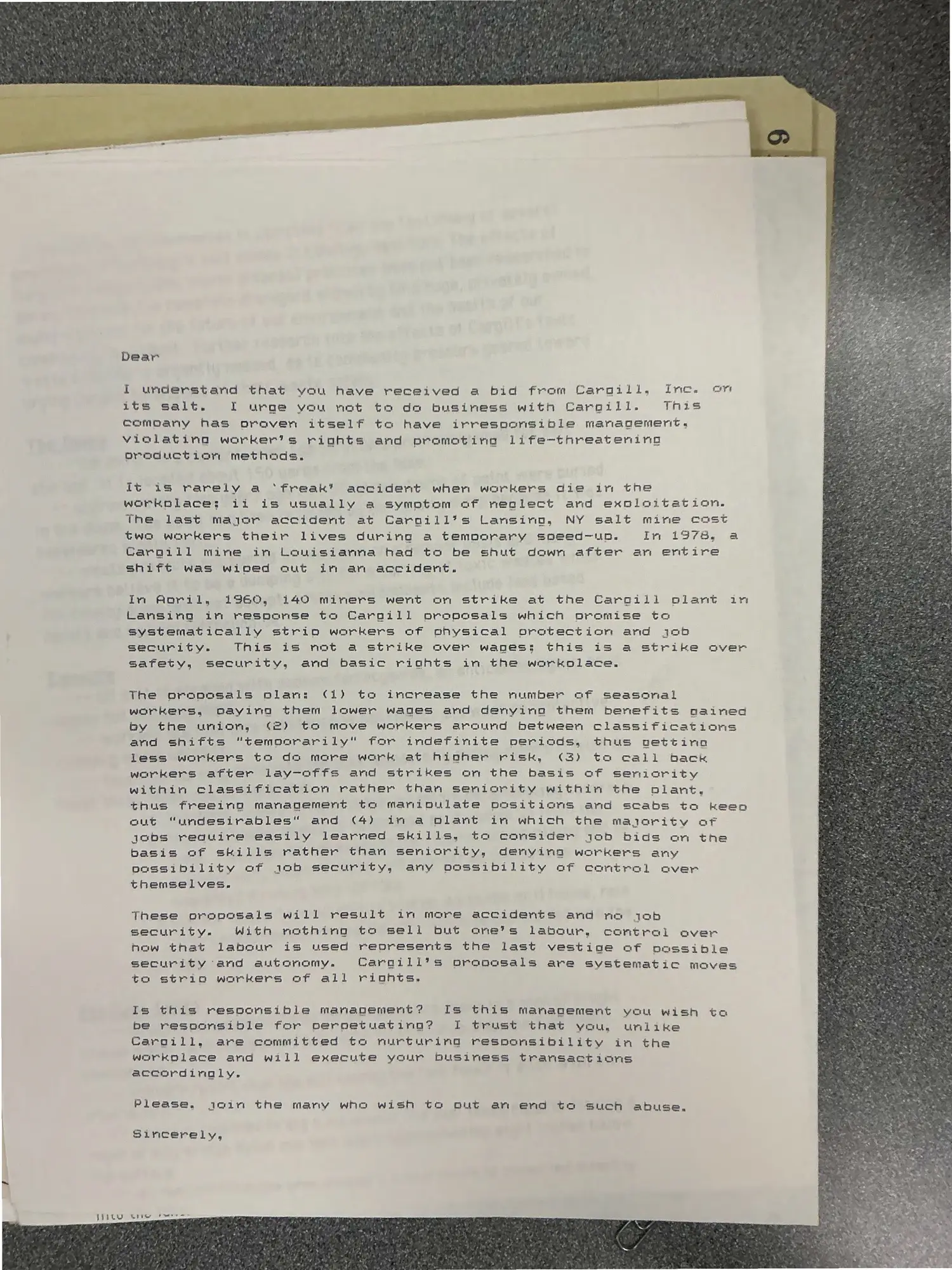
Model letter to Cargill salt customers: “It is rarely a ‘freak’ accident…”
[1986]Date inferred
A draft letter for supporters to send to municipalities and other buyers of road salt that had received bids from Cargill. It argues that workplace deaths are rarely freak accidents and asks buyers to consider Cargill's labor and safety record.
Download or cite this itemPages
 (open zoom view)
Read the page text (machine-read, contains errors)
This text was generated automatically from the photograph and has not been corrected. The image is the authoritative record.
Dear

I understand that you have received a bid from Cargill, inc. or
its salt. Io urge vou net to da business with Cargill. (Sintec!
comoany has oroaven itself ta have irresoonsible management .«
violating worker’s rights and proemotina life-threatening
preductiloan methods.

It iS rarely a ‘freak’ accident when workers die in the
workolace; ii is usually a symotom of nealect and exoloitation.
The last major accident at Cargill’s Lansing, NY salt mine cast
two workers their lives during a temoorary soeed-un. Inots7e, a
Cargill mine in Louwuisiarnma had to be shut down after an entire
shift was wioed aut in an accident.

Im Aoril, 1960, 140 miners went on strike at the Cargill oblant in
Lansino im resoonse to Cargill proposals which premise ta
Systematically strip workers of ohysical orotection and i306
security. This is net a strike over wanes: this is a str
safety, security, and basic rights in the workplace.

The oropoesals olan: (1) to increase the number af seasonal
workers, oDaying them lower wages and denying them benefits oained
by the union, (2) to move workers around between classifications
and shifts "“temoorarily" for indefinite nericds, thus svettinea
less workers toa do more work at hinher risk, (3) to call back
workers after lay-offs and strikes on the basis of seniority
within classification rather than seniority within the olant,.
thus freeing management ta manipulate oasitians and scabs ta keen
out “undesirables” and (4) in a Dlant in which the majority of
jobs reauire easily learned skills. to consider ji90b bids on the
basis of skills rather than seniority, denying workers any
pessibility of j90b security, any possibility af cemtrol aver

themselves.

These oreposals will result in more accidents and neo jab
security. With mothing to seli but one’s labour, contreal over
how that labour is used represents the last vestige of possible
security and autonomy. Cargill’s oreoasals are systematic moves
to strio workers of all riohts.

Is this responsible mananement? Is this management you wish tea
be resoonsible for oeroetuating? I trust that you, unlike
Cargill, are committed to nurturing resoonmsibilityv in the
workolace and will execute your business transactions
accordingly,

Please. jacin the many whe wish to out an end ta such abuse.

Sincerely,

LEU Re

¢ q 4 ai . 4 WA
See something wrong, or recognize a person or event? Send a correction. If you hold rights in this item or think it should not be public, write to the same address.