Speech, 2 pages
Presentation on child labor and trade to the Dryden Sertoma Club
September 3, 1998
The text of a talk on child labor in global production, the Harkin bill, and the Sanders amendment to the Tariff Act, given to the Dryden Sertoma Club on September 3, 1998. Page 2 precedes page 1 in the source.
Download or cite this itemPages
 (open zoom view)
Read the page text (machine-read, mostly readable)
This text was generated automatically from the photograph and has not been corrected. The image is the authoritative record.
AT "IX Tom Stephens

Subject:
Date:

From:
To:

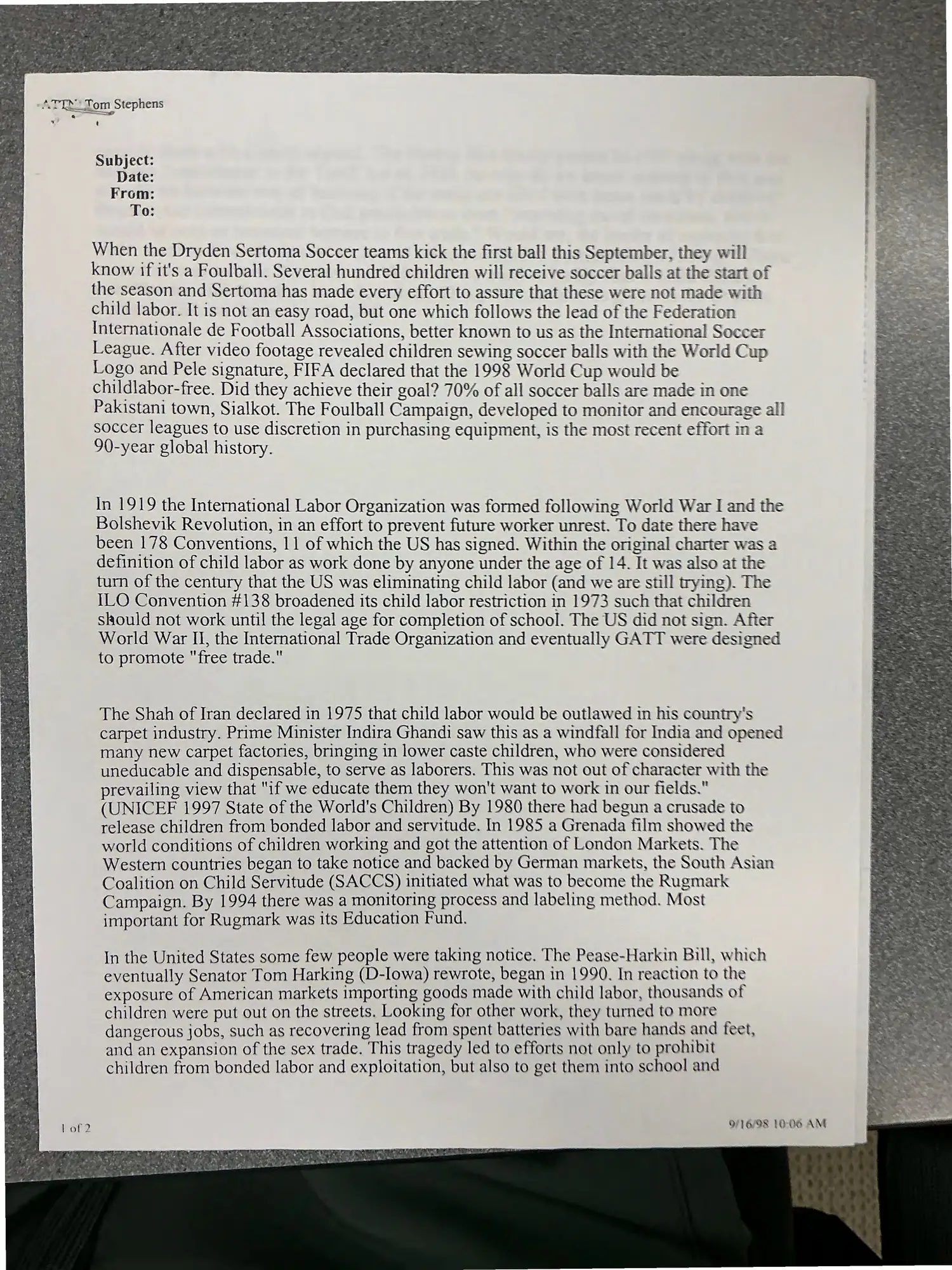
When the Dryden Sertoma Soccer teams kick the first ball this September, they will
know if it's a Foulball. Several hundred children will receive soccer balls at the start of
the season and Sertoma has made every effort to assure that these were not made with
child labor. It is not an easy road, but one which follows the lead of the Federation
Internationale de Football Associations, better known to us as the International Soccer
League. After video footage revealed children sewing soccer balls with the World Cup
Logo and Pele signature, FIFA declared that the 1998 World Cup would be
childlabor-free. Did they achieve their goal? 70% of all soccer balls are made in one
Pakistani town, Sialkot. The Foulball Campaign, developed to monitor and encourage all
soccer leagues to use discretion in purchasing equipment, is the most recent effort in a
90-year global history.

In 1919 the International Labor Organization was formed following World War I and the
Bolshevik Revolution, in an effort to prevent future worker unrest. To date there have
been 178 Conventions, 11 of which the US has signed. Within the original charter was a
definition of child labor as work done by anyone under the age of 14. It was also at the
tur of the century that the US was eliminating child labor (and we are still trying). The
ILO Convention #138 broadened its child labor restriction in 1973 such that children
should not work until the legal age for completion of school. The US did not sign. After
World War II, the International Trade Organization and eventually GATT were designed

to promote "free trade."

The Shah of Iran declared in 1975 that child labor would be outlawed in his country's
carpet industry. Prime Minister Indira Ghandi saw this as a windfall for India and opened
many new carpet factories, bringing in lower caste children, who were considered
uneducable and dispensable, to serve as laborers. This was not out of character with the
prevailing view that "if we educate them they won't want to work in our fields."
(UNICEF 1997 State of the World's Children) By 1980 there had begun a crusade to
release children from bonded labor and servitude. In 1985 a Grenada film showed the
world conditions of children working and got the attention of London Markets. The
Western countries began to take notice and backed by German markets, the South Asian
Coalition on Child Servitude (SACCS) initiated what was to become the Rugmark
Campaign. By 1994 there was a monitoring process and labeling method. Most

important for Rugmark was its Education Fund.

In the United States some few people were taking notice. The Pease-Harkin Bill, which
eventually Senator Tom Harking (D-Iowa) rewrote, began in 1990. In reaction to the
exposure of American markets importing goods made with child labor, thousands of
children were put out on the streets. Looking for other work, they turned to more
dangerous jobs, such as recovering lead from spent batteries with bare hands and feet,
and an expansion of the sex trade. This tragedy led to efforts not only to prohibit
children from bonded labor and exploitation, but also to get them into school and

9/16/88 10-06 AM
 (open zoom view)
Read the page text (machine-read, mostly readable)
This text was generated automatically from the photograph and has not been corrected. The image is the authoritative record.
Stephens

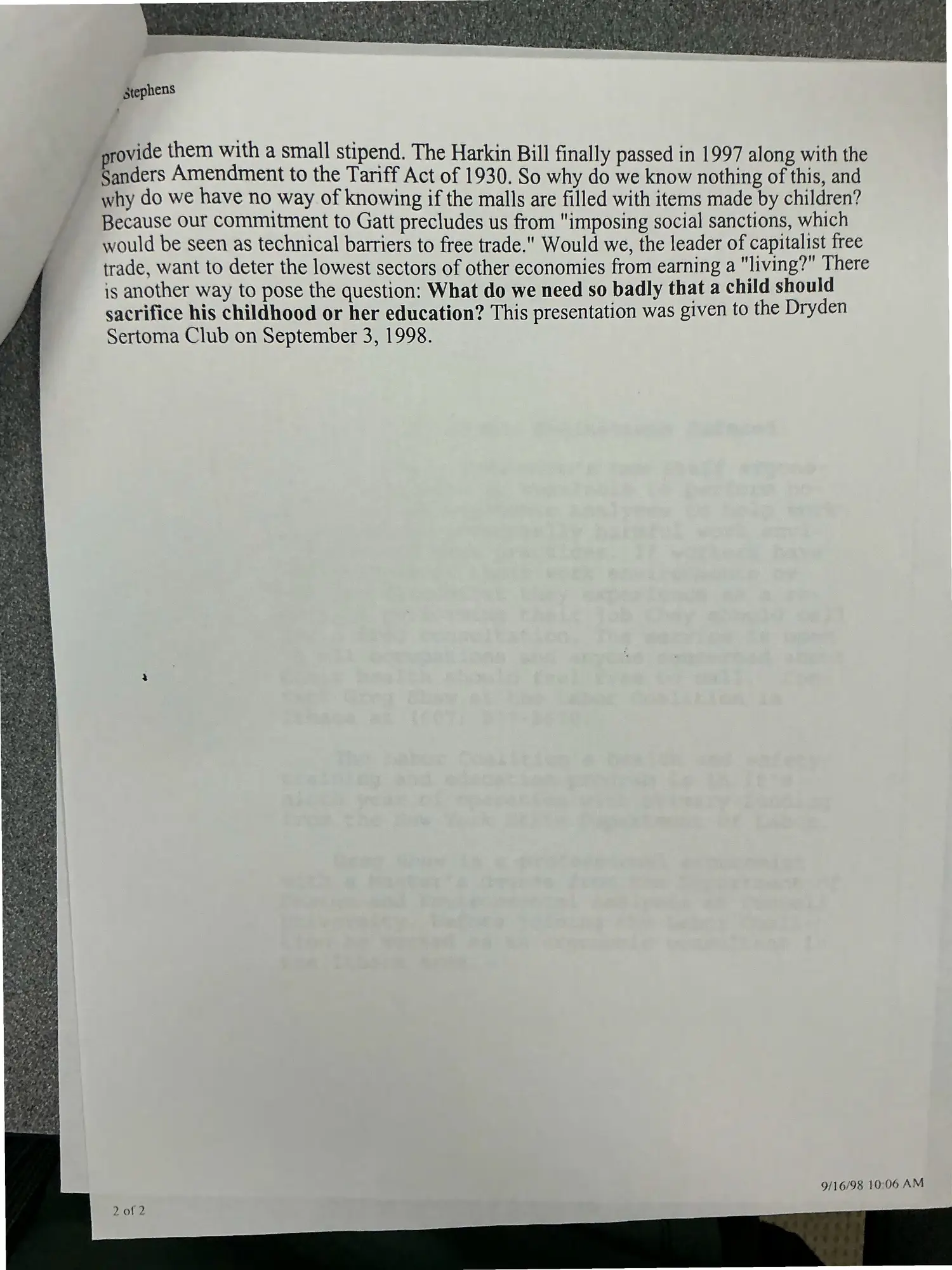
provide them with a small stipend. The Harkin Bill finally passed in 1997 along with the
Sanders Amendment to the Tariff Act of 1930. So why do we know nothing of this, and
why do we have no way of knowing if the malls are filled with items made by children?
Because our commitment to Gatt precludes us from "imposing social sanctions, which
would be seen as technical barriers to free trade." Would we, the leader of capitalist free
trade, want to deter the lowest sectors of other economies from earning a "living?" There
is another way to pose the question: What do we need so badly that a child should
sacrifice his childhood or her education? This presentation was given to the Dryden
Sertoma Club on September 3, 1998.

9/16/98 10:06 AM
See something wrong, or recognize a person or event? Send a correction. If you hold rights in this item or think it should not be public, write to the same address.