Letter, 4 pages
John J. Sweeney to Al Davidoff on Union Cities, with “Union Cities: Equal Strong Communities”
January 3, 1997
The AFL-CIO president describes the 1996 outreach to central labor councils and introduces the Union Cities program. Enclosed is the program outline with its goals: organizing, rapid response, membership growth, political action, and economic development.
Download or cite this itemPages
 (open zoom view)
Read the page text (machine-read, contains errors)
This text was generated automatically from the photograph and has not been corrected. The image is the authoritative record.
EXECUTIVE VICE PRESIDENT

Wayne £. Gierp
Pillar 4 Qumanee
Ritter Gaongre
ete t Bary
Peach Harriiew
Retran 8, Co
‘George = Siacker
WA. "War Fiening
doe. Graare
tocrow Mitercie
Raider A Srareseilietti

Janmes € Matien’
Maree: Goede
Gere Upshaw
Mice Bitter

diarres, 4. Nizrtte
Peart Murt
Stepher ? Yorict
Carcive L omest
Sooniny Mail
Willary Lacw

AL. Miike” Norma
Apert £ Wikazes.

echo & Stern

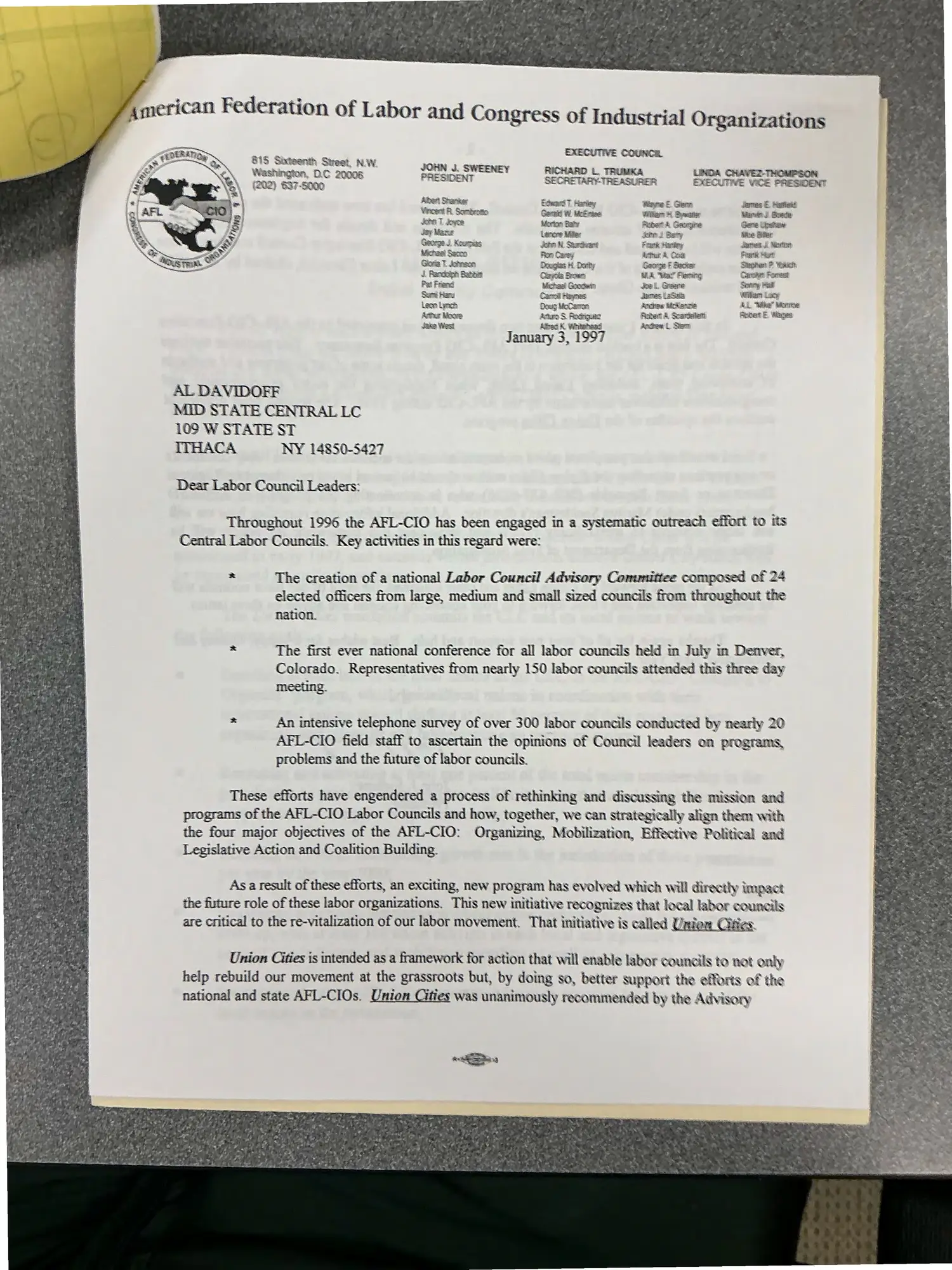
AL DAVIDOFF

MID STATE CENTRAL LC
109 W STATE ST

ITHACA NY 14850-5427

Dear Labor Council Leaders:

Throughout 1996 the AFL-CIO has been engaged in a systematic outreach effort to its
Central Labor Councils. Key activities in this regard were:

= The creation of a national Labor Council Advisory Committee composed of 24
elected officers from large, medium and small sized councils from throughout the
nation.

The first ever national conference for all labor councils held in July in Denver,
Colorado. Representatives from nearly 150 labor councils attended this three day

meeting.

An intensive telephone survey of over 300 labor councils conducted by nearly 20
AFL-CIO field staff to ascertain the opinions of Council leaders on programs,
problems and the future of labor councils.

These efforts have engendered a process of rethinking and discussing the mission and
programs of the AFL-CIO Labor Councils and how, together, we can strategically align them with
the four major objectives of the AFL-CIO: Organizing, Mobilization, Effective Political and
Legislative Action and Coalition Building.

As a result of these efforts, an exciting, new program has evolved which will directly i wnpact
the fisture role of these labor organizations. This new initiative recognizes that local labor Soaams
are critical to the re-vitalization of our labor movement. That initiative is called Upden

Union Cities is intended as a framework for action that will enable labor councils to not only
help rebuild our movement at the grassroots but, by doing so, better support the efforts of the
national and state AFL-CIOs. Union Cities was unanimously recommended by the Advisory

Bhs
 (open zoom view)
Read the page text (machine-read, mostly readable)
This text was generated automatically from the photograph and has not been corrected. The image is the authoritative record.
SO ae

: 4 i il has now embraced the p]
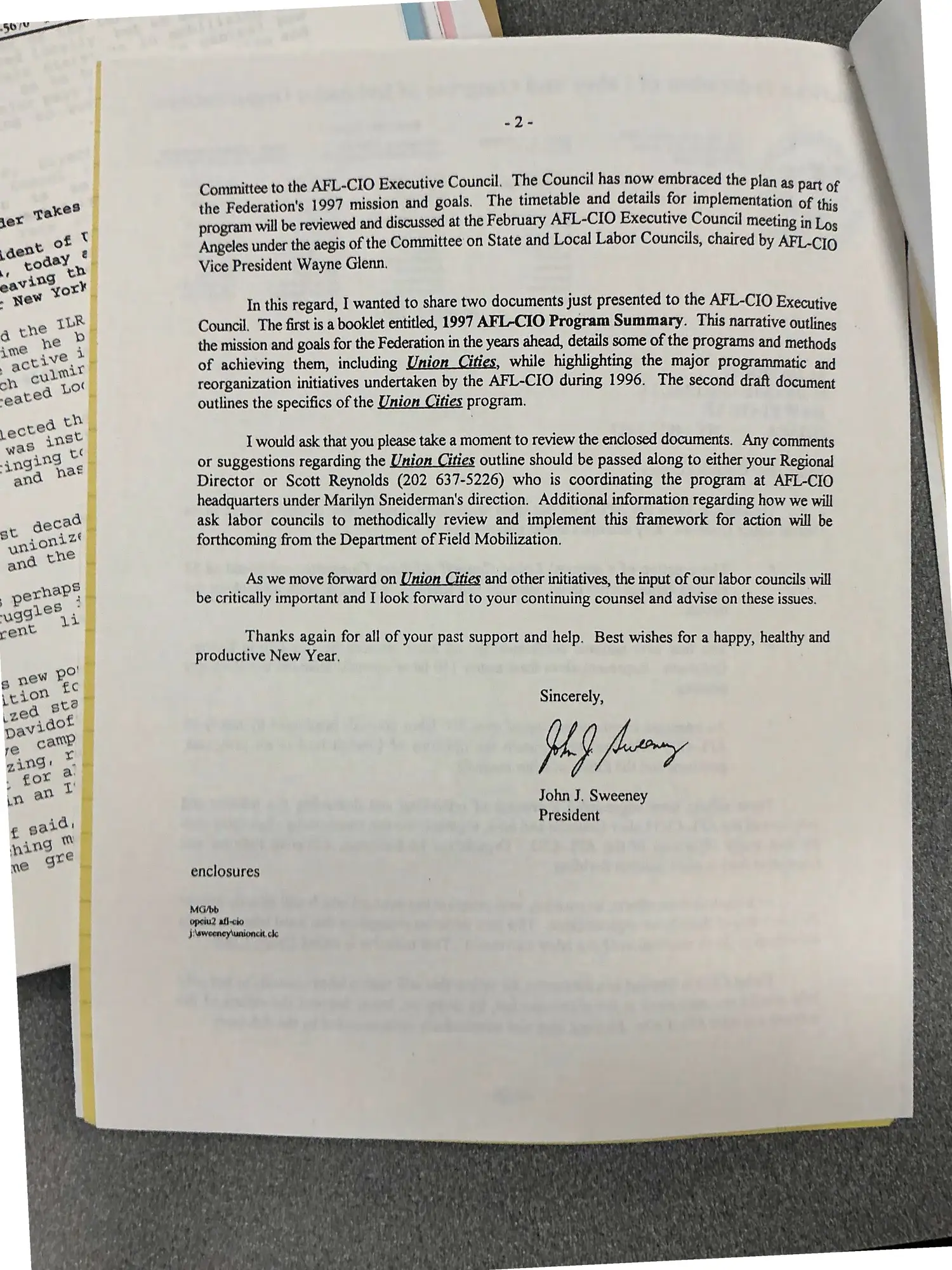
mmittee to the AFL-CIO Executive Council. The Counci : plan as part of
te Federation's 1997 mission and goals. The timetable and details for implementation of this

program will be reviewed and discussed at the February AFL-CIO Executive Council meeting in Los
Angeles under the aegis of the Committee on State and Local Labor Councils, chaired by AFL-C] 0

Vice President Wayne Glenn.

In this regard, I wanted to share two documents just presented to the AFL-CIO Executive
Council. The first is a booklet entitled, 1997 AFL-CIO Program Summary. This narrative outlines
the mission and goals for the Federation in the years ahead, details some of the programs and methods
of achieving them, including Union Cities, while highlighting the major programmatic and
reorganization initiatives undertaken by the AFL-CIO during 1996. The second draft document
outlines the specifics of the Union Cities program.

I would ask that you please take a moment to review the enclosed documents. Any comments

or suggestions regarding the Union Cities outline should be passed along to either your Regional
Director or Scott Reynolds (202 637-5226) who is coordinating the program at AFL-CIO

headquarters under Marilyn Sneiderman's direction. Additional information regarding how we will
ask labor councils to methodically review and implement this framework for action will be

forthcoming from the Department of Field Mobilization.

As we move forward on Union Cities and other initiatives, the input of our labor councils will
be critically important and I look forward to your continuing counsel and advise on these issues.

Thanks again for all of your past support and help. Best wishes for a happy, healthy and
productive New Year.

Sincerely,

jf fone

John J. Sweeney
President

enclosures

MG/bb
opeiu2 all-cio
J:\sweency\unioncit. cle
 (open zoom view)
Read the page text (machine-read, mostly readable)
This text was generated automatically from the photograph and has not been corrected. The image is the authoritative record.
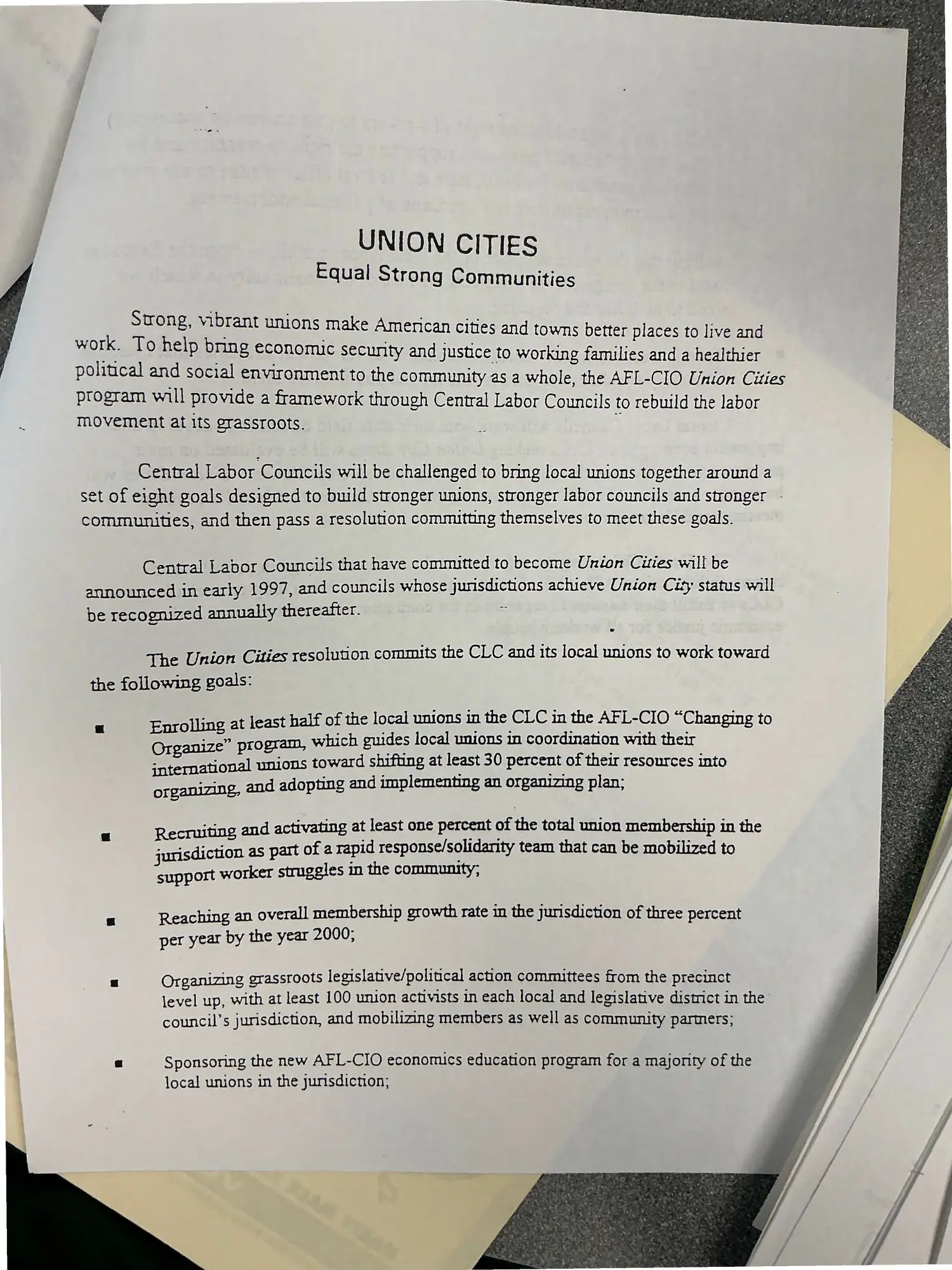
UNION CITIES

Equal Strong Communities

Strong, vibrant unions make Amencan cities and towns better places to live and
work. To help bning €conomuc security and justice to working families and a healthier
political and social environment to the community as a whole, the AFL-CIO Union Cities

program will provide a framework through Central Labor Councils to rebuild the labor
movement at its grassroots. }

Central Labor Councils will be challenged to bring local unions together around a
set of eight goals designed to build stronger unions, stronger labor councils and stronger -
communities, and then pass a resolution committing themselves to meet these goals.

Central Labor Councils that have committed to become Union Cities will be
announced in early 1997, and councils whose jurisdictions achieve Union City status will

be recognized annually thereafter.

The Union Cities resolution commits the CLC and its local unions to work toward
the following goals:

e Enrolling at least half of the local unions in the CLC in the AFL-CIO “Changing to
Organize” program, which guides local unions in coordination with their
international unions toward shifting at least 30 percent of their resources into
organizing, and adopting and implementing an organizing plan;

Recruiting and activating at least one percent of the total union membership in the
jurisdiction as part of a rapid response/solidarity team that can be mobilized to

support worker struggles in the community;

Reaching an overall membership growth rate in the jurisdiction of three percent
per year by the year 2000;

a Organizing grassroots legislatve/political action committees from the precinct
level up, with at least 100 union activists in each local and legislative district in the
council’s jurisdiction, and mobilizing members as well as community parmers;

SI Sponsoring the new AFL-CIO economucs education program for a majority of the
local unions in the jurisdiction;
 (open zoom view)
Read the page text (machine-read, mostly readable)
This text was generated automatically from the photograph and has not been corrected. The image is the authoritative record.
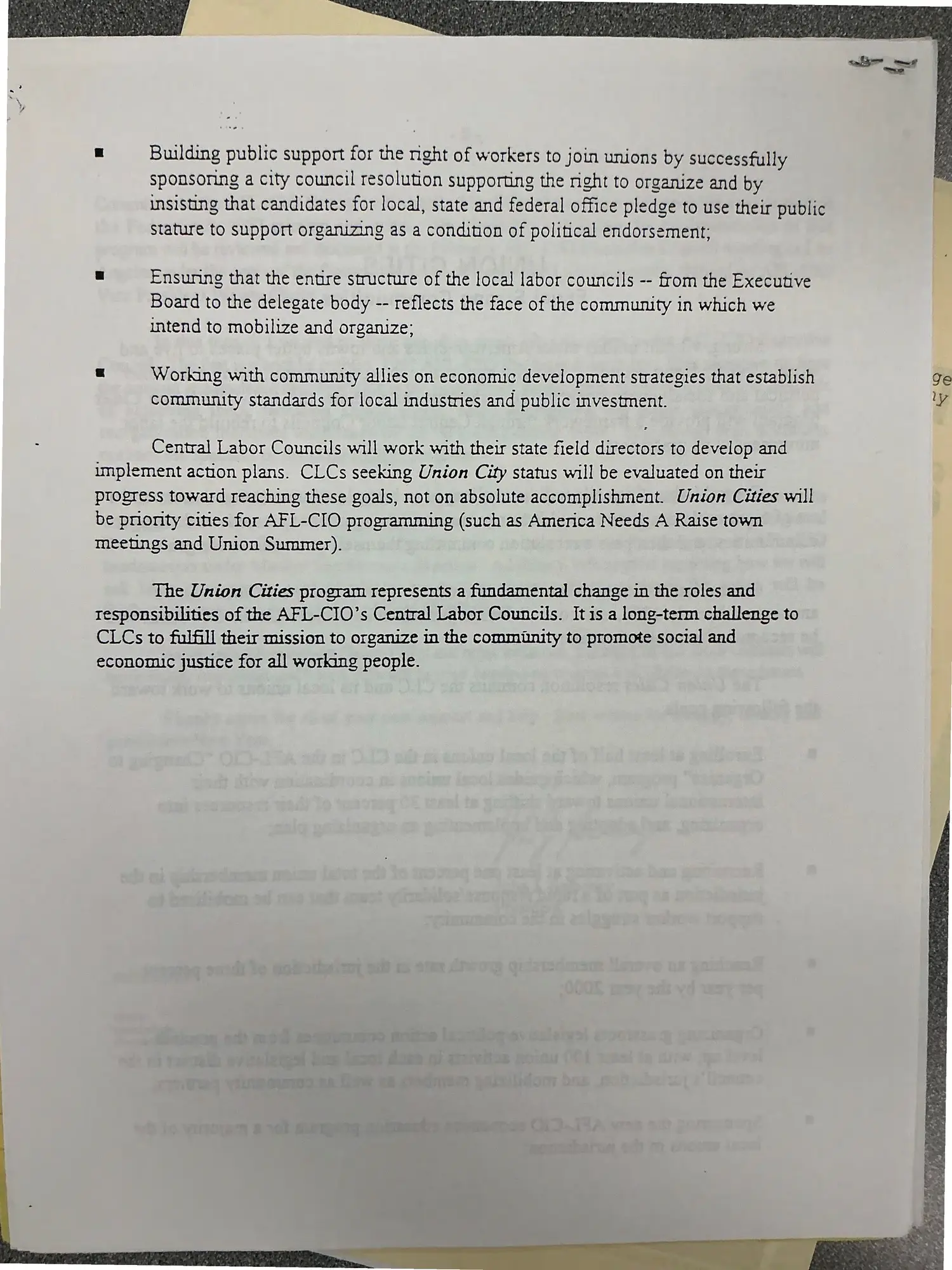
| Building public support for the nght of workers to join unions by successfully
sponsoring a city council resolution supporting the right to organize and by
insisting that candidates for local, state and federal office pledge to use their public
stature to support organizing as a condition of political endorsement;

a Ensunng that the entre smmucture of the local labor councils -- from the Executive

Board to the delegate body -- reflects the face of the community in which we
intend to mobilize and organize;

& Working with community allies on economic development strategies that establish
community standards for local industnies and public investment.

Central Labor Councils will work with their state field directors to develop and
implement action plans. CLCs seeking Union City status will be evaluated on their
progress toward reaching these goals, not on absolute accomplishment. Union Cities will

be prionity cities for AFL-CIO programming (such as America Needs A Raise town
meetings and Union Summer).

The Union Cities program represents a fundamental change in the roles and
Tesponsibilities of the AFL-CIO’s Central Labor Councils. It is a long-term challenge to
CLCs to fulfill their mission to organize in the community to promote social and
economic justice for all working people.

paler
See something wrong, or recognize a person or event? Send a correction. If you hold rights in this item or think it should not be public, write to the same address.