Press release, 2 pages
Coalition press statement on its Smith Corona investigation
[1991]Date inferred
The coalition summarizes what its investigation found about layoffs and shifts in production from Cortland to Singapore since 1989, and why it could not bring a suit under the WARN Act.
Download or cite this itemPages
 (open zoom view)
Read the page text (machine-read, mostly readable)
This text was generated automatically from the photograph and has not been corrected. The image is the authoritative record.
Ithaca Schoo! District
Employees Association

Civil Service Employees
Association Local 855

United Auto Workers
Local 2300

Sheetmetal Workers
Local 112

Painters Local 178
Plumbers Local 267
Musicians Local 132

Operating Engineers
Local 545

Civil Service Employees
Association Local 605

Teamsters Local 65

Comell Security
Employees Union

Service Employees
Local 200A

Civil Service Employees
Association Local 561
United Food and
Commercial Workers
Local 1

Electrical Workers

Local 241

TCCC Faculty Assocauon
Fire Fighters Local 1737
Electrical Workers

Local 961

£lectrical Workers Local 79

Machinists Lodge 160

United Auto Workers
Local 802

United Auto Workers
Local 1774

Fire Fighters Local 2737
Ithaca Teachers Association

Ithaca Paraprofessionals
Association

United Auto Workers
Local 1326

Ithaca Union of Police

United University
Professions

Laborers Local 589
Carpenters Local 603
Bricklayers Local 17

BOCES Teachers Association
Postal Workers Local 1151

Electrical Workers Local 43

TOMPKINS/CORTLAND LABOR COALITION

109 West State Street, Ithaca, New York 14850 Ph. (607) 277-5670

PRESS STATEMENT

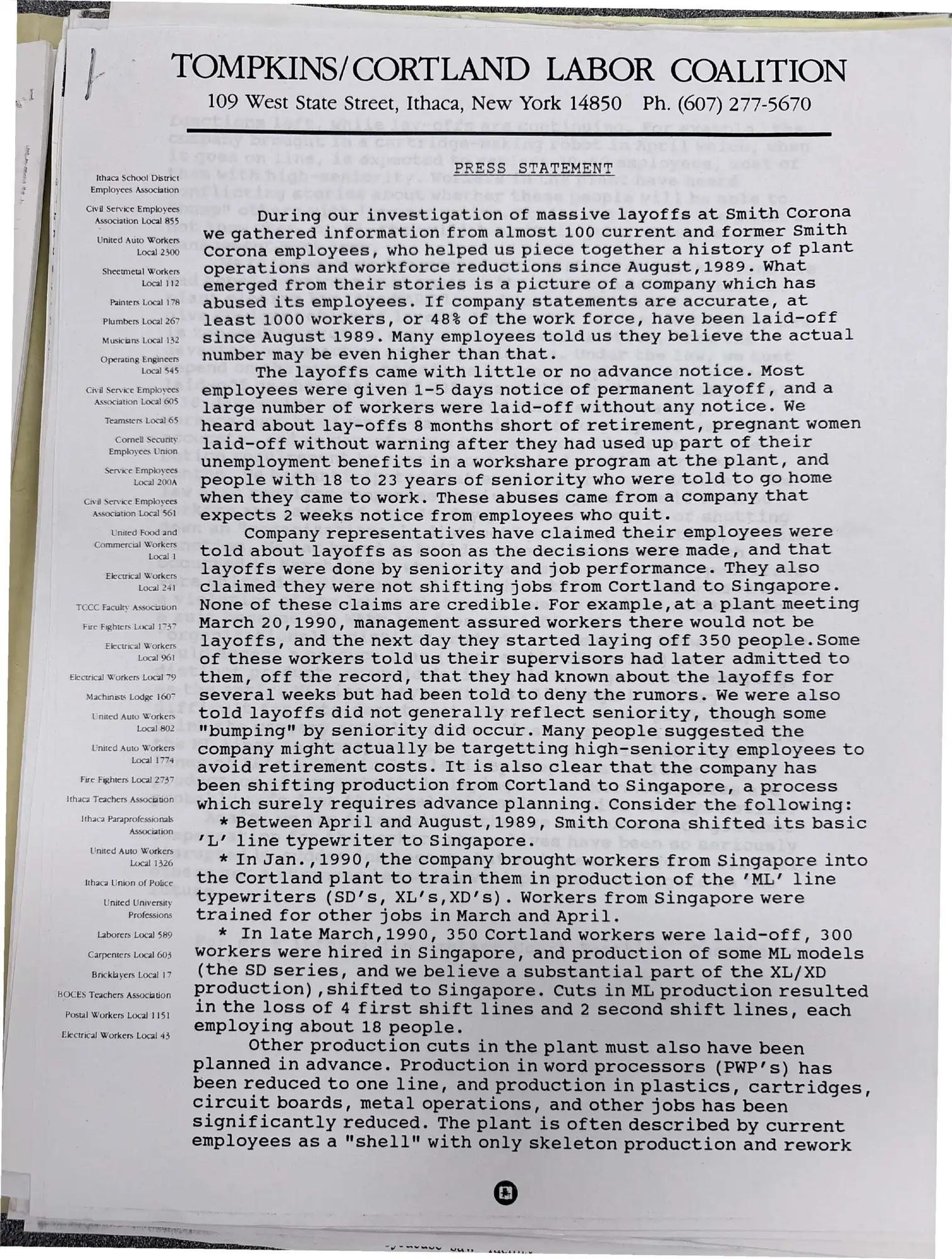
During our investigation of massive layoffs at Smith Corona
we gathered information from almost 100 current and former Smith
Corona employees, who helped us piece together a history of plant
operations and workforce reductions since August,1989. What
emerged from their stories is a picture of a company which has
abused its employees. If company statements are accurate, at
least 1000 workers, or 48% of the work force, have been laid-off
since August 1989. Many employees told us they believe the actual
number may be even higher than that.

The layoffs came with little or no advance notice. Most
employees were given 1-5 days notice of permanent layoff, anda
large number of workers were laid-off without any notice. We
heard about lay-offs 8 months short of retirement, pregnant women
laid-off without warning after they had used up part of their
unemployment benefits ina workshare program at the plant, and
people with 18 to 23 years of seniority who were told to go home
when they came to work. These abuses came from a company that
expects 2 weeks notice from employees who quit.

Company representatives have claimed their employees were
told about layoffs as soon as the decisions were made, and that
layoffs were done by seniority and job performance. They also
claimed they were not shifting jobs from Cortland to Singapore.
None of these claims are credible. For example,at a plant meeting
March 20,1990, management assured workers there would not be
layoffs, and the next day they started laying off 350 people.Some
of these workers told us their supervisors had later admitted to
them, off the record, that they had known about the layoffs for
several weeks but had been told to deny the rumors. We were also
told layoffs did not generally reflect seniority, though some
"bumping" by seniority did occur. Many people suggested the
company might actually be targetting high-seniority employees to
avoid retirement costs. It is also clear that the company has
been shifting production from Cortland to Singapore, a process
which surely requires advance planning. Consider the following:

* Between April and August,1989, Smith Corona shifted its basic
'L’ line typewriter to Singapore.

* In Jan.,1990, the company brought workers from Singapore into
the Cortland plant to train them in production of the ’ML’ line
typewriters (SD’s, XL’s,XD’s) . Workers from Singapore were
trained for other jobs in March and April.

* In late March,1990, 350 Cortland workers were laid-off, 300
workers were hired in Singapore, and production of some ML models
(the SD series, and we believe a substantial part of the XL/XD
production) , Shifted to Singapore. Cuts in ML production resulted
in the loss of 4 first shift lines and 2 second shift lines, each
employing about 18 people.

Other production cuts in the plant must also have been
planned in advance. Production in word processors (PWP’s) has
been reduced to one line, and production in plastics, cartridges,
circuit boards, metal operations, and other jobs has been
significantly reduced. The plant is often described by current
employees as a "shell" with only skeleton production and rework

ASRS TO a ages eee
 (open zoom view)
Read the page text (machine-read, mostly readable)
This text was generated automatically from the photograph and has not been corrected. The image is the authoritative record.
functions left, while lav-

company brought ina cartr
it goes on line

Offs are conti
idg ij : ample, the

Lys A i
not know when, or dig they will see Chaly fold thalchiei oe ee
management must know.

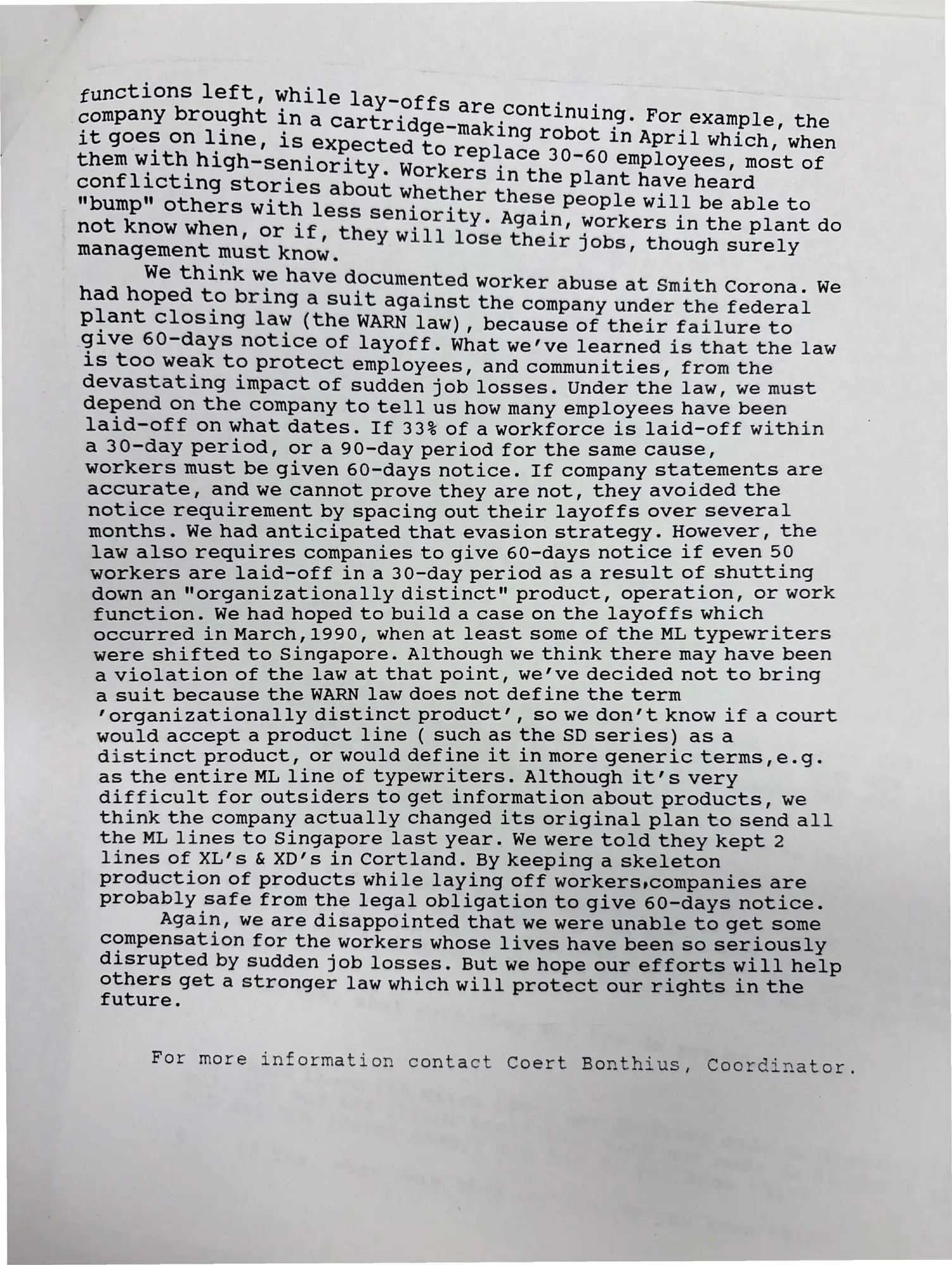
We think we have documented worker abuse at Smith Corona. We
had hoped to bring a suit against the company under the federal
plant closing law (the WARN law), because of their failure to
give 60-days notice of 1

ayoff. What we’ve learned is that the law
is too weak to protect employees, and communities, from the

devastating impact of sudden job losses. Under the law, we must
depend on the company to tell us how many employees have been
laid-off on what dates. If 33% of a workforce is laid-off within
a 30-day period, or a 90-day period for the same cause,
workers must be given 60-days notice. If company statements are
accurate, and we cannot prove they are not, they avoided the
notice requirement by spacing out their layoffs over several
months. We had anticipated that evasion strategy. However, the
law also requires companies to give 60-days notice if even 50
workers are laid-off ina 30-day period as a result of shutting
down an "organizationally distinct" product, operation, or work
function. We had hoped to build a case on the layoffs which
occurred in March,1990, when at least some of the ML typewriters
were shifted to Singapore. Although we think there may have been
a violation of the law at that point, we’ve decided not to bring
a suit because the WARN law does not define the term
‘organizationally distinct product’, so we don’t know if a court
would accept a product line ( such as the SD series) asa
distinct product, or would define it in more generic terms,e.g.
as the entire ML line of typewriters. Although it’s very
difficult for outsiders to get information about products, we
think the company actually changed its original plan to send all
the ML lines to Singapore last year. We were told they kept 2
lines of XL’s & XD’s in Cortland. By keeping a skeleton
production of products while laying off workers companies are
probably safe from the legal obligation to give 60-days notice.
Again, we are disappointed that we were unable to get some
compensation for the workers whose lives have been so seriously
disrupted by sudden job losses. But we hope our efforts will help

panere get a stronger law which will protect our rights in the
uture.

For more information contact Coert Bonthius, Coordinator.
See something wrong, or recognize a person or event? Send a correction. If you hold rights in this item or think it should not be public, write to the same address.