Proposal, 7 pages
“A Comprehensive Organizing Program for South-Central New York”: grant proposal
May 1996
The council's proposal to the AFL-CIO Organizing Institute and Department of Organization and Field Services, asking for $20,000 for 1996. It proposes a training conference for local officers, training 40–60 rank-and-file volunteer organizers, community workers' rights programs, a Workers' Rights Board in Cortland, and computer matching of members and leads. It also gives a history of the council's campaigns since 1982 and a budget.
Photographed back-to-front; shown here in reading order.
Download or cite this itemPages
 (open zoom view)
Read the page text (machine-read, mostly readable)
This text was generated automatically from the photograph and has not been corrected. The image is the authoritative record.
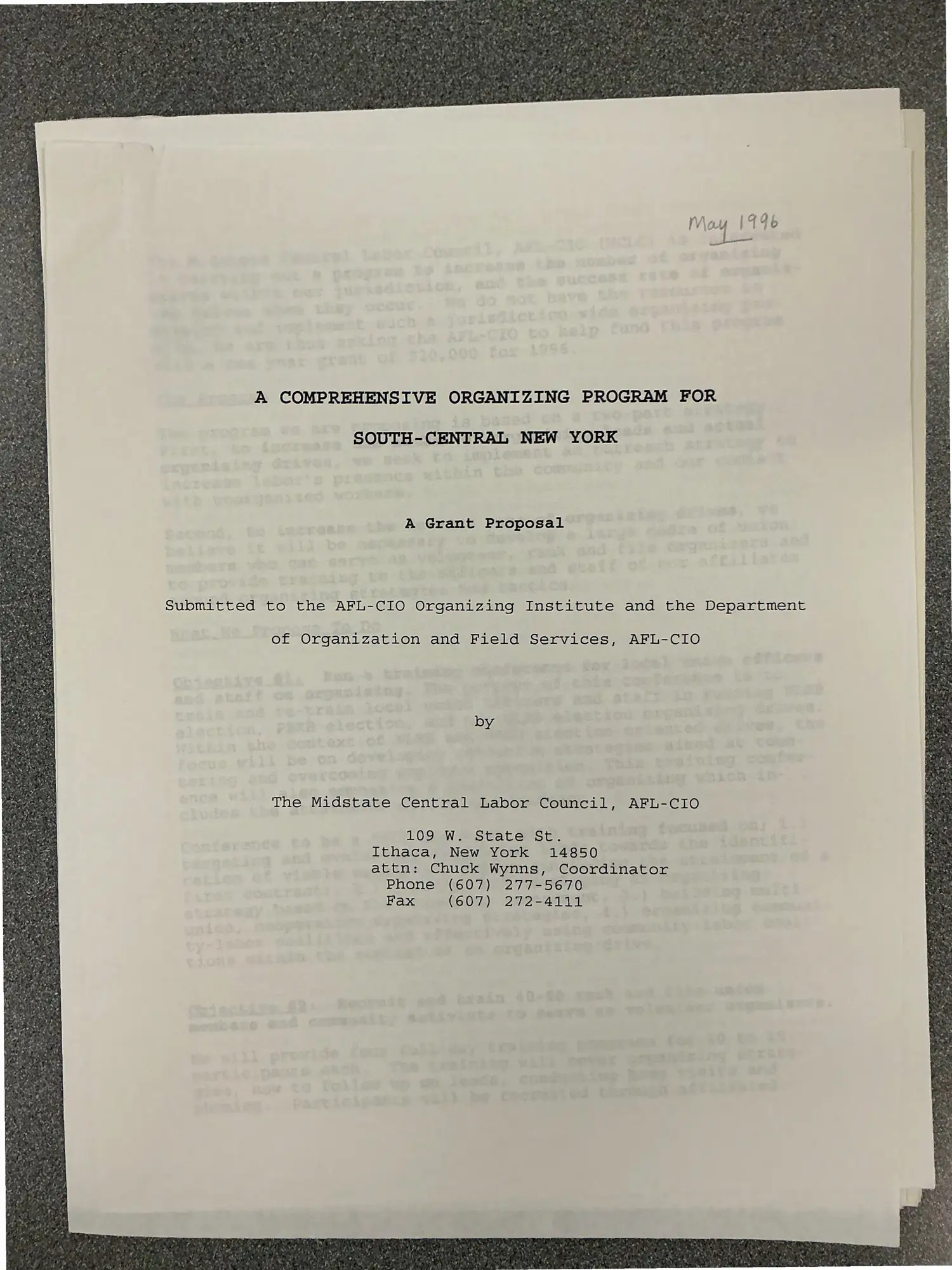
A COMPREHENSIVE ORGANIZING PROGRAM FOR

SOUTH-CENTRAL NEW YORK

A Grant Proposal

Submitted to the AFL-CIO Organizing Institute and the Department

of Organization and Field Services, AFL-CIO

The Midstate Central Labor Council, AFL-CIO

109 W. State St.
Ithaca, New York 14850
attn: Chuck Wynns, Coordinator
Phone (607) 277-5670
Fax (607) 272-4111
 (open zoom view)
Read the page text (machine-read, mostly readable)
This text was generated automatically from the photograph and has not been corrected. The image is the authoritative record.
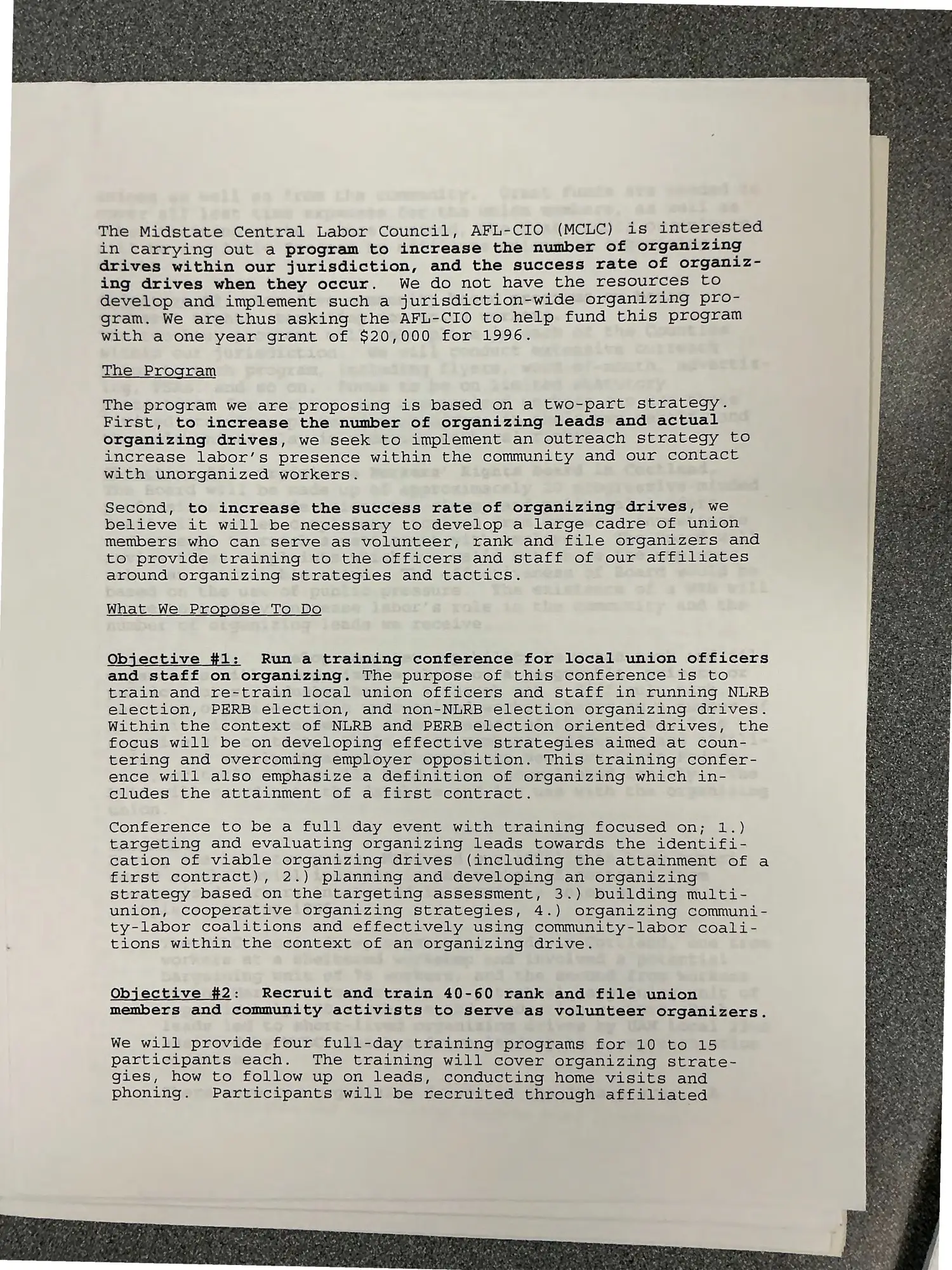
The Midstate Central Labor Council, AFL-CIO (MCLC) is interested
in carrying out a program to increase the number of organizing
drives within our jurisdiction, and the success rate of organiz-
ing drives when they occur. We do not have the resources to
develop and implement such a jurisdiction-wide organizing pro-
gram. We are thus asking the AFL-CIO to help fund this program
with a one year grant of $20,000 for 1996.

The Program

The program we are proposing is based on a two-part strategy.
First, to increase the number of organizing leads and actual
organizing drives, we seek to implement an outreach strategy to
increase labor’s presence within the community and our contact
with unorganized workers.

Second, to increase the success rate of organizing drives, we
believe it will be necessary to develop a large cadre of union
members who can serve as volunteer, rank and file organizers and
to provide training to the officers and staff of our affiliates
around organizing strategies and tactics.

What We Propose To Do

Objective #1: Run a training conference for local union officers
and staff on organizing. The purpose of this conference is to
train and re-train local union officers and staff in running NLRB
election, PERB election, and non-NLRB election organizing drives.
Within the context of NLRB and PERB election oriented drives, the
focus will be on developing effective strategies aimed at coun-
tering and overcoming employer opposition. This training confer-
ence will also emphasize a definition of organizing which in-
cludes the attainment of a first contract.

Conference to be a full day event with training focused on; 1.)
targeting and evaluating organizing leads towards the identifi-
cation of viable organizing drives (including the attainment of a
first contract), 2.) planning and developing an organizing
strategy based on the targeting assessment, 3.) building multi-
union, cooperative organizing strategies, 4.) organizing communi-
ty-labor coalitions and effectively using community-labor coali-
tions within the context of an organizing drive.

Objective #2: Recruit and train 40-60 rank and file union
members and community activists to serve as volunteer organizers.

We will provide four full-day training programs for 10 to 15
participants each. The training will cover organizing strate-
gies, how to follow up on leads, conducting home visits and
phoning. Participants will be recruited through affiliated
 (open zoom view)
Read the page text (machine-read, mostly readable)
This text was generated automatically from the photograph and has not been corrected. The image is the authoritative record.
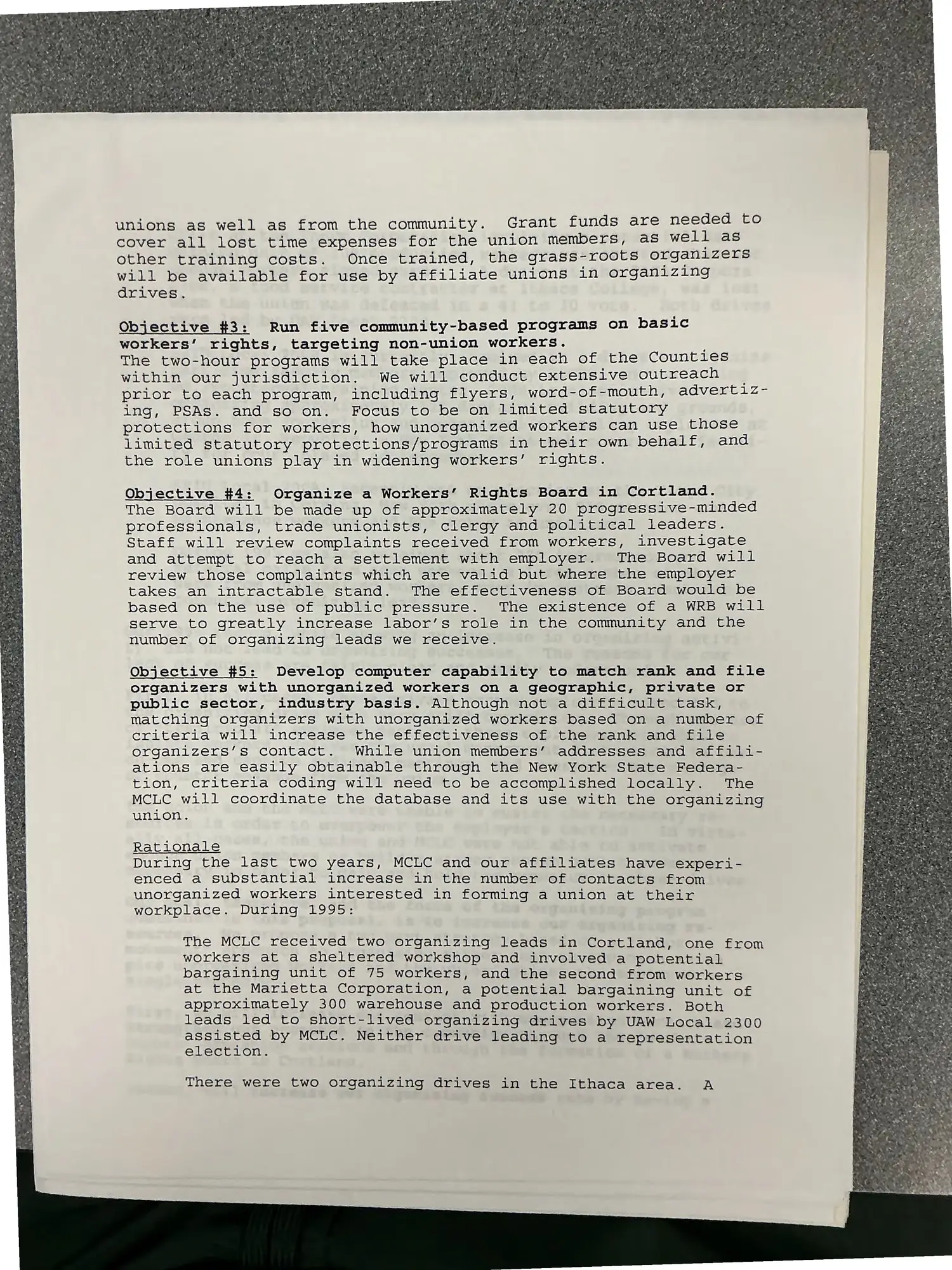
unions as well as from the community. Grant funds are needed to
cover all lost time expenses for the union members, as well as
other training costs. Once trained, the grass-roots organizers
will be available for use by affiliate unions in organizing
drives.

Objective #3: Run five community-based programs on basic
workers‘ rights, targeting non-union workers. '
The two-hour programs will take place in each of the Counties
within our jurisdiction. We will conduct extensive outreach —
prior to each program, including flyers, word-of-mouth, advertiz-
ing, PSAs. and so on. Focus to be on limited statutory
protections for workers, how unorganized workers can use those
limited statutory protections/programs in their own behalf, and
the role unions play in widening workers’ rights.

Objective #4: Organize a Workers’ Rights Board in Cortland.

The Board will be made up of approximately 20 progressive-minded
professionals, trade unionists, clergy and political leaders.
Staff will review complaints received from workers, investigate
and attempt to reach a settlement with employer. The Board will
review those complaints which are valid but where the employer
takes an intractable stand. The effectiveness of Board would be
based on the use of public pressure. The existence of a WRB will
serve to greatly increase labor’s role in the community and the
number of organizing leads we receive.

Objective #5: Develop computer capability to match rank and file
organizers with unorganized workers on a geographic, private or
public sector, industry basis. Although not a difficult task,
Matching organizers with unorganized workers based on a number of
criteria will increase the effectiveness of the rank and file
organizers’s contact. While union members’ addresses and affili-
ations are easily obtainable through the New York State Federa-
tion, criteria coding will need to be accomplished locally. The
MCLC will coordinate the database and its use with the organizing
union.

Rationale
During the last two years, MCLC and our affiliates have experi-
enced a substantial increase in the number of contacts from
unorganized workers interested in forming a union at their
workplace. During 1995:

The MCLC received two organizing leads in Cortland, one from
workers at a sheltered workshop and involved a potential
bargaining unit of 75 workers, and the second from workers
at the Marietta Corporation, a potential bargaining unit of
approximately 300 warehouse and production workers. Both
leads led to short-lived organizing drives by UAW Local 2300
assisted by MCLC. Neither drive leading to a representation
election.

There were two organizing drives in the Ithaca area. A
 (open zoom view)
Read the page text (machine-read, mostly readable)
This text was generated automatically from the photograph and has not been corrected. The image is the authoritative record.
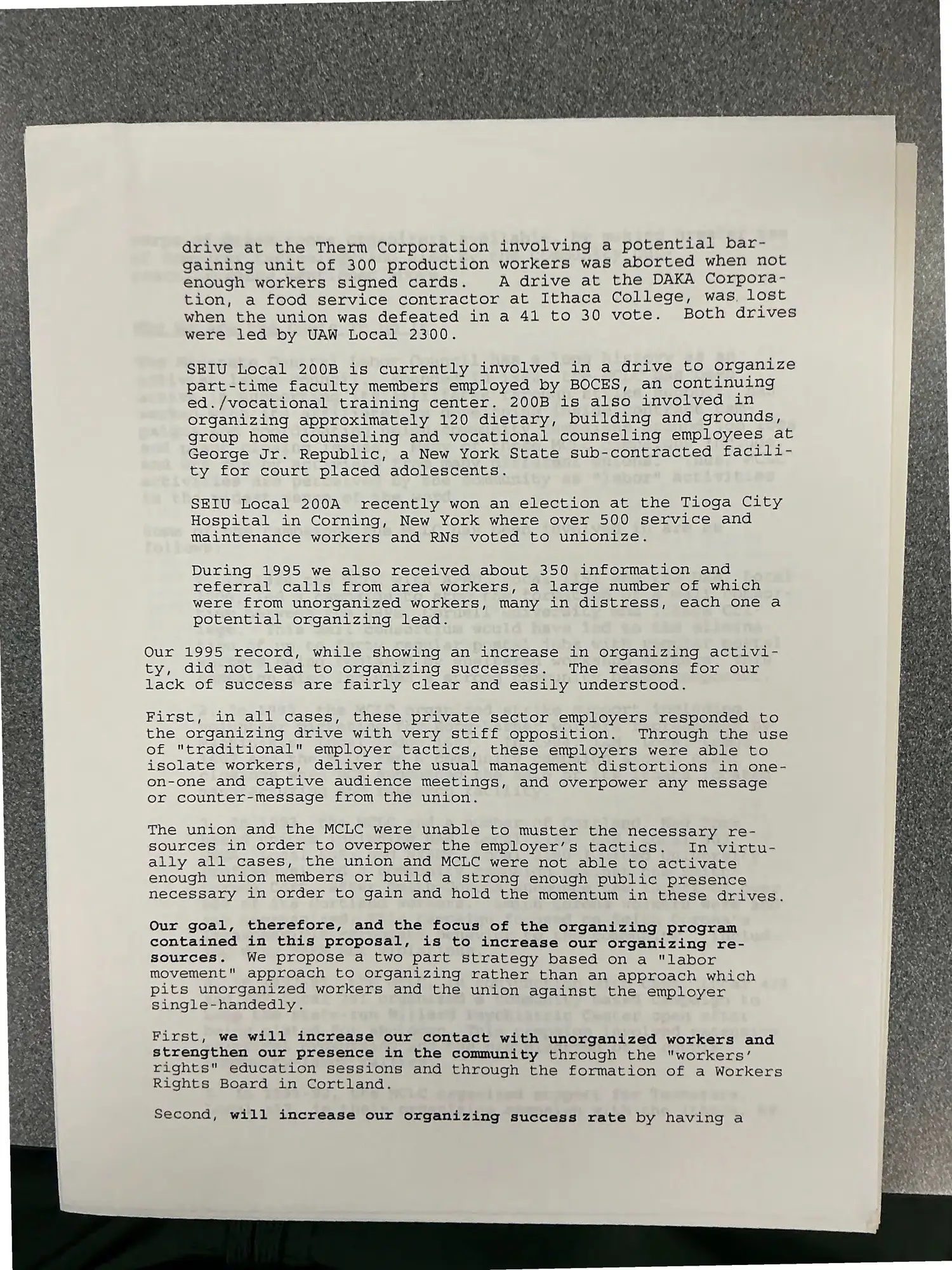
drive at the Therm Corporation involving a potential bar-

gaining unit of 300 production workers was aborted when not
enough workers signed cards. A drive at the DAKA Corpora-
tion, a food service contractor at Ithaca College, was, lost

when the union was defeated in a 41 to 30 vote. Both drives
were led by UAW Local 2300.

SEIU Local 200B is currently involved in a drive to organize
part-time faculty members employed by BOCES, an continuing
ed./vocational training center. 200B is also involved in
organizing approximately 120 dietary, building and grounds,
group home counseling and vocational counseling employees at

George Jr. Republic, a New York State sub-contracted facili-
ty for court placed adolescents.

SEIU Local 200A recently won an election at the Tioga Carsy:
Hospital in Corning, New York where over 500 service and
Maintenance workers and RNs voted to unionize.

During 1995 we also received about 350 information and |
referral calls from area workers, a large number of which

were from unorganized workers, many in distress, each one a
potential organizing lead.

Our 1995 record, while showing an increase in organizing activi-
ty, did not lead to organizing successes. The reasons for our
lack of success are fairly clear and easily understood.

First, in all cases, these private sector employers responded to
the organizing drive with very stiff opposition. Through the use
of "traditional" employer tactics, these employers were able to

isolate workers, deliver the usual management distortions in one-

on-one and captive audience meetings, and overpower any message
or counter-message from the union.

The union and the MCLC were unable to muster the necessary re-
sources in order to Overpower the employer’s tactics. In virtu-
ally all cases, the union and MCLC were not able to activate
enough union members or build a strong enough public presence
necessary in order to gain and hold the momentum in these drives.

Our goal, therefore, and the focus of the organizing program
contained in this proposal, is to increase our organizing re-
sources. We propose a two part strategy based on a "labor

movement" approach to organizing rather than an approach which

pits unorganized workers and the union against the employer
single-handedly.

First, we will increase our contact with unorganized workers and
strengthen our presence in the community through the "workers’

rights" education sessions and through the formation of a Workers
Rights Board in Cortland.

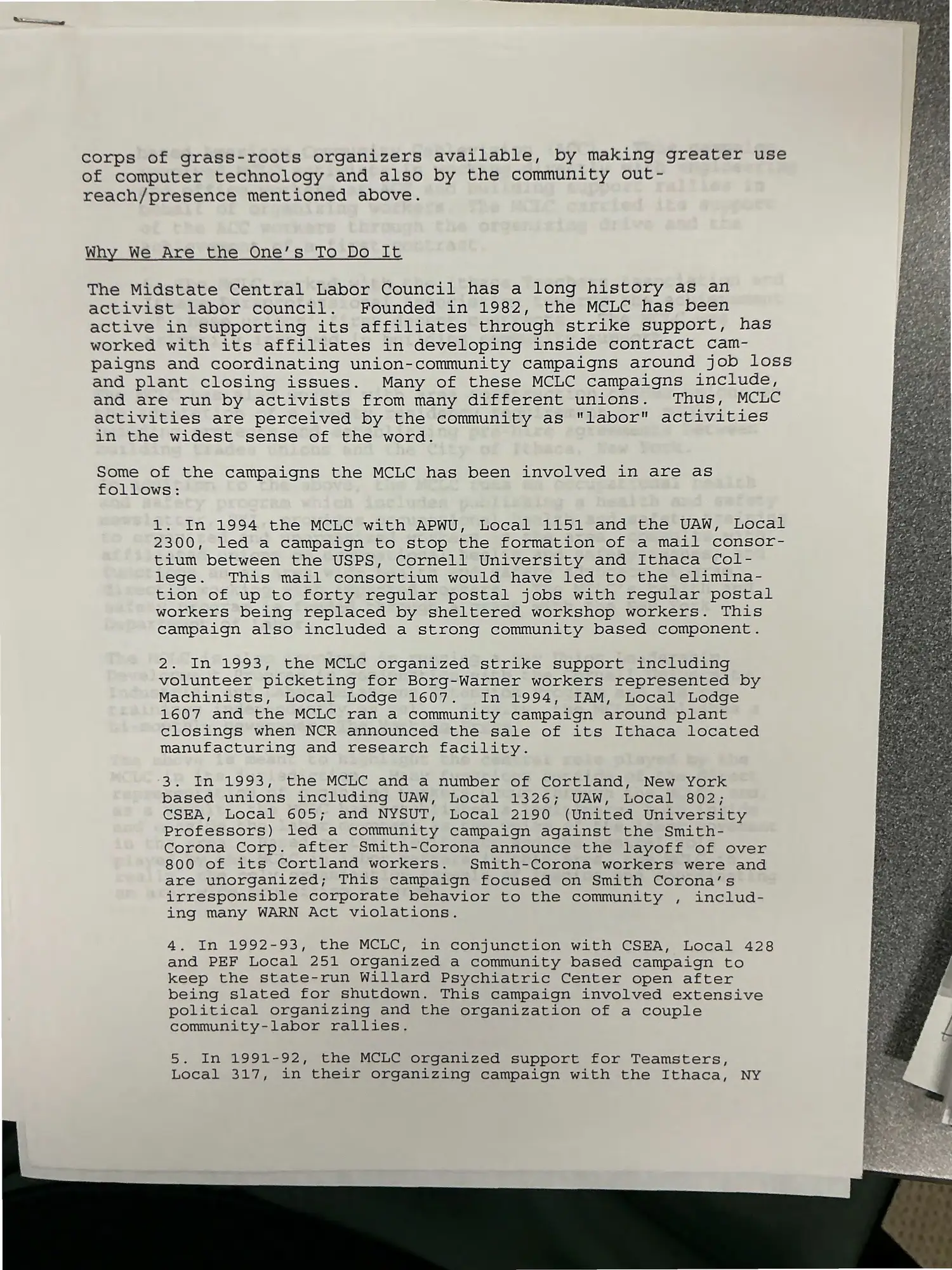
Second, will increase our organizing success rate by having a
 (open zoom view)
Read the page text (machine-read, mostly readable)
This text was generated automatically from the photograph and has not been corrected. The image is the authoritative record.
corps of grass-roots organizers available, by making greater use
of computer technology and also by the community out-
reach/presence mentioned above.

Why We Are the One’s To Do It

The Midstate Central Labor Council has a long history as an
activist labor council. Founded in 1982, the MCLC has been
active in supporting its affiliates through strike support, has
worked with its affiliates in developing inside contract cam-
paigns and coordinating union-community campaigns around job loss
and plant closing issues. Many of these MCLC campaigns include,
and are run by activists from many different unions. Thus, MCLC

activities are perceived by the community as "labor" activities
in the widest sense of the word.

Some of the campaigns the MCLC has been involved in are as
follows:

1. In 1994 the MCLC with APWU, Local 1151 and the UAW, Local
2300, led a campaign to stop the formation of a mail consor-
tium between the USPS, Cornell University and Ithaca Col-
lege. This mail consortium would have led to the elimina-

tion of up to forty regular postal jobs with regular postal
workers being replaced by sheltered workshop workers. This
Campaign also included a strong community based component.

2. In 1993, the MCLC organized strike support including
volunteer picketing for Borg-Warner workers represented by
Machinists, Local Lodge 1607. In 1994, IAM, Local Lodge
1607 and the MCLC ran a community campaign around plant

closings when NCR announced the sale of its Ithaca located
manufacturing and research facility.

3. In 1993, the MCLC and a number of Cortland, New York
based unions including UAW, Local 1326; UAW, Local 802;
CSEA, Local 605; and NYSUT, Local 2190 (United University
Professors) led a community campaign against the Smith-
Corona Corp. after Smith-Corona announce the layoff of over
800 of its Cortland workers. Smith-Corona workers were and
are unorganized; This campaign focused on Smith Corona’s

irresponsible corporate behavior to the community , includ-
ing many WARN Act violations.

4, In 1992-93, the MCLG) in conjunction with CSEA, Local 428
and PEF Local 251 organized a community based campaign to
keep the state-run Willard Psychiatric Center open after
being slated for shutdown. This campaign involved extensive

political organizing and the organization of a couple
community-labor rallies.

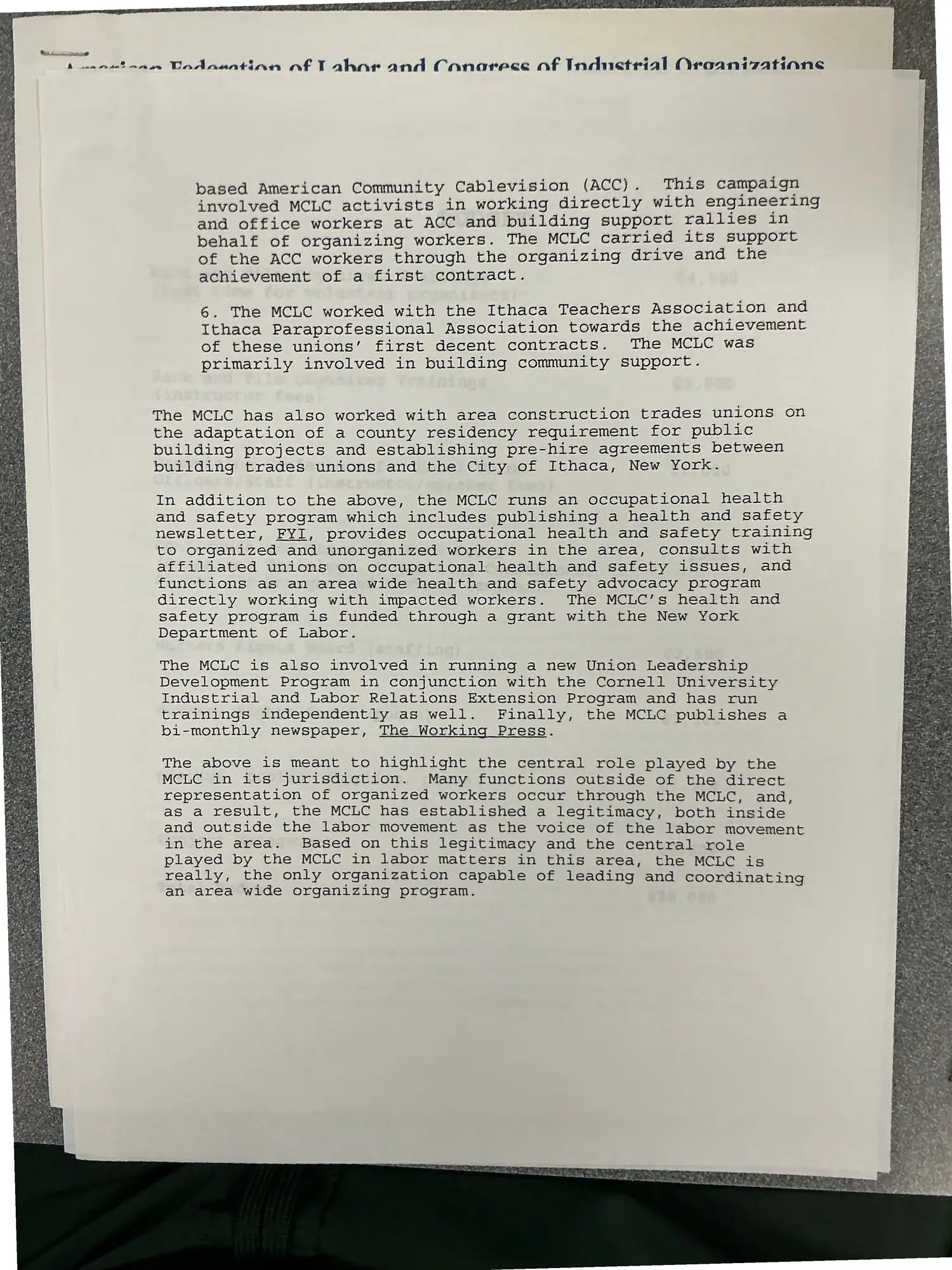
5. In 1991-92, the MCLC organized support for Teamsters,
Local 317, in their organizing campaign with the Ithaca, NY
 (open zoom view)
Read the page text (machine-read, mostly readable)
This text was generated automatically from the photograph and has not been corrected. The image is the authoritative record.
A aanetnnen Dndaentino af Tahar and Caonorecc of Inductrial Oroanizatione

based American Community Cablevision (ACC). This campaign
involved MCLC activists in working directly with engineering

and office workers at ACC and building support rallies in
behalf of organizing workers. The MCLC carried its support

of the ACC workers through the organizing drive and the
achievement of a first contract.

6. The MCLC worked with the Ithaca Teachers Association and
Ithaca Paraprofessional Association towards the achievement
of these unions’ first decent contracts. The MCLC was
primarily involved in building community support.

The MCLC has also worked with area construction trades unions on
the adaptation of a county residency requirement for public

building projects and establishing pre-hire agreements between Ee
building trades unions and the City of Ithaca, New York. iy

In addition to the above, the MCLC runs an occupational health
and safety program which includes publishing a health and safety
newsletter, FYI, provides occupational health and safety training
to organized and unorganized workers in the area, consults with
affiliated unions on occupational health and safety issues, and ie
functions as an area wide health and safety advocacy program pe
directly working with impacted workers. The MCLC’s health and
safety program is funded through a grant with the New York
Department of Labor.

The MCLC is also involved in running a new Union Leadership
Development Program in conjunction with the Cornell University
Industrial and Labor Relations Extension Program and has run
trainings independently as well. Finally, the MCLC publishes a

bi-monthly newspaper, The Working Press.

The above is meant to highlight the central role played by the
MCLC in its jurisdiction. Many functions outside of the direct
representation of organized workers occur through the MCLC, and,
as a result, the MCLC has established a legitimacy, both inside
and outside the labor movement as the voice of the labor movement ve
in the area. Based on this legitimacy and the central role oe)
played by the MCLC in labor matters in this area, the MCLC is oa
really, the only organization capable of leading and coordinating
an area wide organizing program.
 (open zoom view)
Read the page text (machine-read, mostly readable)
This text was generated automatically from the photograph and has not been corrected. The image is the authoritative record.
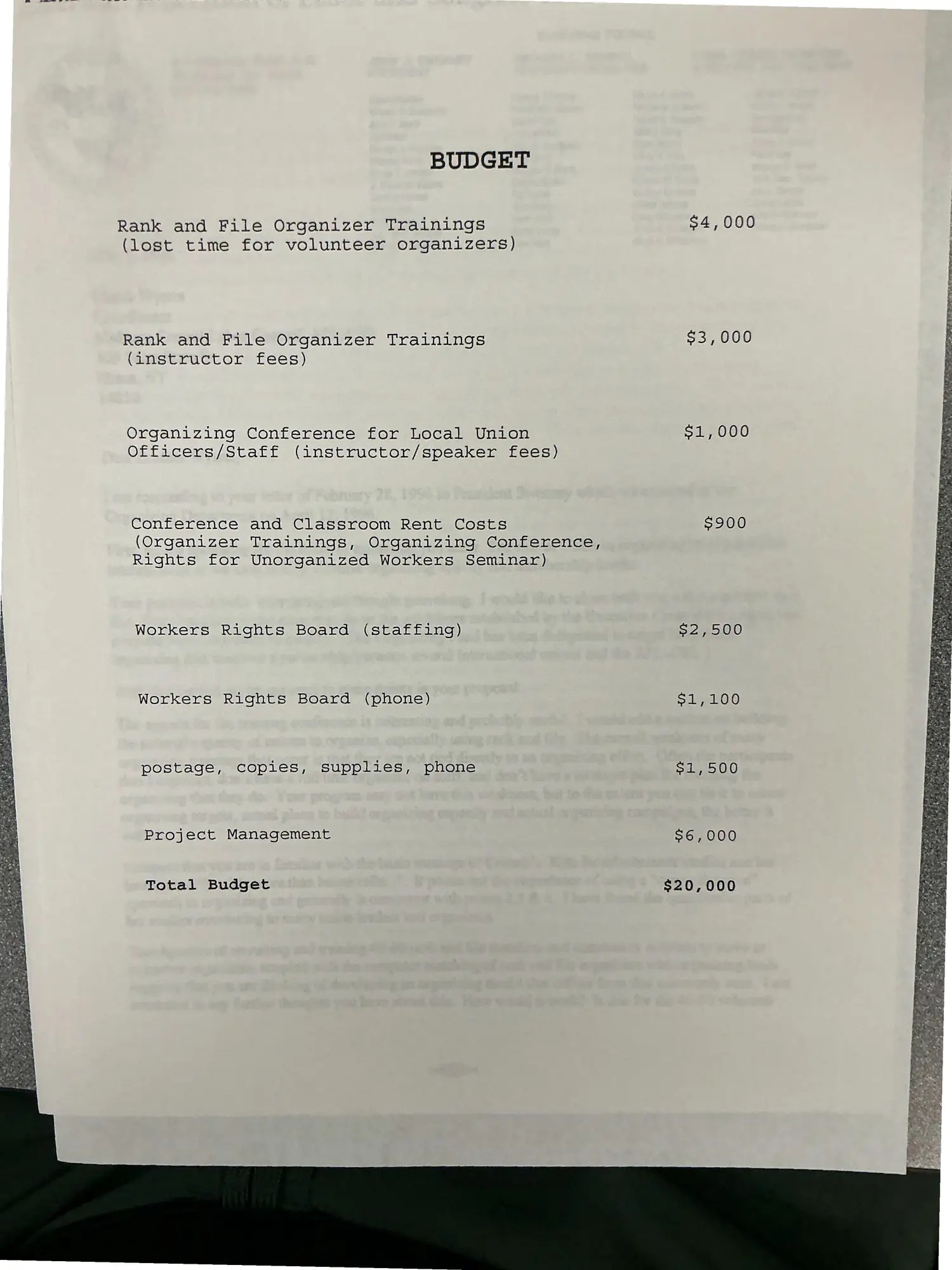
BUDGET

Rank and File Organizer Trainings $4,000
(lost time for volunteer organizers)

Rank and File Organizer Trainings 33, 000
(instructor fees)

Organizing Conference for Local Union $1,000
Officers/Staff (instructor/speaker fees)

Conference and Classroom Rent Costs $900
(Organizer Trainings, Organizing Conference,
Rights for Unorganized Workers Seminar)

Workers Rights Board (staffing) $2,500
Workers Rights Board (phone) S100

postage, copies, supplies, phone $1,500
= Project Management $6,000

a4 Total Budget $20,000

SE Ten
See something wrong, or recognize a person or event? Send a correction. If you hold rights in this item or think it should not be public, write to the same address.