Letter, 1 page
Federation for Industrial Retention and Renewal letter to friends
September 1989
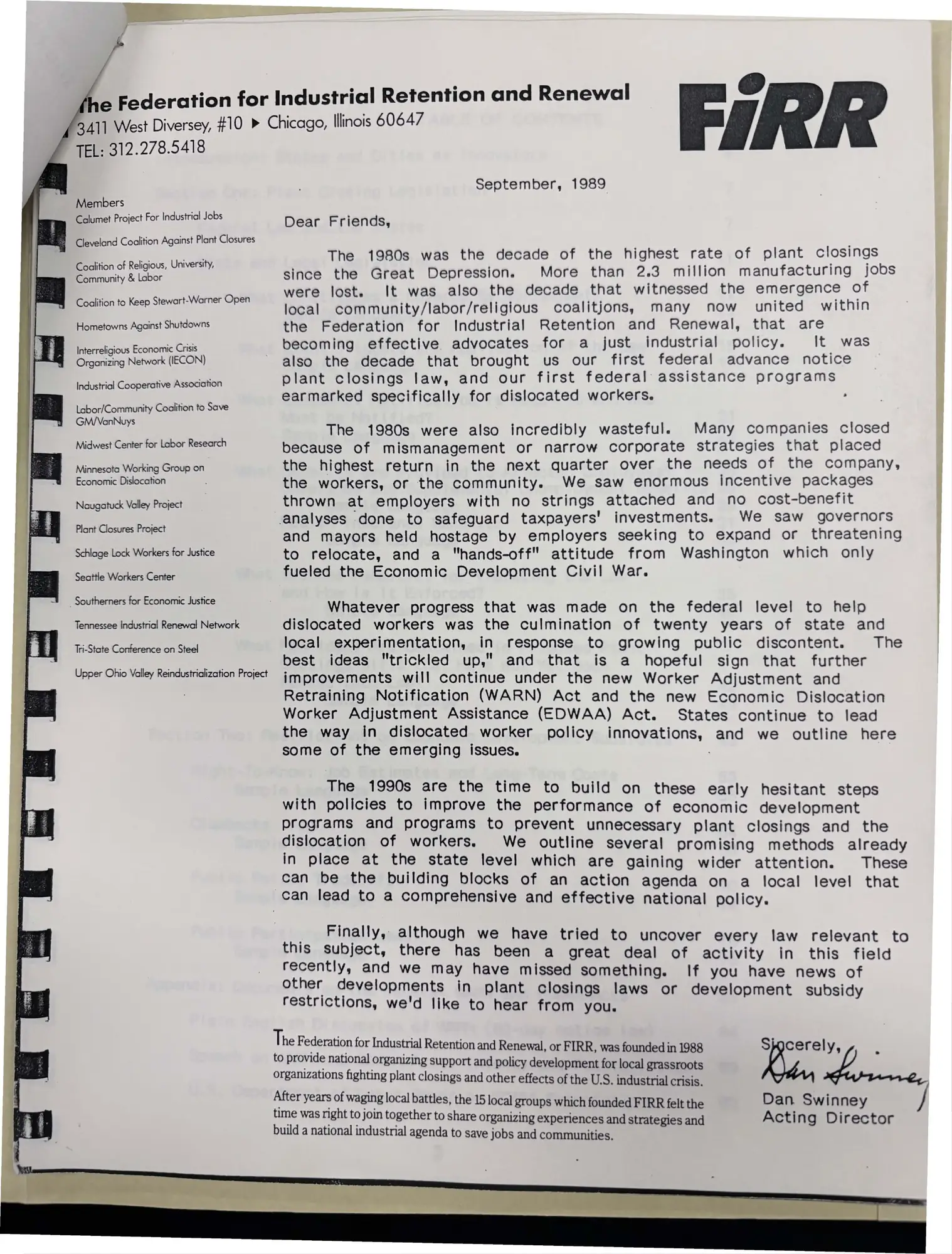
FIRR's acting director Dan Swinney looks back on the 1980s, “the decade of the highest rate of plant closings since the Great Depression,” and describes the federation's work for the 1990s. The letterhead lists its member groups.
Download or cite this itemPages
 (open zoom view)
Read the page text (machine-read, mostly readable)
This text was generated automatically from the photograph and has not been corrected. The image is the authoritative record.
e Federation for Industrial Retention and Renewal
3411 West Diversey, #10 > Chicago, Illinois 60647

TEL: 312.278.5418

Members
Calumet Project For Industrial Jobs

Cleveland Coalition Against Plant Closures

Coalition of Religious, University,
Community & Labor

Coalition to Keep Stewart-Warner Open

Hometowns Against Shutdowns

Interreligious Economic Crisis
Organizing Network (IECON)

Industrial Cooperative Association

Labor/Community Coalition to Save
GM/VanNuys

Midwest Center for Labor Research

Minnesota Working Group on
Economic Dislocation

Naugatuck Valley Project

Plant Closures Project

Schlage Lock Workers for Justice
Seattle Workers Center

_ Southerners for Economic Justice

Tennessee Industrial Renewal Network

Tri-State Conference on Steel

Upper Ohio Valley Reindustrialization Project

FiRR

The 1980s was the decade of the highest rate of plant closings
since the Great Depression. More than 2.3 million manufacturing jobs %
were lost. It was also the decade that witnessed the emergence of
community/labor/religious coalitions, many now united within

September, 1989

Dear Friends,

local
the Federation for Industrial Retention and Renewal, that are
becoming effective advocates for a just industrial policy. It was

also the decade that brought us our first federal advance notice
plant closings law, and our first federal assistance programs

earmarked specifically for dislocated workers.

bh elles x: © Le ee ey Fu

The 1980s were also incredibly wasteful. Many companies closed
because of mismanagement or narrow corporate strategies that placed
the highest return in the next quarter over the needs of the company,
the workers, or the community. We saw enormous incentive packages
thrown at employers with no strings attached and no cost-benefit
analyses done to safeguard taxpayers’ investments. We saw governors
and mayors held hostage by employers seeking to expand or threatening
to relocate, and a "hands-off" attitude from Washington which only
fueled the Economic Development Civil War.

Whatever progress that was made on the federal level to help
dislocated workers was the culmination of twenty years of state and
local experimentation, in response to growing public discontent. The
best ideas "trickled up," and that is a hopeful sign that further
improvements will continue under the new Worker Adjustment and
Retraining Notification (WARN) Act and the new Economic Dislocation
Worker Adjustment Assistance (EDWAA) Act. States continue to lead
the way in dislocated worker policy innovations, and we outline here
some of the emerging issues.

The 1990s are the time to build on these early hesitant steps
with policies to improve the performance of economic development
programs and programs to prevent unnecessary plant closings and the
dislocation of workers. We outline several promising methods already
in place at the state level which are gaining wider attention. These
can be the building blocks of an action agenda on a local level that

can lead to a comprehensive and effective national policy.

. Finally, although we have tried to uncover every law relevant to
this subject, there has been a great deal of activity in this field
recently, and we may have missed something. If you have news of
other developments in plant Closings laws or development subsidy

restrictions, we'd like to hear from you.
Be. cL -

Dan Swinney
Acting Director

The F ederation for Industrial Retention and Renewal, or FIRR, was founded in 1988
to provide national organizing Support and policy development for local grassroots
organizations fighting plant closings and other effects of the U.S. industrial crisis.

After years of waging local battles, the 15 local groups which founded FIRR felt the
time was right to join together to share organizing experiences and strategies and
build a national industrial agenda to save jobs and communities.
See something wrong, or recognize a person or event? Send a correction. If you hold rights in this item or think it should not be public, write to the same address.