Agreement, 20 pages
State health and safety training contract, 1996 (Midstate Central Labor Council)
January 1 – December 31, 1996
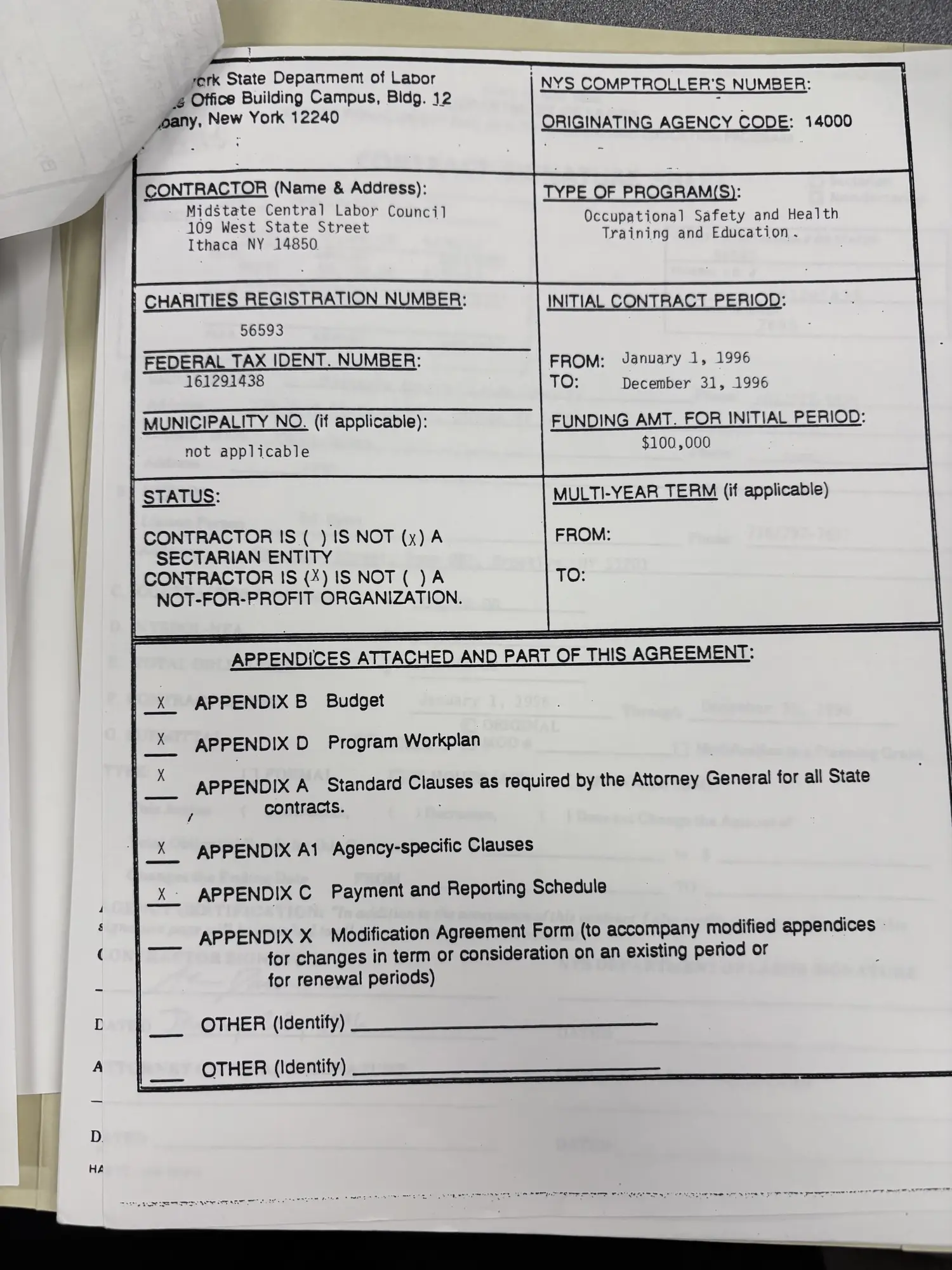
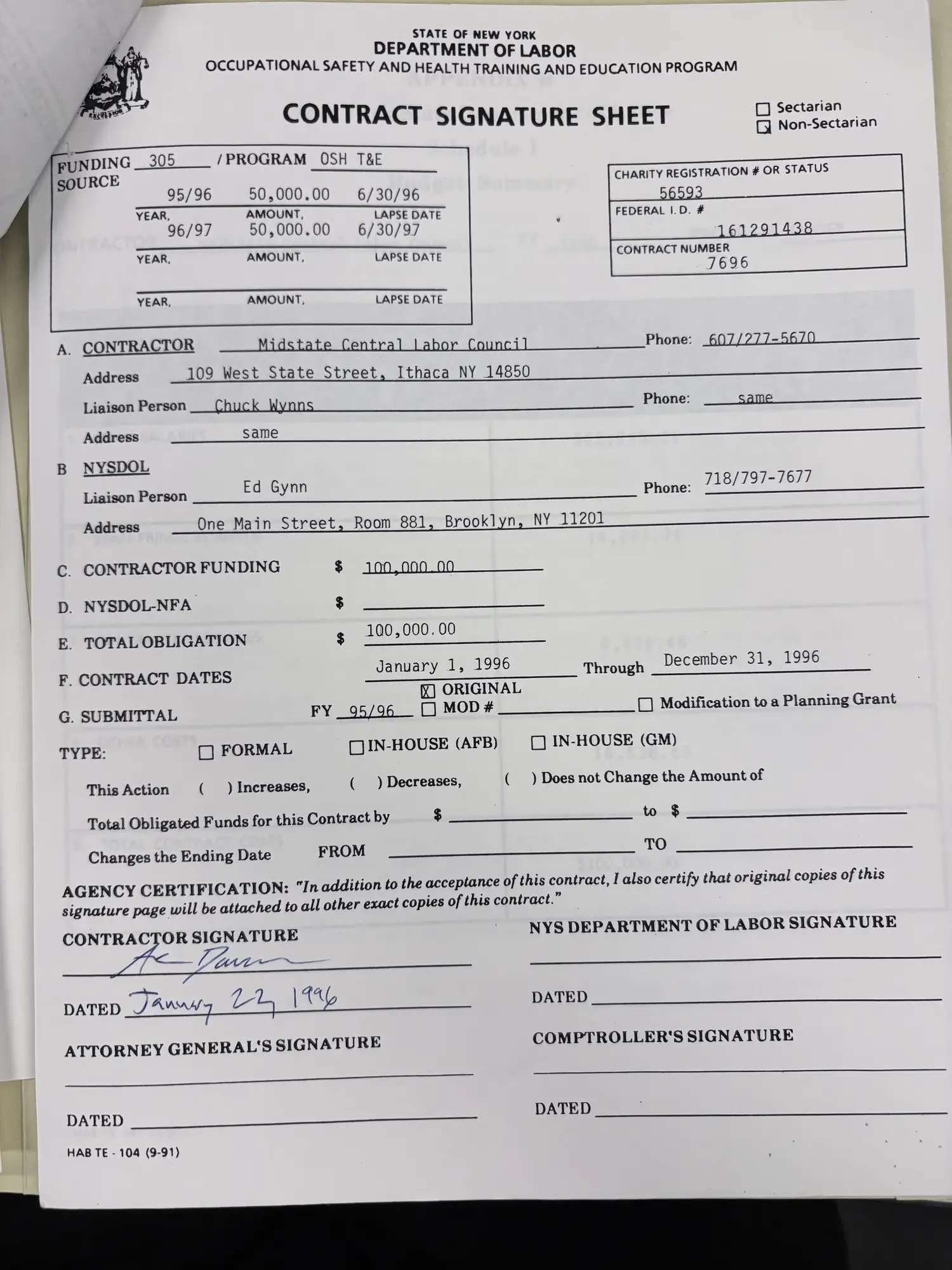
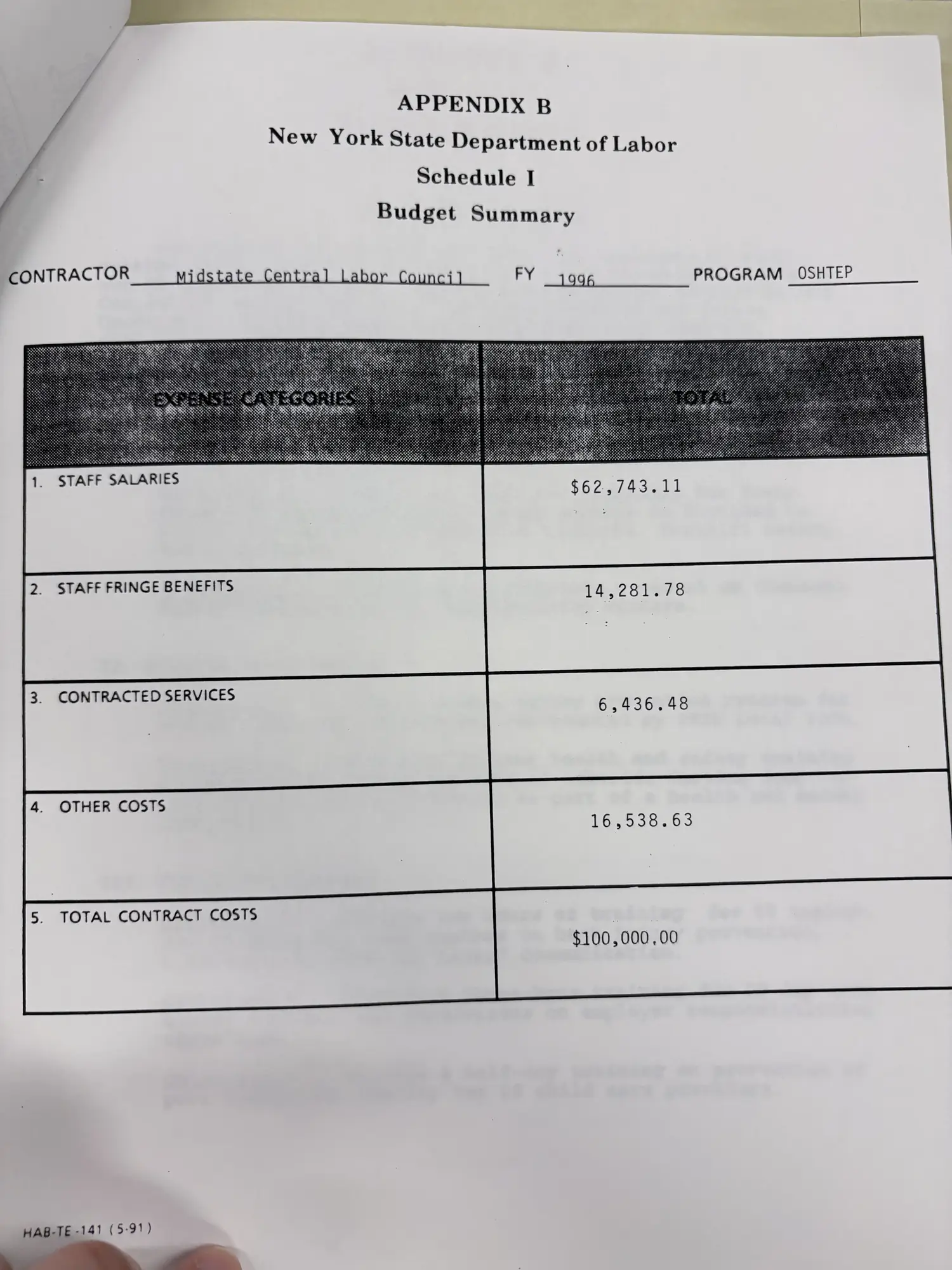
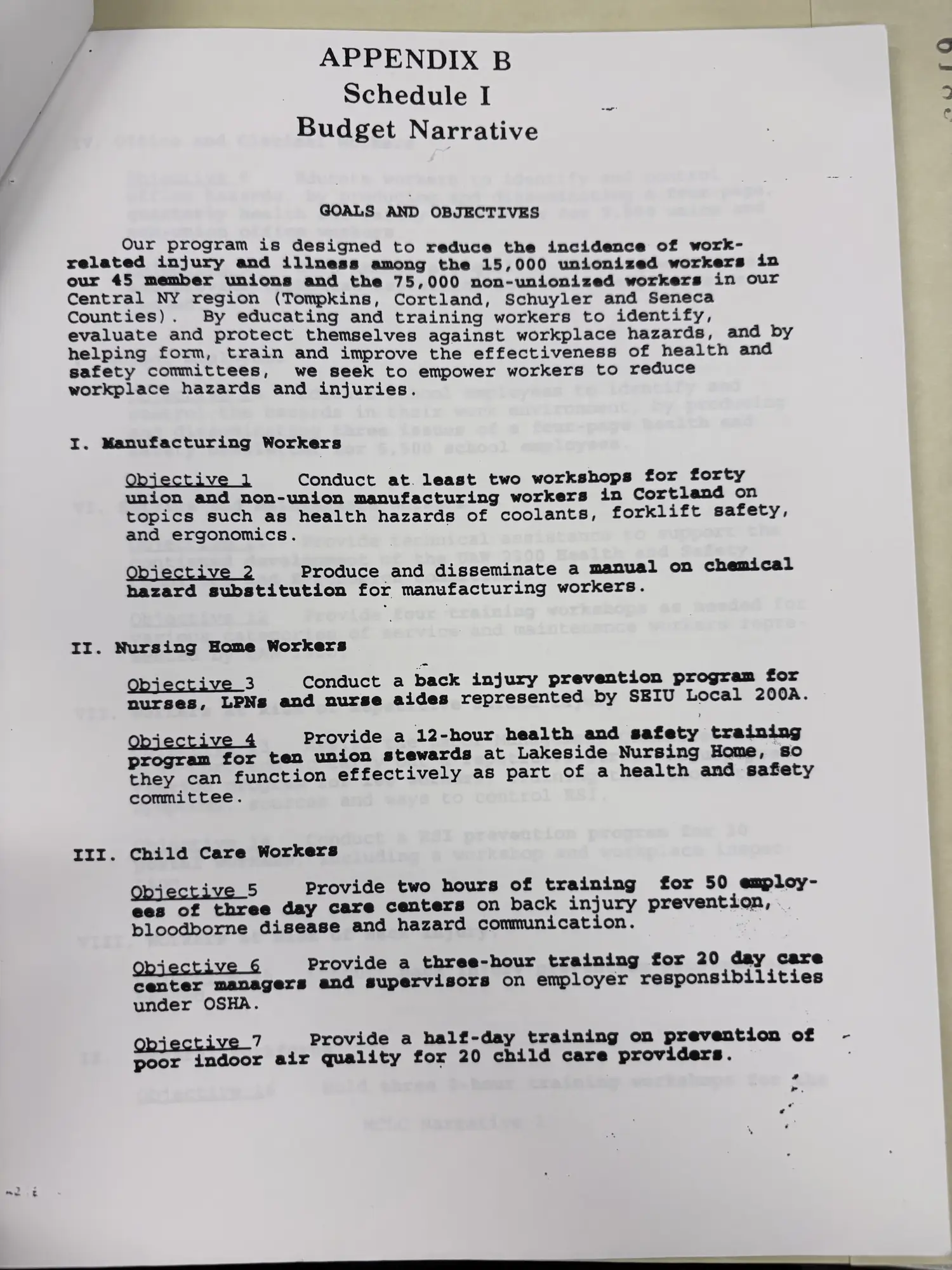
The $100,000 contract for January–December 1996, with Chuck Wynns as liaison, and its budget narrative. The program aims to reduce work-related injury and illness among the 15,000 union members of the council's 45 locals and 75,000 nonunion workers in Tompkins, Cortland, Schuyler, and Seneca counties, with workshops, newsletters, and technical help for manufacturing, nursing home, child care, office, school, and service workers, people at risk of repetitive strain and back injuries, and the general workforce. The budget pages cover materials, office equipment, rent, and travel.
A second photograph of one narrative page is not shown. The budget narrative page naming the bookkeeper and her hourly rate is withheld.
Download or cite this itemPages
 (open zoom view)
Read the page text (machine-read, contains errors)
This text was generated automatically from the photograph and has not been corrected. The image is the authoritative record.
verk State Depanment of Labor
6 Office Building Campus, Bidg. 12
pany, New York 12240

| NYS COMPTROLLER’S NUMBER:

ORIGINATING AGENCY CODE: 14000

CONTRACTOR (Name & Address):
Midstate Central Labor Council
109 West State Street

Ithaca NY 14850

TYPE OF PROGRAM(S):
Occupational Safety and Health
Training and Education .

S CHARITIES REGISTRATION NUMBER:

, OO oom’

56593
Nee ey eae ed

FEDERAL TAX IDENT. NUMBER:

Ee SOOO OMmWwn'’

161291438

INITIAL CONTRACT PERIOD:

FROM: January 1, 1996
TO; December 31, 1996

| MUNICIPALITY NO. (if applicable):
not applicable

FUNDING AMT. FOR INITIAL PERIOD:
$100,000

MULTI-YEAR TERM (if applicable)

FROM:

| CONTRACTOR IS (_) 1S NOT (x) A
| SECTARIAN ENTITY

| CONTRACTOR !S (X) IS NOT()A

| NOT-FOR-PROFIT ORGANIZATION.

"APPENDICES ATTACHED AND PART OF THIS AGREEMENT:

APPENDILES ALIAUREY ANY A) Se

APPENDIX B_ Budget
APPENDIX D Program Workplan

APPENDIX A Standard Clauses as required by the Attorney acetal for all State

; contracts.

APPENDIX A1 Agency-specific Clauses
APPENDIX C Payment and Reporting Schedule

APPENDIX X Modification Agreement Form (to accompany modified appendices -
for changes in term or consideration on an existing period or
for renewal periods)

OTHER (Identify) =

OTHER (Identity) __
 (open zoom view)
Read the page text (machine-read, contains errors)
This text was generated automatically from the photograph and has not been corrected. The image is the authoritative record.
DEPART OF NEW YORK
TMENT OF LABOR
OCCUPATIONAL SAFETY AND HEALTH TRAINING AND EDUCATION PROGRAM

CONTRACT SIGNATURE SHEET 1 sectarian

Q Non-Sectarian

305 /PROGRAM OSH T&E

FUNDING
SOURCE CHARITY REGISTRATION # OR STATUS
95/96 50,000.00 6/30/96
YEA AMOUNT, LAPSE DATE

EAR,
96/97 50,000.00 6/30/97

YEAR,

FEDERAL |.D. #

CONTRACT NUMBER
7696

_ CONTRACTOR _ Midstate Central Labor Counci] ___Phone: 607/277-5670 —_—

AMOUNT, LAPSE DATE

nem A
YEAR, AMOUNT, LAPSE DATE

Address 109 West State Street, Ithaca NY 14850

Liaison Person ee Nuc WV ONS Ses ee ee Phone: Same

Address same
B NYSDOL
Liaison Person Ed Gynn Bitte PIS ISP IGI)

Address One Main Street, Room 881, Brooklyn, NY 11201

C. CONTRACTOR FUNDING $ 100,000.00
D. NYSDOL-NFA $
E. TOTAL OBLIGATION g 100,000.00
F. CONTRACT DATES January Ps 1996 Through December 31, 1996
[Ug ORIGINAL eo

G. SUBMITTAL FY 95/96 0) MOD # (1 Modification toa Planning Grant
TYPE: (J FORMAL oO IN-HOUSE (AFB) (0 IN-HOUSE (GM)

This Action (_ ) Increases, (__) Decreases, (_ ) Does not Change the Amount of

to $

Total Obligated Funds for this Contract by $

TO Be

Changes the Ending Date FROM

AGENCY CERTIFICATION: “In addition to the acceptance of this contract, I also certify that original copies of this
signature page will be attached to all other exact copies of this contract.”

NYS DEPARTMENT OF LABOR SIGNATURE

CONTRACTOR SIGNATURE
foment
DATED SL SSE Cas | 440 DATED

ATTORNEY GENERAL'S SIGNATURE COMPTROLLER'S SIGNATURE

DATED ;

DATED

HAB TE - 104 (9-91)
 (open zoom view)
Read the page text (machine-read, mostly readable)
This text was generated automatically from the photograph and has not been corrected. The image is the authoritative record.
APPENDIX B
New York State Department of Labor
j Schedule I
Budget Summary

CONTRACTOR Midstate Central Labor Council FY _s00¢ PROGRAM _OSHTEP

STAFF SALARIES
$62.9743.11

STAFF FRINGE BENEFITS 14; 281878

CONTRACTED SERVICES
6,436.48

4. OTHER COSTS
1G p SSB 0 SS

TOTAL CONTRACT COSTS
$100,000.00

HAB-TE-141 (5-91)
 (open zoom view)
Read the page text (machine-read, mostly readable)
This text was generated automatically from the photograph and has not been corrected. The image is the authoritative record.
APPENDIX B
Schedule I
Budget Narrative

GOALS AND OBJECTIVES

Our program is designed to reduce the incidence of work-
related injury and illness among the 15,000 unionized workers in
our 45 member unions and the 75,000 non-unionized workers in our
Central NY region (Tompkins, Cortland, Schuyler and Seneca
Counties). By educating and training workers to identify,
evaluate and protect themselves against workplace hazards, and by
helping form, train and improve the effectiveness of health and

safety committees, we seek to empower workers to reduce
workplace hazards and injuries.

I. Manufacturing Workers

Conduct at. least two workshops for forty
union and non-union manufacturing workers in Cortland on

topics such as health hazards of coolants, forklift safety,
and ergonomics.

Produce and disseminate a manual on chemical
hazard substitution for manufacturing workers.

II. Nursing Home Workers

3 Conduct a back injury prevention program for
nurses, LPNs and nurse aides represented by SEIU Local 200A.

Objective 4 Provide a 12-hour health and safety training
program for ten union stewards at Lakeside Nursing Home, so
they can function effectively as part of a health and safety
committee.

III. Child Care Workers

Objective 5 Provide two hours of training for 50 employ-
ees of three day care centers on back injury prevention,
bloodborne disease and hazard communication.

Objective 6 Provide a three-hour training for 20 day care
center managers and supervisors on employer responsibilities
under OSHA.

Objective 7 Provide a half-day training on prevention of -
poor indoor air quality for 20 child care providers.

mC)
 (open zoom view)
Read the page text (machine-read, mostly readable)
This text was generated automatically from the photograph and has not been corrected. The image is the authoritative record.
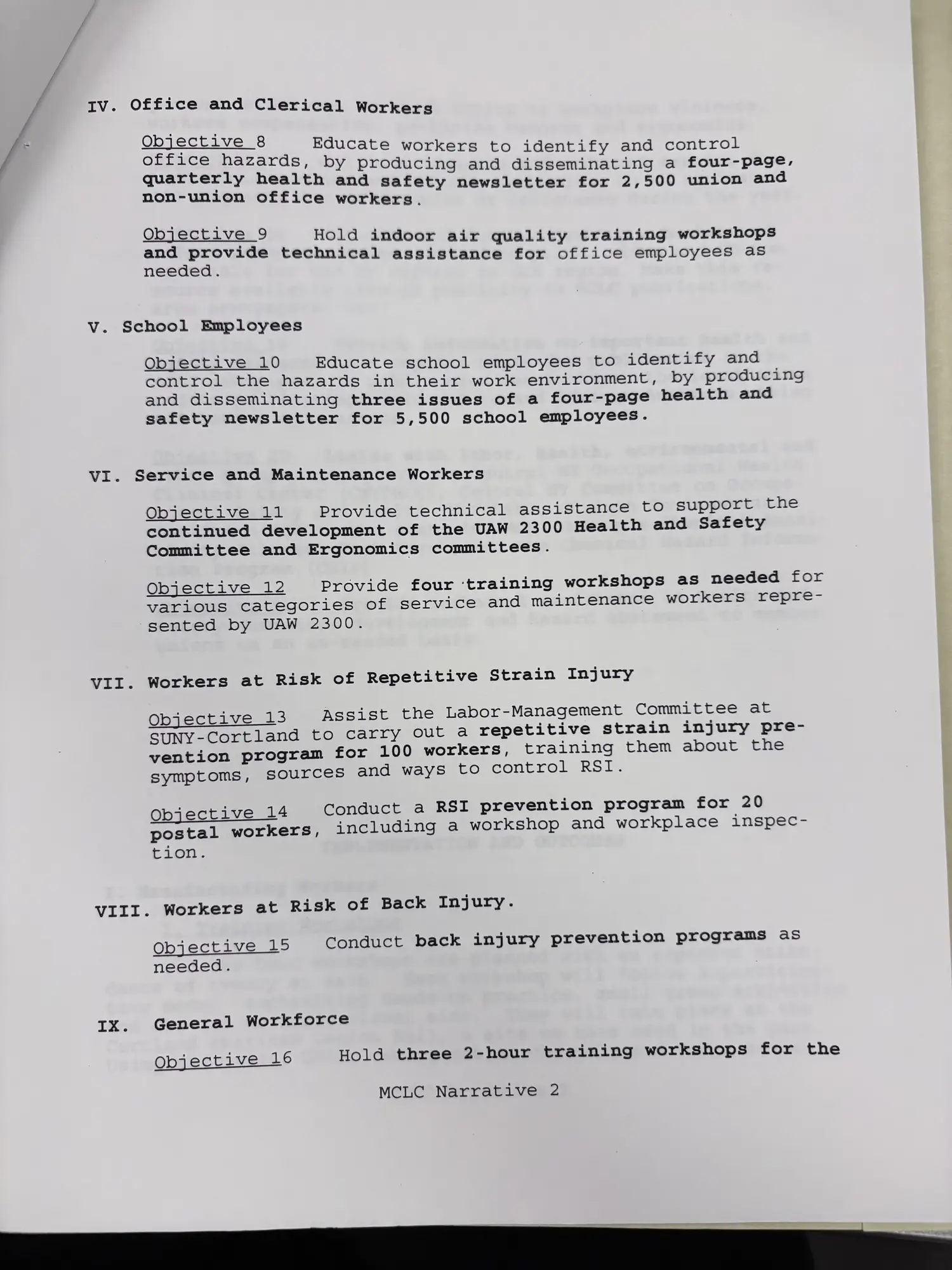
Iv. Office and Clerical Workers

f oe Reed 4 Educate workers to identify and control
rds, by producing and disseminating a four-page,

. news er and

ce coe eH Hold indoor air quality training workshops
mai 8 ay technical assistance for office employees as

Vv. School Employees

Objective 10 Educate school employees to identify and
control the hazards in their work environment, by producing
and disseminating three issues of a four-page health and
safety newsletter for 5,500 school employees.

VI. Service and Maintenance Workers
Objective 11 Provide technical assistance to support the
continued development of the UAW 2300 Health and Safety
Committee and Ergonomics committees.
Obsiectave 12 Provide four ‘training workshops as needed for
various categories of service and maintenance workers repre-
sented by UAW 2300.

VII. Workers at Risk of Repetitive Strain Injury
Objective 13 Assist the Labor-Management Committee at
SUNY-Cortland to carry out a repetitive strain injury pre-
vention program for 100 workers, training them about the

symptoms, sources and ways to control RSI.

Objective 14 Conduct a RSI prevention program for 20
postal workers, including a workshop and workplace inspec-

ci0n-

VIII. Workers at Risk of Back Injury.
Objective 15 Conduct back injury prevention programs as
needed.

Ix. General Workforce

Objective 16 Hold three 2-hour training workshops for the

MCLC Narrative 2
 (open zoom view)
Read the page text (machine-read, mostly readable)
This text was generated automatically from the photograph and has not been corrected. The image is the authoritative record.
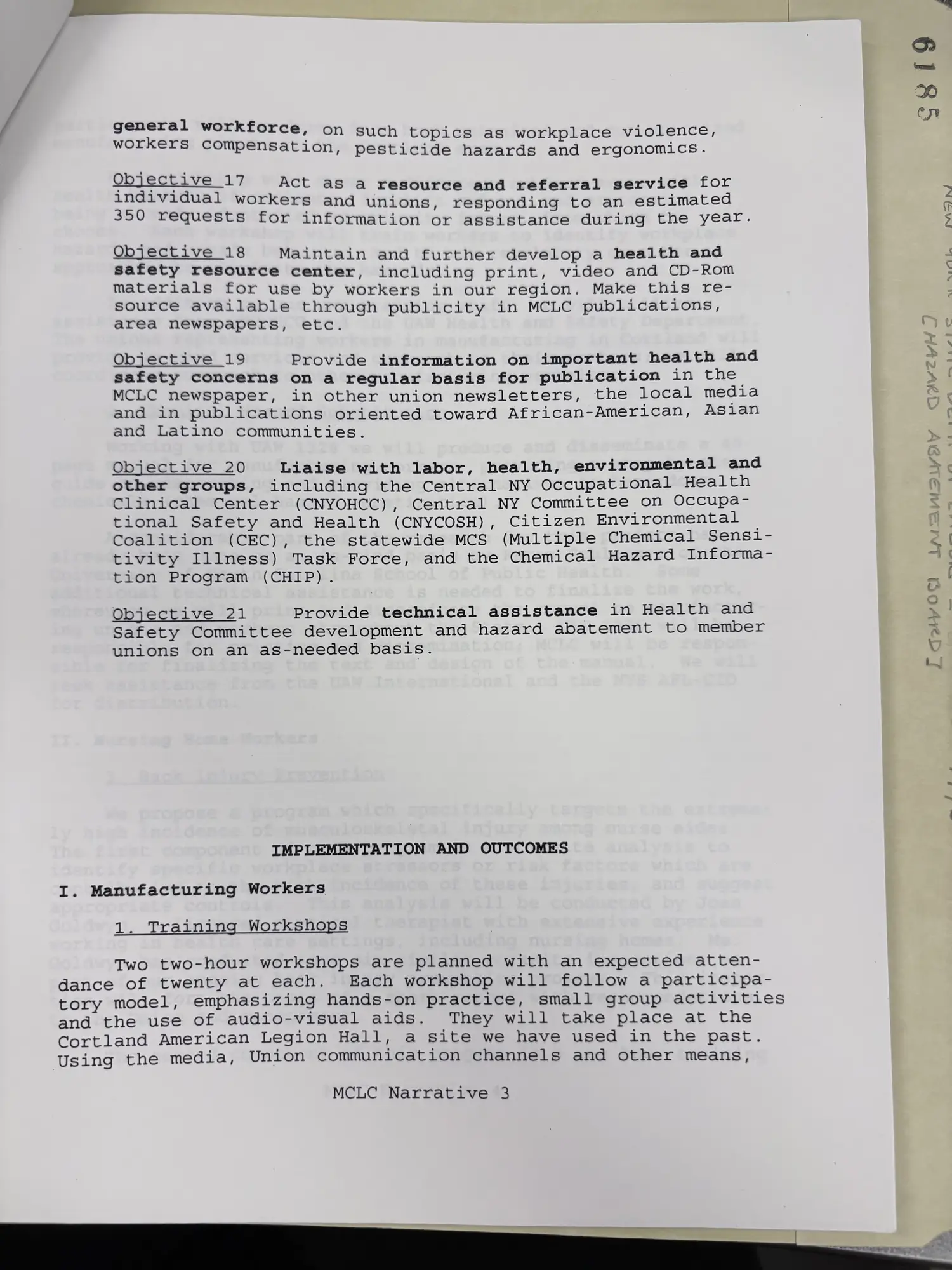
ss 19

eneral w : :
/ Ae aise oe On such topics as workplace violence,
pensation, pesticide hazards and ergonomics.

eae ee Act as a resource and referral service for
350 1dual workers and unions, responding to an estimated
requests for information or assistance during the year.

rasa n/

Objective 18 Maintain and further develop a health and

safety resource center, including print, video and CD-Rom
materials for use by workers in our region. Make this re-
source available through publicity in MCLC publications,

area newspapers, etc.

atime oe lL.

Objective 19 Provide information on important health and
safety concerns on a regular basis for publication in the
MCLC newspaper, in other union newsletters, the local media
and in publications oriented toward African-American, Asian
and Latino communities.

Wy ZH j
om beat

eh ami

Objective 20 Liaise with labor, health, environmental and
other groups, including the Central NY Occupational Health
Clinical Center (CNYOHCC), Central NY Committee on Occupa-
tional Safety and Health (CNYCOSH), Citizen Environmental
Coalition (CEC), the statewide MCS (Multiple Chemical Sensi-
tivity Illness) Task Force, and the Chemical Hazard Informa-
tion Program (CHIP).

Objective 21 Provide technical assistance in Health and
Safety Committee development and hazard abatement to member
unions on an as-needed basis.

Taxnv0d) incawsiyav

IMPLEMENTATION AND OUTCOMES
I. Manufacturing Workers

1. Training Workshops

Two two-hour workshops are planned with an expected atten-
dance of twenty at each. Each workshop will follow a participa-
tory model, emphasizing hands-on practice, small group activities
and the use of audio-visual aids. They will take place at the
Cortland American Legion Hall, a site we have used in the past.
Using the media, Union communication channels and other means,

MCLC Narrative 3
 (open zoom view)
Read the page text (machine-read, mostly readable)
This text was generated automatically from the photograph and has not been corrected. The image is the authoritative record.
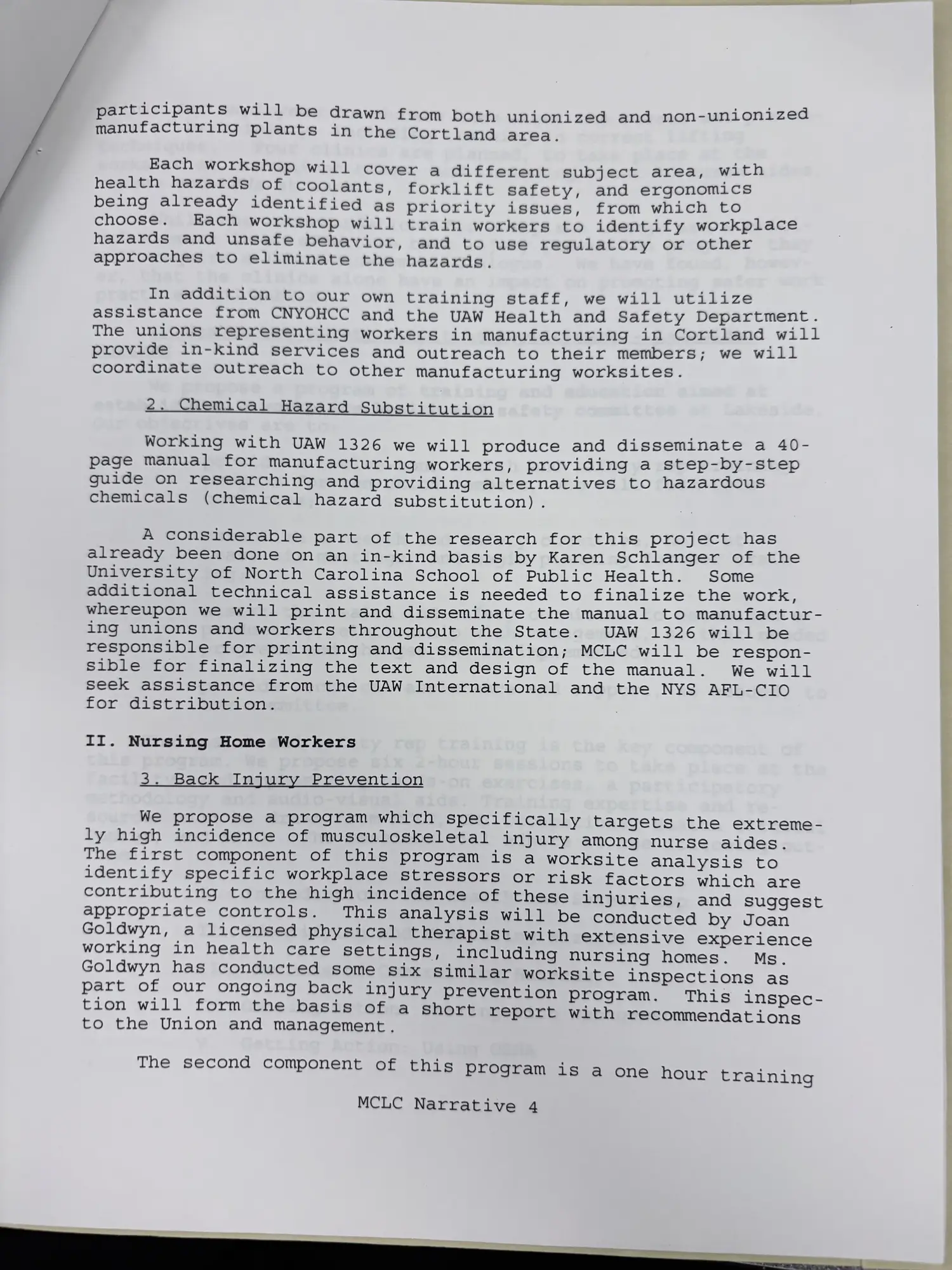
participants will be drawn from both unionized and non-unionized
manufacturing plants in the Cortland area.

Each workshop will cover a different subject area, with
health hazards of coolants, forklift safety, and ergonomics
being already identified as priority issues, from which to
choose. Each workshop will train workers to identify workplace
hazards and unsafe behavior, and to use regulatory or other
approaches to eliminate the hazards.

In addition to our own training staff, we will utilize
assistance from CNYOHCC and the UAW Health and Safety Department.
The unions representing workers in manufacturing in Cortland will
provide in-kind services and outreach to their members; we will
coordinate outreach to other manufacturing worksites.

2. Chemical Hazard Substitution

Working with UAW 1326 we will produce and disseminate a 40-
page manual for manufacturing workers, providing a step-by-step
guide on researching and providing alternatives to hazardous
chemicals (chemical hazard SUbsStueutaron) =

A considerable part of the research for this project has
already been done on an in-kind basis by Karen Schlanger of the
University of North Carolina School of Public Health. Some
additional technical assistance is needed to finalize the work,
whereupon we will print and disseminate the manual to manufactur-
ing unions and workers throughout the State. UAW 1326 will be
responsible for printing and dissemination; MCLC will be respon-
sible for finalizing the text and design of the manual. We will
seek assistance from the UAW International and the NYS AFL-CIO
for distribu one

II. Nursing Home Workers

3. Back Injury Prevention

We propose a program which specifically targets the extreme-
ly high incidence of musculoskeletal injury among nurse aides.
The first component of this program is a worksite analysis to
identify specific workplace stressors or risk factors which are
contributing to the high incidence of these injuries, and suggest
appropriate controls. This analysis will be conducted by Joan
Goldwyn, a licensed physical therapist with extensive experience
working in health care settings, including nursing homes. Ms.
Goldwyn has conducted some six similar worksite inspections as
part of our ongoing back injury prevention program. This inspec-
tion will form the basis of a short report with recommendations
to the Union and management.

The second component of this program is a one hour training

MCLC Narrative 4
 (open zoom view)
Read the page text (machine-read, mostly readable)
This text was generated automatically from the photograph and has not been corrected. The image is the authoritative record.
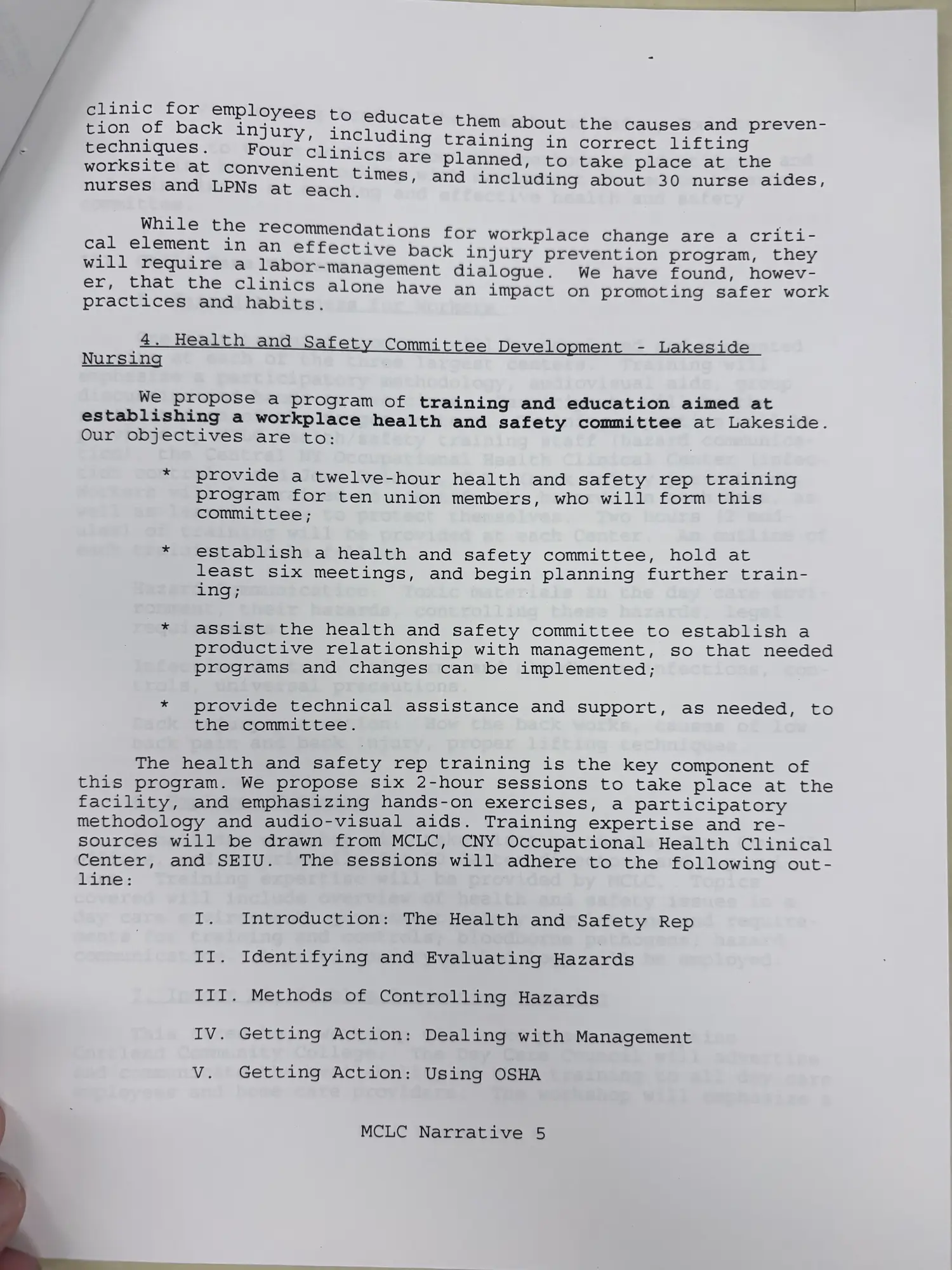
clinic for employees to educate t
tion of back injury, incl

a hem about the causes and preven-
: ,c-uding training in correct lifting
: techniques. Four clinics are Planned, to take place at the

Pel cceiatcineie ce eee and including about 30 nurse aides,

While the recommendations for workplace change are a criti-
cal element in an effective back injury prevention program, they
will require a labor-management dialogue. We have found, howev-
er, that the clinics alone have an impact on promoting safer work
practices and habits.

4. Health and Safety Committee Development - Lakeside

Nursing

We propose a program of training and education aimed at
establishing a workplace health and safety committee at Lakeside.
Our objectives are to:

* provide a twelve-hour health and safety rep training
program for ten union members, who will form this
committee;

* establish a health and safety committee, hold at
least six meetings, and begin planning further train-
ing;

* assist the health and safety committee to establish a
productive relationship with management, so that needed
programs and changes can be implemented;

* provide technical assistance and support, as needed, to
the committee.

The health and safety rep training is the key component of
this program. We propose six 2-hour sessions to take place at the
facility, and emphasizing hands-on exercises, a participatory
methodology and audio-visual aids. Training expertise and re-
sources will be drawn from MCLC, CNY Occupational Health Clinical
Center, and SEIU. The sessions will adhere to the following out-
line:

I. Introduction: The Health and Safety Rep
II. Identifying and Evaluating Hazards

III. Methods of Controlling Hazards

IV. Getting Action: Dealing with Management

V. Getting Action: Using OSHA

MCLC Narrative 5
 (open zoom view)
Read the page text (machine-read, mostly readable)
This text was generated automatically from the photograph and has not been corrected. The image is the authoritative record.
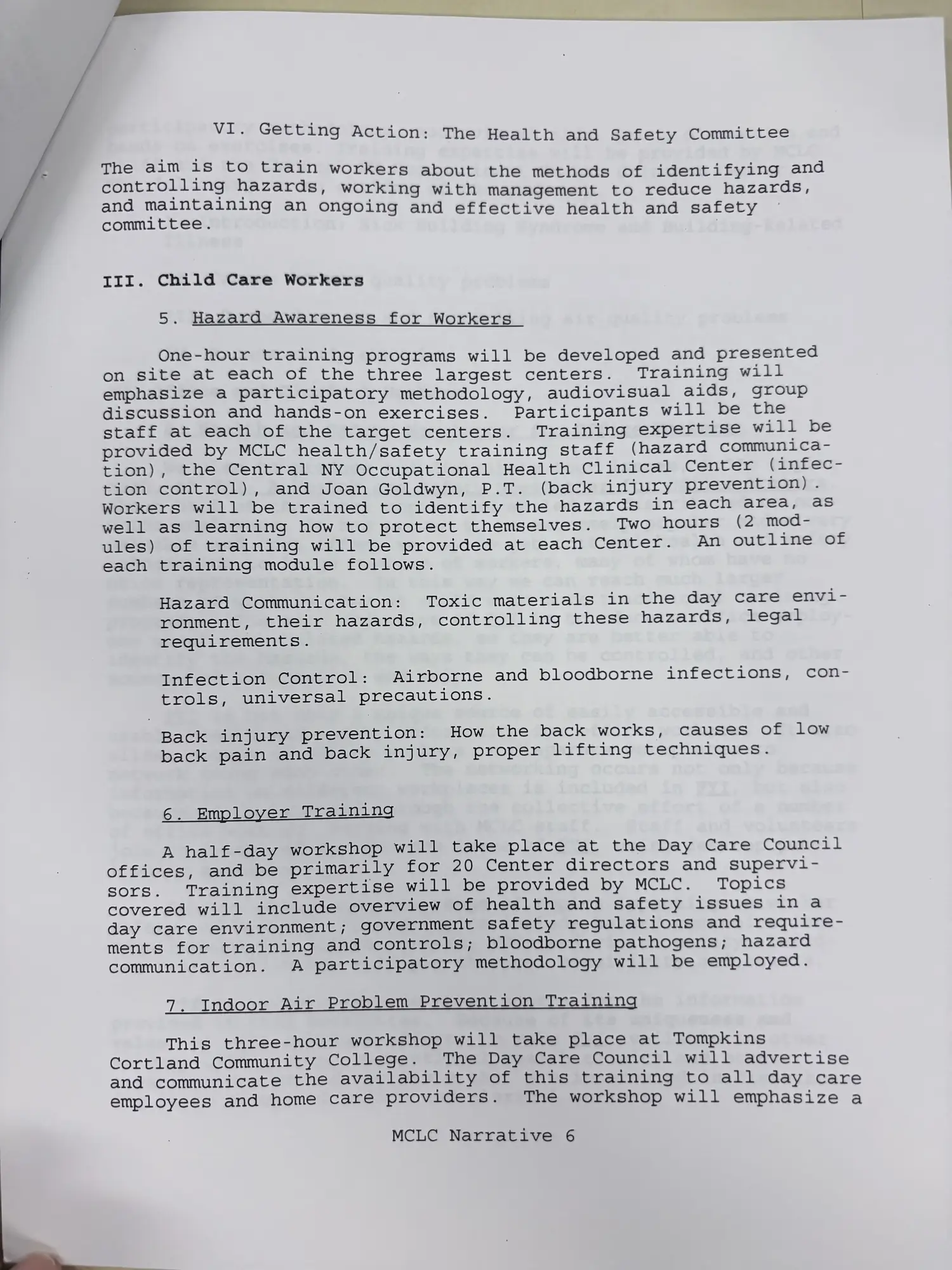
VAI:

Getting Action: The Health and Safety Committee

Sea ihe a train workers about the methods of identifying and
ota ing hazards, working with management to reduce hazards,

and maintaining an ongoing and effective health and safety
committee.

III. Child Care Workers
5. Hazard Awareness for Workers

One-hour training programs will be developed and presented
on site at each of the three largest centers. Training will
emphasize a participatory methodology, audiovisual aids, group
discussion and hands-on exercises. Participants will be the
staff at each of the target centers. Training expertise will be
provided by MCLC health/safety training staff (hazard communica-
tion), the Central NY Occupational Health Clinical Center (infec-
tion control), and Joan Goldwyn, P.T. (back injury prevention) .
Workers will be trained to identify the hazards in each area, as
well as learning how to protect themselves. Two hours (2 mod -
ules) of training will be provided at each Center. An outline of
each training module follows.

Hazard Communication: Toxic materials in the day care envi-
ronment, their hazards, controlling these hazards, legal
requirements.

Infection Control: Airborne and bloodborne infections, con-
trols, universal precautions.

Back injury prevention: How the back works, causes of low

back pain and back injury, proper lifting techniques.

6. Employer Trainin

A half-day workshop will take place at the Day Care Council
offices, and be primarily for 20 Center directors and supervi-
sors. Training expertise will be provided by MCLC. Topics
covered will include overview of health and safety issues in a
day care environment; government safety regulations and require-
ments for training and controls; bloodborne pathogens; hazard
communication. A participatory methodology will be employed.

7. Indoor Air Problem Prevention Training

This three-hour workshop will take place at Tompkins
Cortland Community College. The Day Care Council will advertise
and communicate the availability of this training to all day care
employees and home care providers. The workshop will emphasize a

MCLC Narrative 6
 (open zoom view)
Read the page text (machine-read, mostly readable)
This text was generated automatically from the photograph and has not been corrected. The image is the authoritative record.
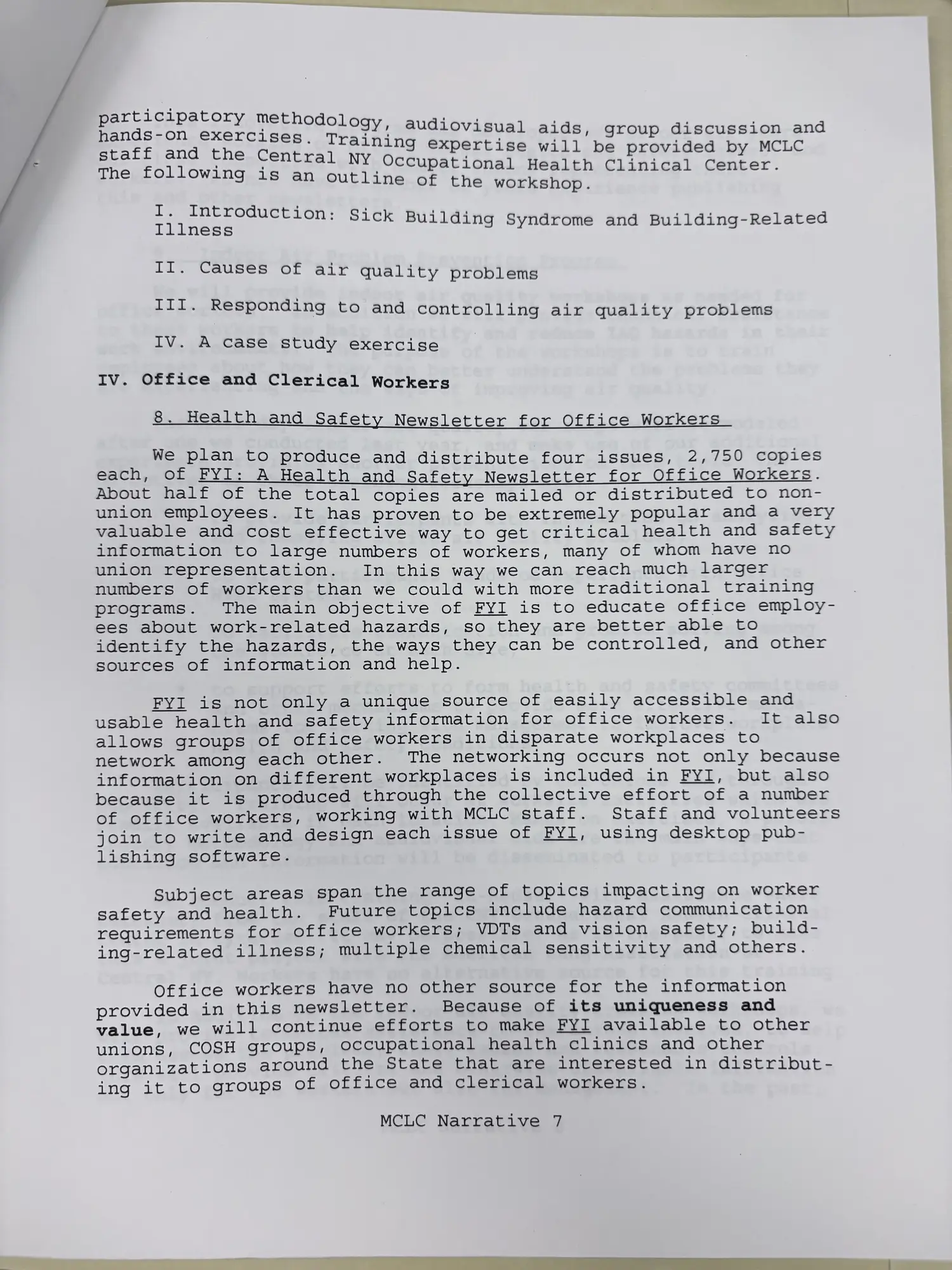
participatory methodology

hands-on exercises, Trainin
staff and the Centra
The following is an

audiovisual aids, group discussion and
+ hy. g expertise will be provided by MCLC

Occupational Health Clinical Center.
Outline of the workshop.

ae Ue ion: 84 ter ers
a ta ee Sick Building Syndrome and Building-Related

II. Causes of air quality problems

III. Responding to and controlling air quality problems

IV. A case study exercise

Iv. Office and Clerical Workers

8. Health and Safety Newsletter for Office Workers

We plan to produce and distribute four issues, 2,750 copies
each, Of FYI: A Health and Safety Newsletter for Office Workers.
About half of the total copies are mailed or distributed to non-
union employees. It has proven to be extremely popular and a very
valuable and cost effective way to get critical health and safety
information to large numbers of workers, many of whom have no
union representation. In this way we can reach much larger
numbers of workers than we could with more traditional training
programs. The main objective of FYI is to educate office employ-
ees about work-related hazards, so they are better able to
identify the hazards, the ways they can be controlled, and other
sources of information and help.

FYI is not only a unique source of easily accessible and
usable health and safety information for office workers. It also
allows groups of office workers in disparate workplaces to
network among each other. The networking occurs not only because
information on different workplaces is included in FYI, but also
because it is produced through the collective effort of a number
of office workers, working with MCLC staff. Staff and volunteers
join to write and design each issue of FYI, using desktop pub-

lishing software.

Subject areas span the range of topics impacting on worker
safety and health. Future topics include hazard communication
requirements for office workers; VDTs and vision safety; build-
ing-related illness; multiple chemical sensitivity and others.

Office workers have no other source for the information
provided in this newsletter. Because of its uniqueness and
value, we will continue efforts to make FYI available to other
unions, COSH groups, occupational health clinics and other
organizations around the State that are interested in distribut-
ing it to groups of office and clerical workers.

MCLC Narrative 7
 (open zoom view)
Read the page text (machine-read, mostly readable)
This text was generated automatically from the photograph and has not been corrected. The image is the authoritative record.
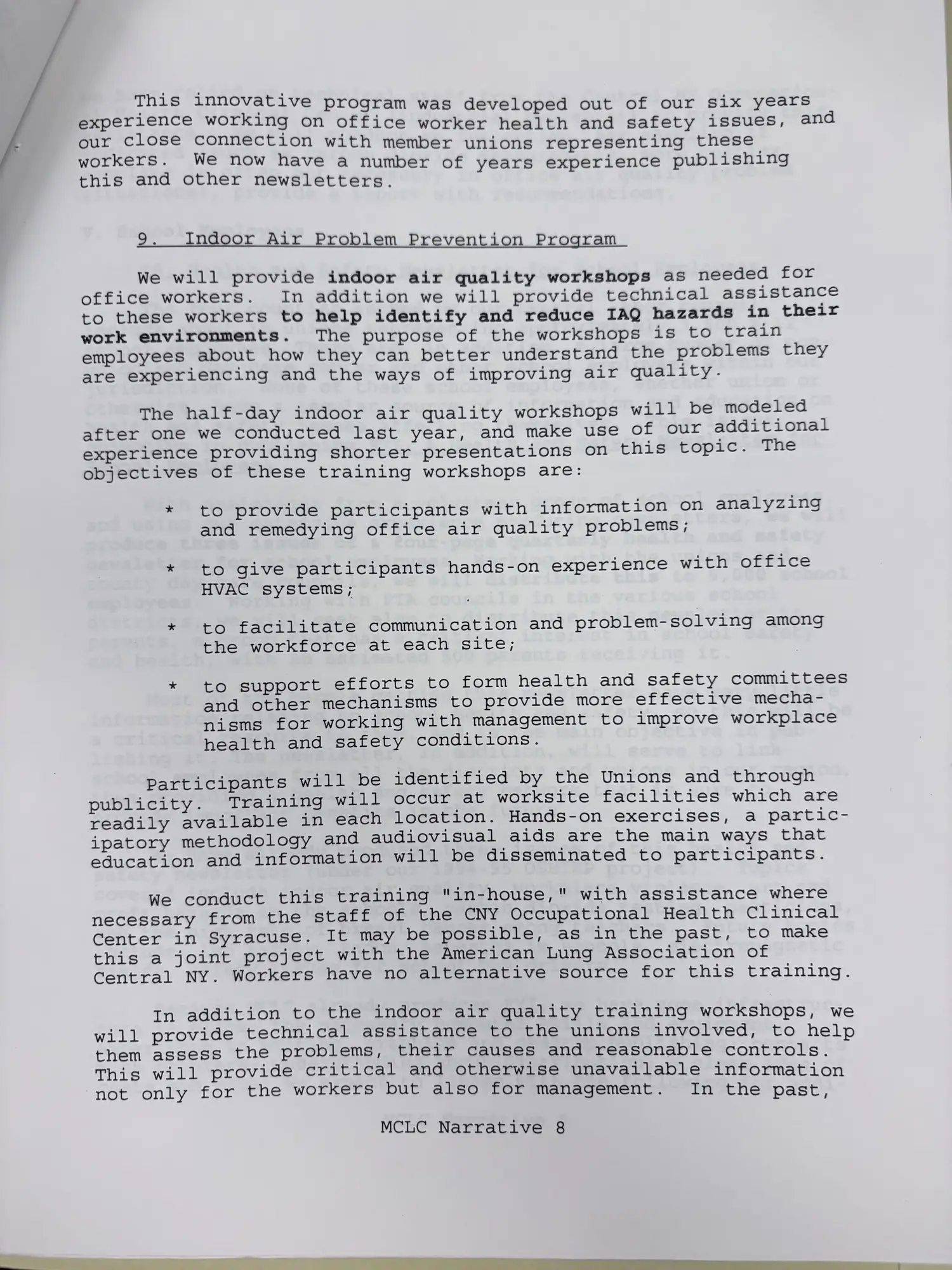
suey Canals program was developed out of our six years
Bees: t € working on office worker health and safety issues, and
our close connection with member unions representing these

workers. We now have a number of i ishi
ears experience publishin
this and other newsletters. f : x a

9. Indoor Air Problem Prevention Program

We will provide indoor air quality workshops as needed for
office workers. In addition we will provide technical assistance
to these workers to help identify and reduce IAQ hazards in their
work environments. The purpose of the workshops is to train
employees about how they can better understand the problems they
are experiencing and the ways of improving air quality.

The half-day indoor air quality workshops will be modeled
after one we conducted last year, and make use of our additional
experience providing shorter presentations on thig~copre>=rne
objectives of these training workshops are:

* to provide participants with information on analyzing
and remedying office air quality problems;

* to give participants hands-on experience WiEeiPeOLeree
HVAC systems;

* to facilitate communication and problem-solving among
the workforce at each site;

* to support efforts to form health and safety committees
and other mechanisms to provide more effective mecha-
nisms for working with management to improve workplace
health and safety conditions.

Participants will be identified by the Unions and through
publicity. Training will occur at worksite facilities which are
readily available in each location. Hands-on exercises, a partic-
ipatory methodology and audiovisual aids are the main ways that

education and information will be disseminated to participants.

We conduct this training "in-house," with assistance where
necessary from the staff of the CNY Occupational Health Clinical
Center in Syracuse. It may be possible, as in the past, to make
this a joint project with the American Lung Association of
Central NY. Workers have no alternative source for this training.

In addition to the indoor air quality training workshops, we
will provide technical assistance to the unions involved, to help
them assess the problems, their causes and reasonable controls.
This will provide critical and otherwise unavailable information
not “only for tne workers but also for management. In the past,

MCLC Narrative 8
 (open zoom view)
Read the page text (machine-read, mostly readable)
This text was generated automatically from the photograph and has not been corrected. The image is the authoritative record.
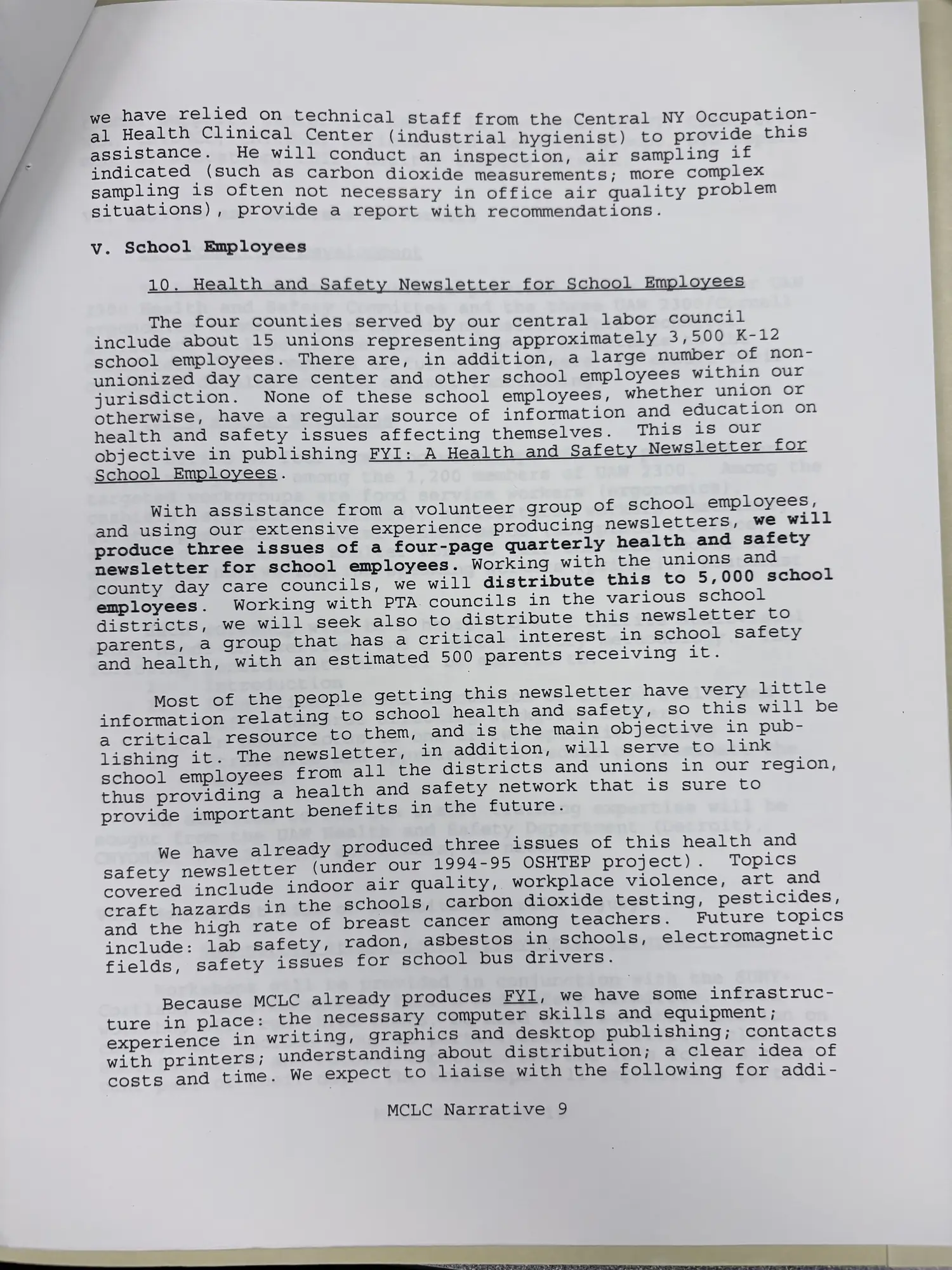
we Se tag ote technical staff from the Central NY Occupation-
ee inical Center (industrial hygienist) to provide this
assistance. He will conduct an inspection, air sampling if
indicated (such as carbon dioxide measurements; more complex
sampling is often not necessary in office air quality problem
situations), provide a report with recommendations.

v. School Employees
10. Health and Safety Newsletter for School Employees

1 The four counties served by our central labor council
include about 15 unions representing approximately 3,500 K-12
school employees. There are, in addition, a large number of non-
unionized day care center and other school employees within our
jurisdiction. None of these school employees, whether union or
otherwise, have a regular source of information and education on
health and safety issues affecting themselves. This is our
objective in publishing FYI: A Health and Safety Newsletter for
School Employees.

With assistance from a volunteer group of school employees,
and using our extensive experience producing newsletters, we will
produce three issues of a four-page quarterly health and safety
newsletter for school employees. Working with the unions and
county day care councils, we will distribute this to 5,000 school
employees. Working with PTA. councils in the various school
districts, we will seek also to distribute this newsletter to
parents, a group that has a critical interest in school safety
and health, with an estimated 500 parents receiving it.

Most of the people getting this newsletter have very little
information relating to school health and safety, so this wali] be
a critical resource to them, and is the main objective in pub-
lishing it. The newsletter, in addition, will serve to link
school employees from all the districts and unions in our region,
thus providing a health and safety network that is sure to

provide important benefits in the future.

We have already produced three issues of this health and
safety newsletter (under our 1994-95 OSHTEP project). Topics
covered include indoor air quality, workplace violence, art and
craft hazards in the schools, carbon dioxide testing, pesticides,
and the high rate of breast cancer among teachers. Future topics
include: lab safety, radon, asbestos in schools, electromagnetic
fields, safety issues for school bus drivers.

Because MCLC already produces FYI, we have some infrastruc-
ture in place: the necessary computer skills and equipment ;
experience in writing, graphics and desktop publishing; contacts
with printers; understanding about distribution; a clear idea of
costs and time. We expect to liaise with the following for addi-

MCLC Narrative 9
 (open zoom view)
Read the page text (machine-read, mostly readable)
This text was generated automatically from the photograph and has not been corrected. The image is the authoritative record.
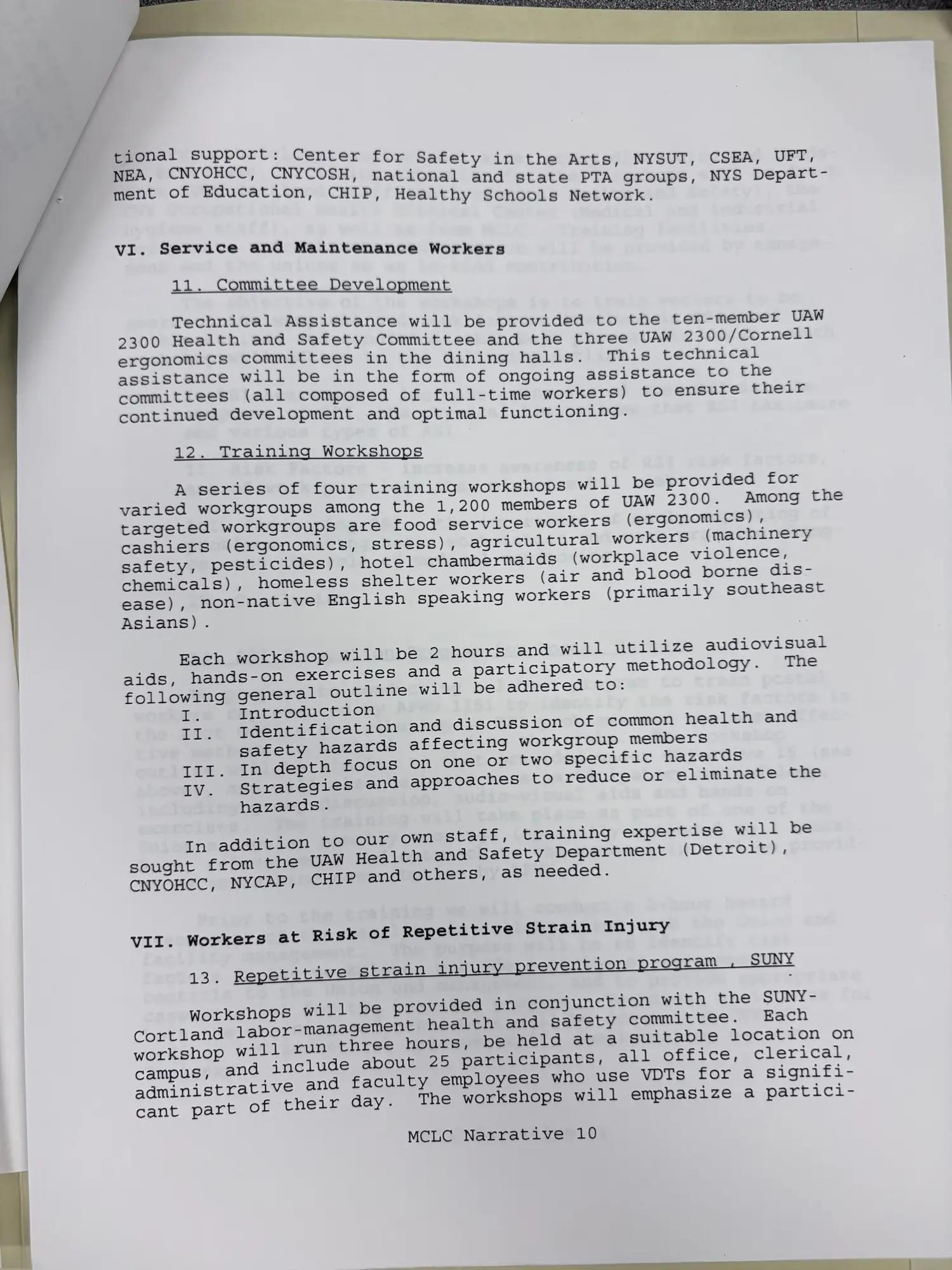
BGcwronec, curcosa, for Safety in the Arts, NYSUT, CSEA, UFT,
j ’ al and state PT. -
ment of Education, CHIP, Healthy Schools metvorkana & pidge

VI. Service and Maintenance Workers

11. Committee Development

Technical Assistance will be provided to the ten-member UAW
2300 Health and Safety Committee and the three UAW 2300/Cornell
ergonomics committees in the dining halls. This technical
assistance will be in the form of ongoing assistance to the
committees (all composed of full-time workers) to ensure their
continued development and optimal functioning.

12. Training Workshops

_ A series of four training workshops will be provided for
varied workgroups among the 1,200 members of UAW 2300. Among the
targeted workgroups are food service workers (ergonomics) ,
cashiers (ergonomics, stress), agricultural workers (machinery
safety, pesticides), hotel chambermaids (workplace violence,
chemicals), homeless shelter workers (air and blood borne dis
ease), non-native English speaking workers (primarily southeast

Asians).

Fach workshop will be 2 hours and will utilize audiovisual
aids, hands-on exercises and a participatory methodology. The
following general outline will be adhered to:

LT, Introduction
TES Identification and discussion of common health and

safety hazards affecting workgroup members
III. In depth focus on one or two specific hazards
Iv. Strategies and approaches to reduce or eliminate the

hazards.

In addition to our own staff, training expertise will be
sought from the UAW Health and Safety Department (Detroit),
CNYOHCC, NYCAP, CHIP and others, as needed.

VII. Workers at Risk of Repetitive Strain Injury

13. Repetitive strain injury prevention program _, SUNY

Workshops will be provided in conjunction with the SUNY-
Cortland labor-management health and safety committee. Each
workshop will run three hours, be held at a suitable location on
campus, and include about 25 participants, all office, clerical,
administrative and faculty employees who use vpTs for a signifi-

cant part of their day. The workshops will emphasize a partici-

MCLC Narrative 10
 (open zoom view)
Read the page text (machine-read, mostly readable)
This text was generated automatically from the photograph and has not been corrected. The image is the authoritative record.
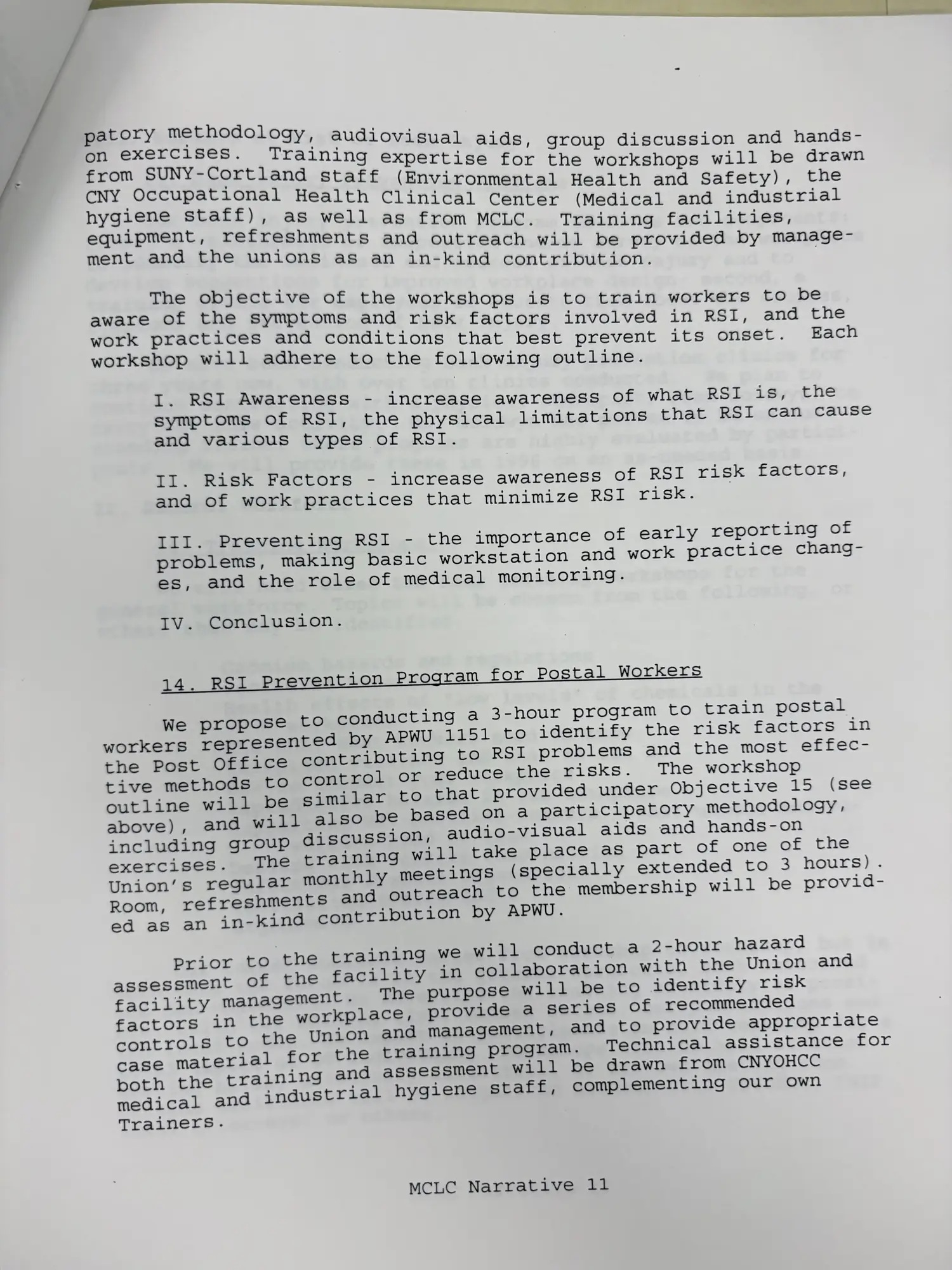
patory methodology, audiovi
on exercises. Cian a

ar aids, group di :
Trainin : y SJ p discussion and hands
from SUNY-Cortland Shah tee paes for the workshops will be drawn

; (Environm
CNY GCCU yey ental Health and Safety), the
pational Health Clinical Center (Medical and EE OES

hygiene staff), as well as from MCLC. Training facilities,

equipment, refreshments and i
; outreach will be vi -
ment and the unions as an in-kind Senter cekonie sci a st ga

The objective of the work i
shops is to train workers to be
aware of the symptoms and risk factors involved in RSI, and the

work practices and conditions th i
: at best prevent its onset. Each
workshop will adhere to the following bij table

I. RSI Awareness - increase awareness of what RSI is,;,the

symptoms of RSI, the physical limitations that RSI can cause
and various types of RSI.

II. Risk Factors - increase awareness of RSI risk factors,
and of work practices that minimize RSI ea Skee

iiT . Preventing RSI - the importance of early reporting of
problems, making basic workstation and work practice chang-
es, and the role of medical monitoring.

IV. Conclusion.

14. RSI Prevention Program for Postal Workers

We propose to conducting a 3-hour program to train postal
workers represented by APWU 1151 to identify the risk factors in
the Post Office contributing to RSI problems and the most effec-
tive methods to control or reduce the risks. The workshop
outline will be similar to that provided under Objective 15 (see
above), and will also be based on a participatory methodology,
including group discussion, audio-visual aids and hands-on
exercises. The training will take place as part of one ef the
Union’s regular monthly meetings (specially extended to 3 hours).
Room, refreshments and outreach to the membership will be provid-
ed as an in-kind contribution by APWU.

Prior to the training we will conduct a 2-hour hazard
assessment of the facility in collaboration with the Union and
facility management. The purpose will be to identify risk
factors in the workplace, provide a series of recommended
controls to the Union and management, and to provide appropriate
case material for the training program. Technical assistance for
both the training and assessment will be drawn from CNYOHCC
medical and industrial hygiene staff, complementing our own

Trainers.

MCLC Narrative 11
 (open zoom view)
Read the page text (machine-read, mostly readable)
This text was generated automatically from the photograph and has not been corrected. The image is the authoritative record.
oT ee

| eee

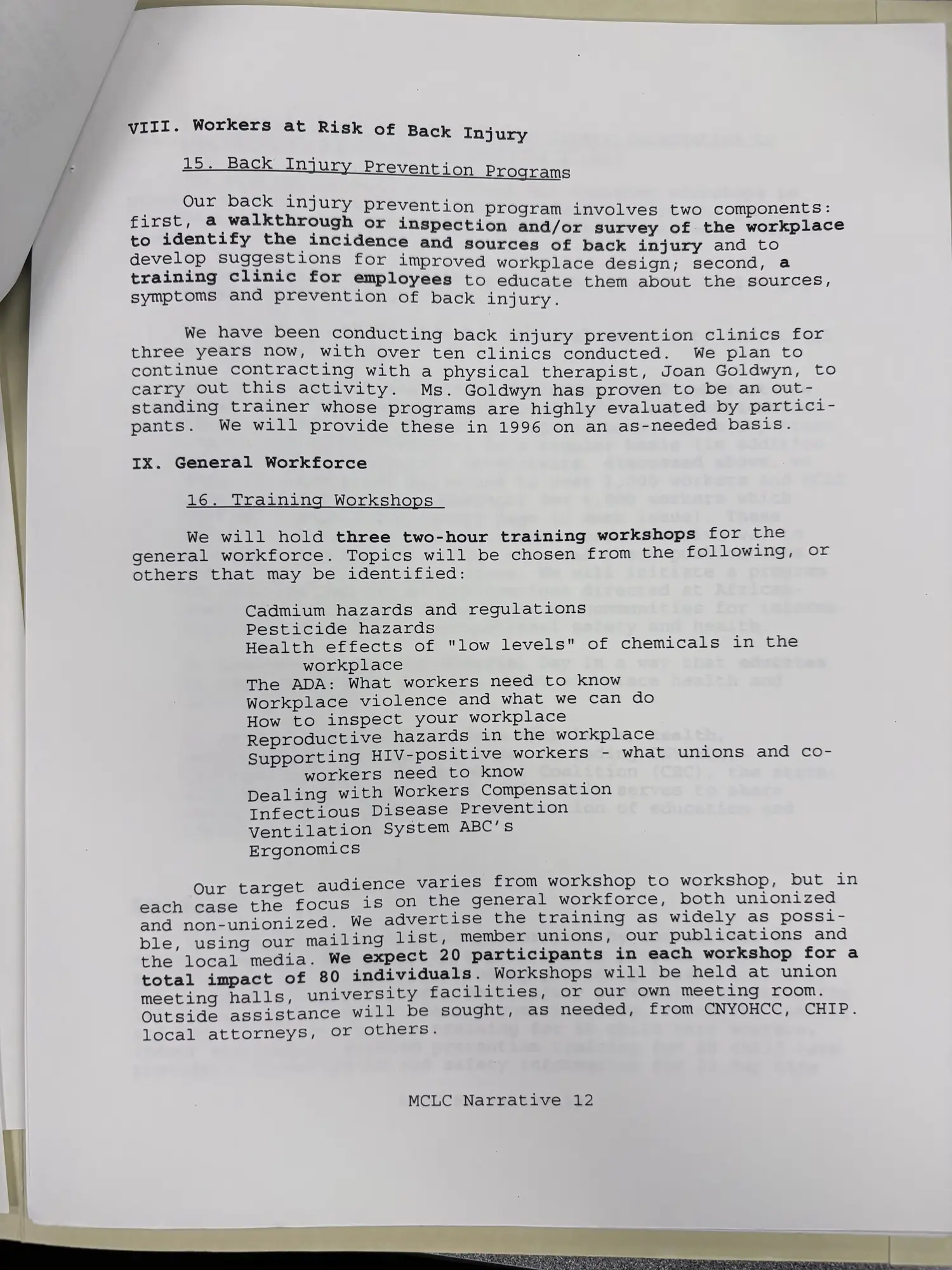
VIII. Workers at Risk of Back Injury

15. Back Injury Prevention Programs

Our back inj i
Pc erneal BAUR TSS, prevention program involves two components:
3 hbentiey eke SRWEABABG aRAvEate and/or survey of the workplace
‘ sources of back inju and to |
develop AE baht for improved workplace Mabigi)s second: a
training clinic for employees to educate them about the sources,
symptoms and prevention of back injury.

We have been conducting back injury prevention clinics for
three years now, with over ten clinics conducted. We plan to
continue contracting with a physical therapist, Joan Goldwyn, to
carry out this activity. Ms. Goldwyn has proven to be an out-
standing trainer whose programs are highly evaluated by partici-
pants. We will provide these in 1996 on an as-needed basis.

IX. General Workforce

16. Training Workshops

We will hold three two-hour training workshops for the
general workforce. Topics will be chosen from the following, or
others that may be identified:

Cadmium hazards and regulations

Pesticide hazards

Health effects of "low levels" of chemicals in the
workplace

The ADA: What workers need to know

Workplace violence and what we can do

How to inspect your workplace

Reproductive hazards in the workplace

Supporting HIV-positive workers - what unions and co-
workers need to know

Dealing with Workers Compensation

Infectious Disease Prevention

Ventilation System ABC’s

Ergonomics

Our target audience varies from workshop to workshop, but in
each case the focus is on the general workforce, both unionized
and non-unionized. We advertise the training as widely as possi-
ble, using our mailing list, member unions, our publications and
the local media. We expect 20 participants in each workshop for a
total impact of 80 individuals. Workshops will be held at union
meeting halls, university facilities, or our own meeting room.
Outside assistance will be sought, as needed, from CNYOHCC, CHIP.
local attorneys, or others.

MCLC Narrative 12
 (open zoom view)
Read the page text (machine-read, mostly readable)
This text was generated automatically from the photograph and has not been corrected. The image is the authoritative record.
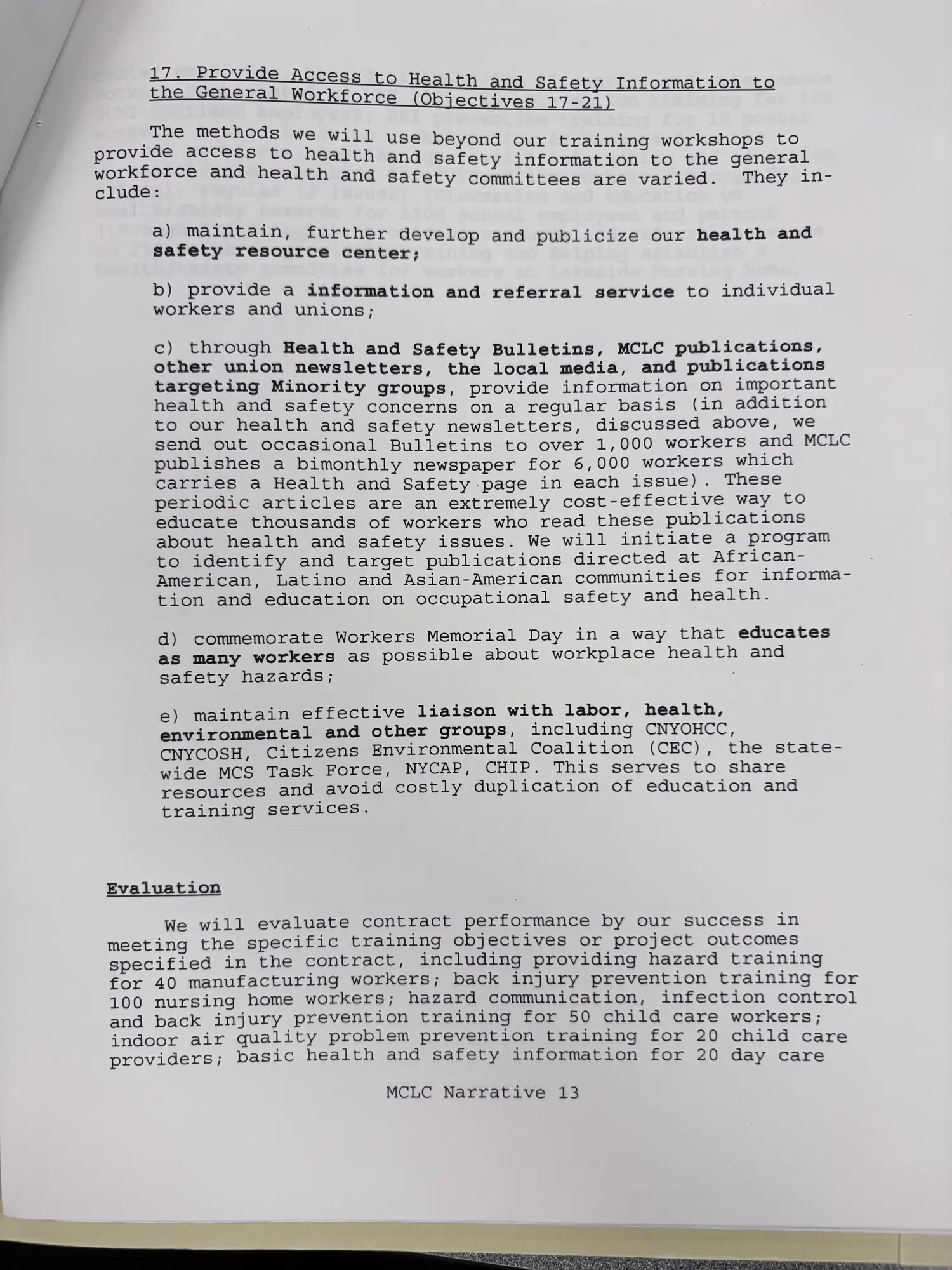
17. Provide Access t :
the General Wdrkeoras Health and Safety Information to

Objectives 17-21

The methods we will use

provid beyond our training workshops to

e ac
cess to health and safety information to the general

Hee and health and safety committees are varied. They in-

a) maintain, further develop and publicize our health and
safety resource center;

b) provide a information and referral service to individual
workers and unions;

c) through Health and Safety Bulletins, MCLC publications,
other union newsletters, the local media, and publications
targeting Minority groups, provide information on important
health and safety concerns on a regular basis (in addition
to our health and safety newsletters, discussed above, we
send out occasional Bulletins to over 1,000 workers and MCLC
publishes a bimonthly newspaper for 6,000 workers which
carries a Health and Safety page in each issue) >. @hese
periodic articles are an extremely cost-effective way to
educate thousands of workers who read these publications
about health and safety issues. We will initiate a program
to identify and target publications directed at African-
American, Latino and Asian-American communities for informa-
tion and education on occupational safety and health.

ad) commemorate Workers Memorial Day in a way that educates
as many workers as possible about workplace health and
safety hazards; :

e) maintain effective liaison with labor, health,
environmental and other groups, including CNYOHCC,

CNYCOSH, Citizens Environmental Coalition (CEC), the state-
wide MCS Task Force, NYCAP, CHIP. This serves to share
resources and avoid costly duplication of education and
training services.

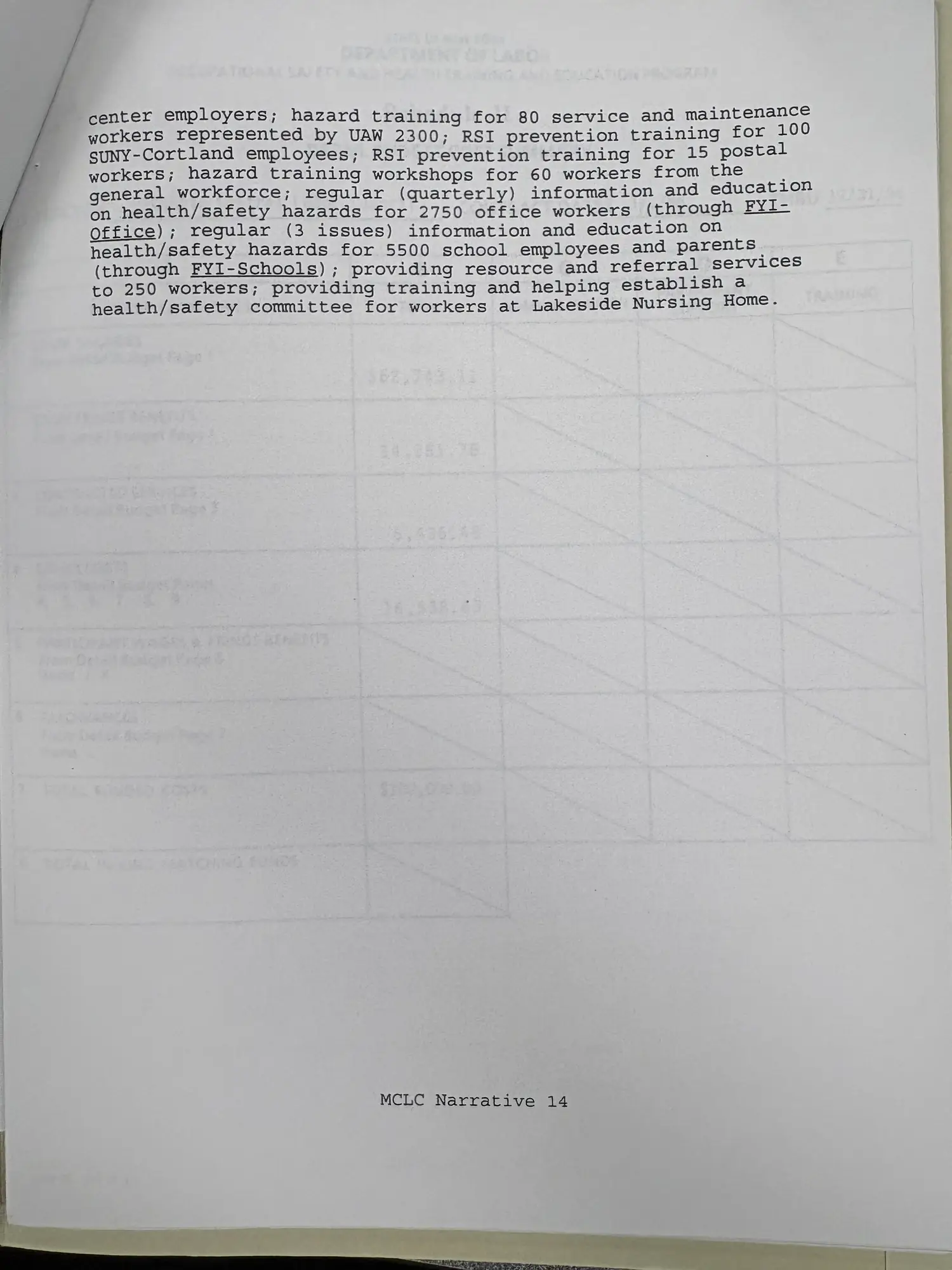
Evaluation

We will evaluate contract performance by our success in
meeting the specific training objectives or project outcomes
specified in the contract, including providing hazard training
for 40 manufacturing workers; back injury prevention training for
100 nursing home workers; hazard communication, infection control
and back injury prevention training for 50 child care workers;
indoor air quality problem prevention training for 20 child care
providers; basic health and safety information for 20 day care

MCLC Narrative 13
 (open zoom view)
Read the page text (machine-read, contains errors)
This text was generated automatically from the photograph and has not been corrected. The image is the authoritative record.
center employers; hazard training for 80 service and ena a a
workers represented by UAW 2300; RSI prevention training ax
SUNY-Cortland employees; RSI prevention training for mes
workers; hazard training workshops for 60 workers pace See ar
general workforce; regular (quarterly) information ae eee
on health/safety hazards for 2750 office workers (t eed
Office); regular (3 issues) information and equcat zie
health/safety hazards for 5500 school employees an eA iaatar se
(through FYI-Schools) ; providing resource and Re ee =

to 250 workers; providing training and helping ont eae aft
health/safety committee for workers at Lakeside Nu

MCLC Narrative 14
 (open zoom view)
Read the page text (machine-read, mostly readable)
This text was generated automatically from the photograph and has not been corrected. The image is the authoritative record.
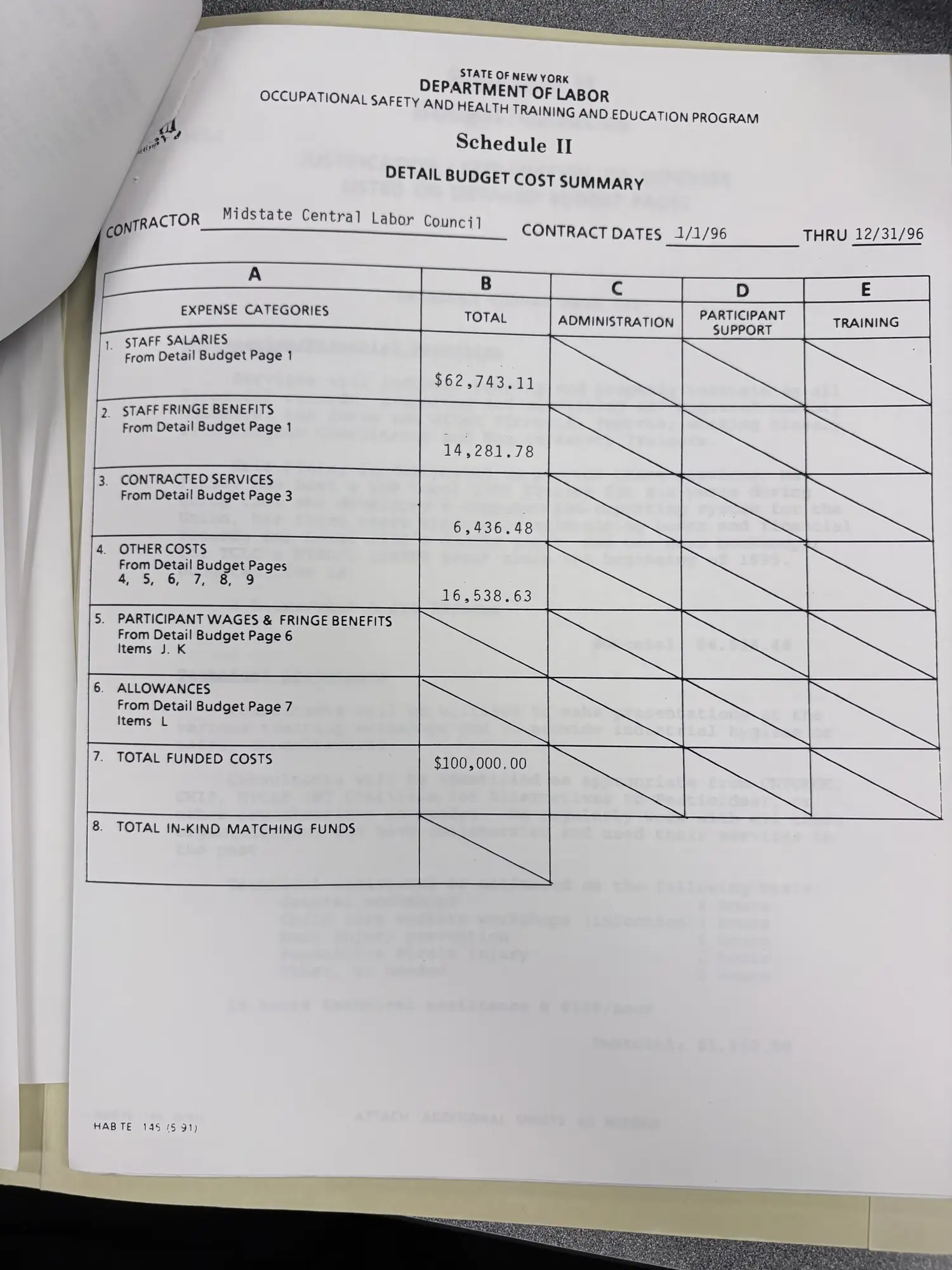
STATE OF NEW YORK
DEPARTMENT OF LA
i BOR
OCCUPATIONAL SAFETY AND HEALTH TRAINING AND EDUCATION PROGRAM

Ag Schedule II

DETAIL BUDGET COST SUMMARY

Midstate Central L i

EXPENSE CATEGORIES

TOTAL ADMINISTRATION | PARTICIPANT TRAINING

SUPPORT
| STAFF SALARIES

From Detail Budget Page 1 :
$62,743.11

2. STAFF FRINGE BENEFITS
From Detail Budget Page 1

14,281.78

3. CONTRACTED SERVICES
From Detail Budget Page 3

6,436.48

pies
were

4. OTHER COSTS
From Detail Budget Pages
4, Ups 3a)

6538.63

5. PARTICIPANT WAGES & FRINGE BENEFITS
From Detail Budget Page 6
Items J. K

6. ALLOWANCES

From Detail Budget Page 7
Items L

7. TOTAL FUNDED COSTS $100,000.00

8. TOTAL IN-KIND MATCHING FUNDS

HABTE 145 (5 91)
 (open zoom view)
Read the page text (machine-read, mostly readable)
This text was generated automatically from the photograph and has not been corrected. The image is the authoritative record.
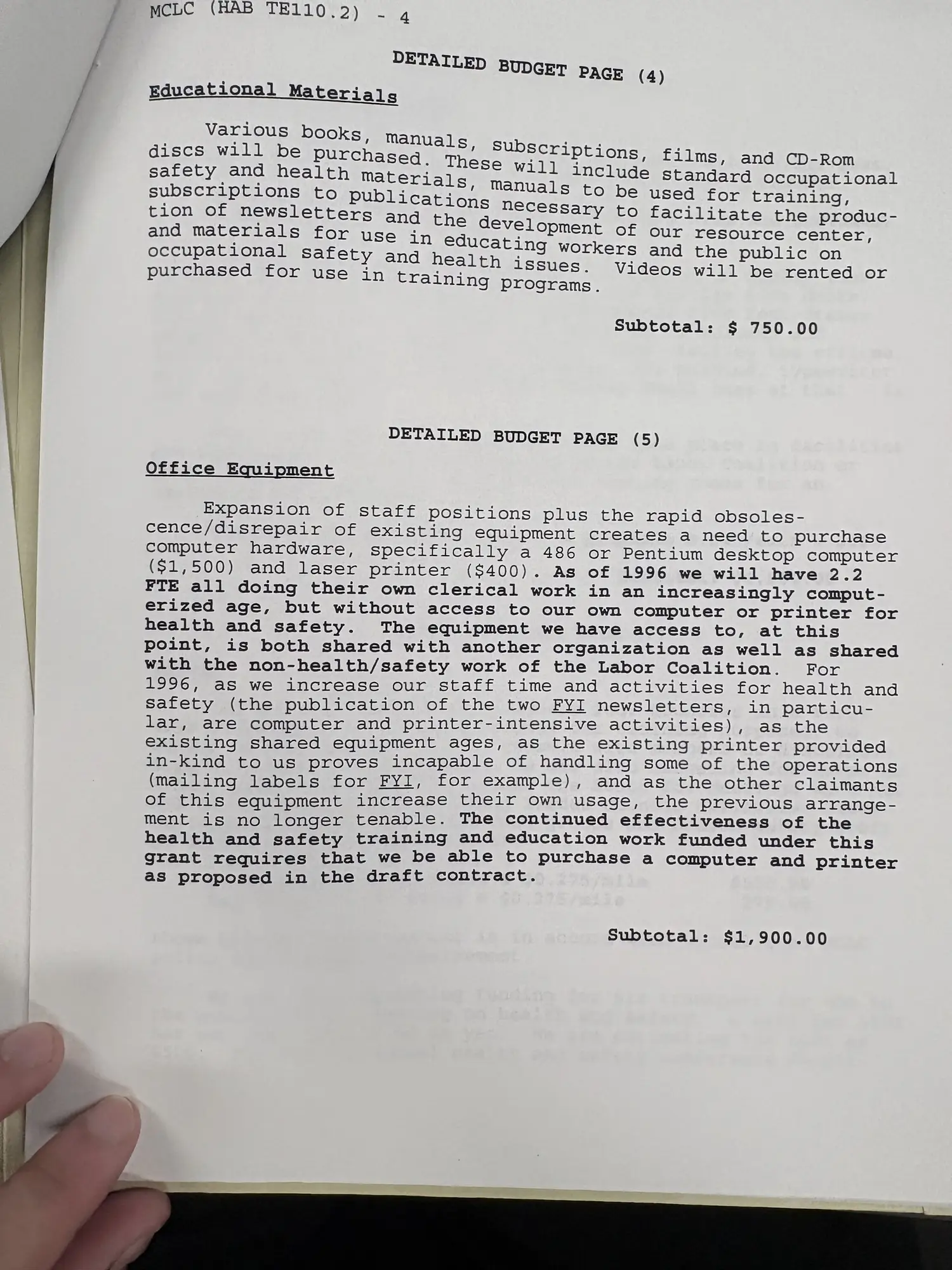
MCLC (HAB TE110.2) - 4

DETAILED BUDGET PAGE (4)
Educational Materials

Various boo
discs will be purchased. he, ,Subscriptions, eee hand CoeRom
SR aan yaa reat materials, maruale’ es Porc endeza Sar ame
s nS to publicati +
tion of newsletters and Ss Cea ees ro facilitate the produc-

occupational safety ing workers and the public on

and health issues. vj i
purchased for use in training programs. te ee

Subtotal: $ 750.00

DETAILED BUDGET PAGE (5)
Office Equipment

Expansion of staff positions plus the rapid obsoles-
cence/disrepair of existing equipment creates a need to purchase
computer hardware, specifically a 486 or Pentium desktop computer
($1,500) and laser printer ($400). As of 1996 we will have 2.2
FTE all doing their own clerical work in an increasingly comput-
erized age, but without access to our own computer or printer for
health and safety. The equipment we have access to, at this
point, is both shared with another organization as well as shared
with the non-health/safety work of the Labor Coalition. For
1996, as we increase our staff time and activities for health and
safety (the publication of the two FYI newsletters, in particu-
lar, are computer and printer-intensive activities), as the
existing shared equipment ages, as the existing printer provided
in-kind to us proves incapable of handling some of the operations
(mailing labels for FYI, for example) , and as the other claimants
of this equipment increase their Own usage, the previous arrange-
Ment is no longer tenable. The continued effectiveness of the
health and safety training and education work funded under this
grant requires that we be able to purchase a computer and printer
as proposed in the draft contract.

Subtotal: $1,900.00
 (open zoom view)
Read the page text (machine-read, mostly readable)
This text was generated automatically from the photograph and has not been corrected. The image is the authoritative record.
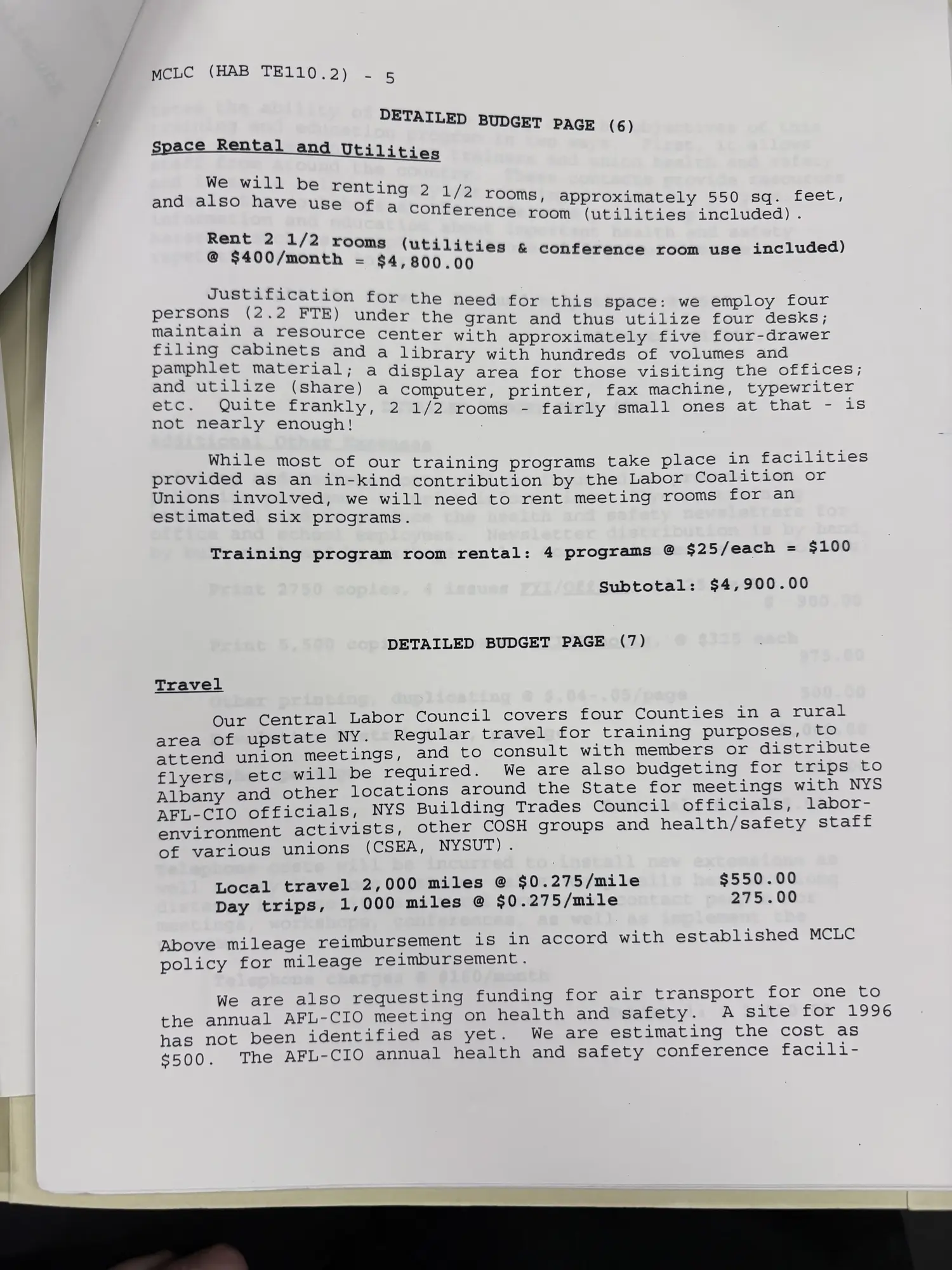
MCLC (HAB TE110.2) - «

DETAILED BUDGET PAGE (6)
Space Rental and Utilities

and also have use peace 2 1/2 rooms, approximately 550 sq. feet,
a conference room (utilities included) .

Rent 2 1/2 rooms creer
@ $400/month - pai 56 Sane & conference room use included)

Justification for the need f

persons (2.2 FTE) or this space: we employ four

s enteicis PhbaCeeu oe, the grant and thus utilize four desks;

Filing MebIneLS and center with approximately five four-drawer

pamphiet “ae kee a library with hundreds of volumes and

SyACSE LAL ee walk ; a display area for those visiting the offices;
share) a computer, printer, fax machine, typewriter

etc. Quite frankly, 2 1/2 - o
So Sh ee yf ele fairly small ones at that is

While most of our training programs take place in facilities
provided as an in-kind contribution by the Labor Coalition or
Unions involved, we will need to rent meeting rooms for an
estimated six programs.

Training program room rental: 4 programs @ $25/each = $100

Subtotal: $4,900.00

DETAILED BUDGET PAGE (7)

Travel

Our Central Labor Council covers four Counties in a rural
area of upstate NY. Regular travel for training purposes, to
attend union meetings, and to consult with members or distribute
flyers, etc will be required. We are also budgeting for trips to
Albany and other locations around the State for meetings with NYS
AFL-CIO officials, NYS Building Trades Council officials, labor-
environment activists, other COSH groups and health/safety staff
of various unions (CSEA, NYSUT) .

Local travel 2,000 miles @ $0.275/mile $550.00
Day trips, 1,000 miles @ $0.275/mile 275.00

Above mileage reimbursement is in accord with established MCLC
policy for mileage reimbursement .

We are also requesting funding for air transport fOr One eo
the annual AFL-CIO meeting on health and safety. A site for 1996
has not been identified as yet. We are estimating the cost as
$500. The AFL-CIO annual health and safety conference facili-
See something wrong, or recognize a person or event? Send a correction. If you hold rights in this item or think it should not be public, write to the same address.