Report, 1 page
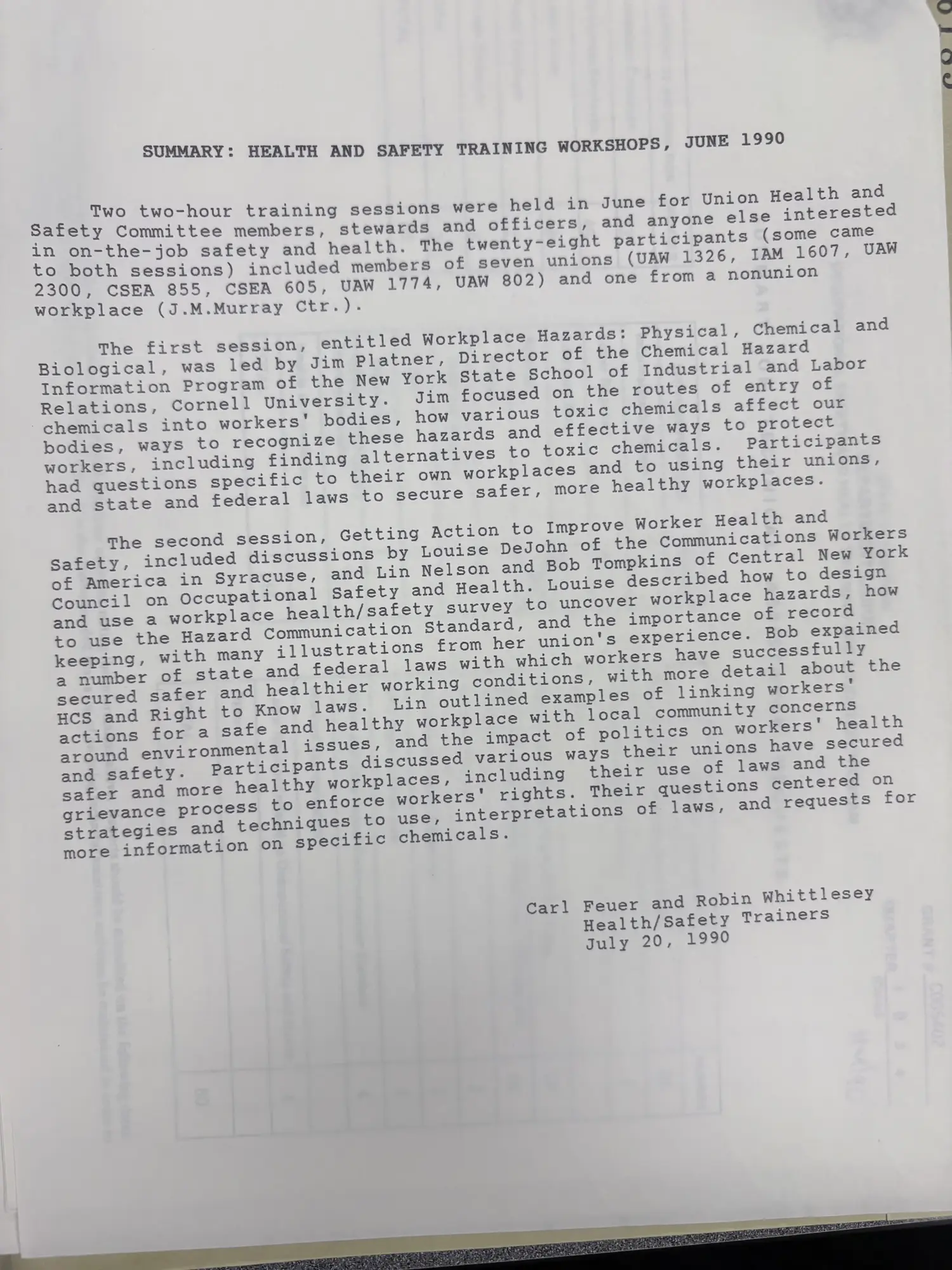
Summary of health and safety training workshops, June 1990
July 20, 1990
Carl Feuer and Robin Whittlesey report on two June workshops for union health and safety committee members, stewards, and officers: “Workplace Hazards: Physical, Chemical and Biological,” led by Jim Platner of Cornell's Chemical Hazard Information Program, and “Getting Action to Improve Worker Health and Safety.” Twenty-eight people from seven unions and one nonunion workplace took part.
Download or cite this itemPages
 (open zoom view)
Read the page text (machine-read, mostly readable)
This text was generated automatically from the photograph and has not been corrected. The image is the authoritative record.
SUMMARY: HEALTH AND SAFETY TRAINING WORKSHOPS, JUNE 1990

Safet en two hour training sessions were held in June for Union Health and
y Committee members, stewards and officers, and anyone else interested

in on-the-job safety and health. The twenty-eight participants (some came

to both sessions) included members of seven unions (UAW 1326, IAM 1607, UAW

2300, CSEA 855, CSEA 605, UAW 1774, UAW 802) and one from a nonunion
workplace (J.M.Murray Ctr.).

The first session, entitled Workplace Hazards: Physical, Chemical and
Biological, was led by Jim Platner, Director of the Chemical Hazard
Information Program of the New York State School of Industrial and Labor
Relations, Cornell University. Jim focused on the routes of entry of
chemicals into workers' bodies, how various toxic chemicals affect our
bodies, ways to recognize these hazards and effective ways to protect
workers, including finding alternatives to toxic chemicals. Participants
had questions specific to their own workplaces and to using their unions,
and state and federal laws to secure safer, more healthy workplaces.

The second session, Getting Action to Improve Worker Health and
Safety, included discussions by Louise DeJohn of the Communications Workers
of America in Syracuse, and Lin Nelson and Bob Tompkins of Central New York
Council on Occupational Safety and Health. Louise described how to design
and use 2 workplace health/safety survey to uncover workplace hazards, how
to use the Hazard Communication Standard, and the importance of record
keeping, with many illustrations from her union's experience. Bob expained
a number of state and federal laws with which workers have successfully
secured safer and healthier working conditions, with more detail about the
HCcS and Right to Know laws. Lin outlined examples of linking workers'
actions for a safe and healthy workplace with local community concerns
around environmental issues, and the impact of politics on workers’ health
and safety. Participants discussed various ways their unions have secured
safer and more healthy workplaces, including their use of laws and the
grievance process to enforce workers’ rights. Their questions centered on
strategies and techniques to use, interpretations of laws, and requests for
more information on specific chemicals.

Carl Feuer and Robin Whittlesey
Health/Safety Trainers
July 20, 1990
See something wrong, or recognize a person or event? Send a correction. If you hold rights in this item or think it should not be public, write to the same address.