Newsletter, 1 page
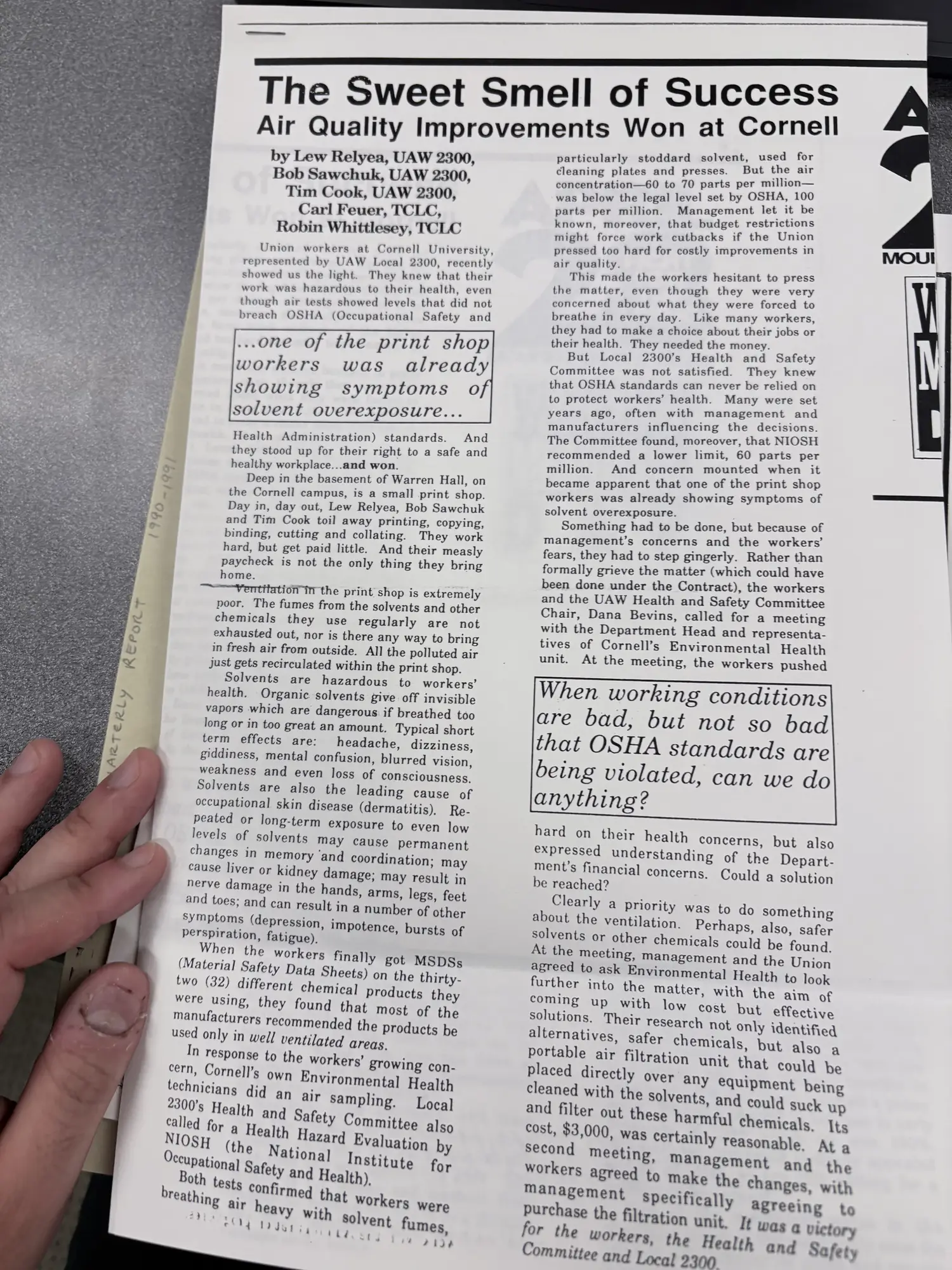
“The Sweet Smell of Success: Air Quality Improvements Won at Cornell”
[c. 1990–1991]Approximate date
UAW Local 2300 members in Cornell University's print shop knew the solvents they worked with were making them sick, even though air tests stayed under OSHA limits. Through their health and safety committee they won a $3,000 portable air filtration unit and other changes. Written by three Local 2300 members with the Coalition's trainers.
A second photograph of this page is not shown.
Download or cite this itemPages
 (open zoom view)
Read the page text (machine-read, mostly readable)
This text was generated automatically from the photograph and has not been corrected. The image is the authoritative record.
by Lew Relyea, UAW 2300,
Bob Sawchuk, UAW 2300,
Tim Cook, UAW 2300,
Carl Feuer, TCLC,
Robin Whittlesey, TCLC

Union workers at Cornell University,
represented by UAW Local 2300, recently
showed us the light. They knew that their
work was hazardous to their health, even

though air tests showed levels that did not
breach OSHA (Occupational Safety and

...one of the print shop
workers was already
showing symptoms o
solvent overexposure...

Health Administration) standards. And
they stood up for their right to a safe and
healthy workplace...and won.

Deep in the basement of Warren Hall, on
the Cornell campus, is a small print shop.
Day in, day out, Lew Relyea, Bob Sawchuk
and Tim Cook toil away printing, copying,
binding, cutting and collating. They work
hard, but get paid little. And their measly
paycheck is not the only thing they bring

home.
—~—-Yerrtitation in the print shop is extremely
poor. The fumes from the solvents and other
chemicals they use regularly are not
exhausted out, nor is there any way to bring
in fresh air from outside. All the polluted air
just gets recirculated within the print shop.
Solvents are hazardous to workers’
health. Organic solvents give off invisible
vapors which are dangerous if breathed too
long or in too great an amount. Typical short
term effects are: headache, dizziness,
giddiness, mental confusion, blurred vision,
weakness and even loss of consciousness,
Solvents are also the leading cause of
occupational skin disease (dermatitis). Re-
peated or long-term exposure to even low
levels of solvents may cause permanent
changes in memory ‘and coordination; may
cause liver or kidney damage; may result in
in the hands, arms, legs, feet
; and can result in a number of other
symptoms (depression, impotence, bursts of
perspiration, fatigue),
When the worker,

é 8 finally got MSDSs
(Material Safety Data Sheets) on the thirty-

two (32) different chemical products they
were using, they found that most of the
manufacturers recommended the products be
used only in wel] ventilated areas.

In response to the workers’ growing con-
cern, Cornell's own Environmental Health
technicians did an air Sampling. Local

The Sweet Smell of Success
Air Quality Improvements Won at Cornell

icularly stoddard solvent, used for
mepcr slated and presses. But the air
concentration—60 to 70 parts per million—
was below the legal level set by OSHA, 100
parts per million. Management let it be
known, moreover, that budget restrictions
might force work cutbacks if the Union
pressed too hard for costly improvements in
air quality.

This made the workers hesitant to press
the matter, even though they were very
concerned about what they were forced to
breathe in every day. Like many workers,
they had to make a choice about their jobs or
their health. They needed the money.

But Local 2300’s Health and Safety
Committee was not satisfied. They knew
that OSHA standards can never be relied on
to protect workers’ health. Many were set
years ago, often with management and
manufacturers influencing the decisions.
The Committee found, moreover, that NIOSH
recommended a lower limit, 60 parts per
million. And concern mounted when it
became apparent that one of the print shop
workers was already showing symptoms of
solvent overexposure. :

Something had to be done, but because of
Management’s concerns and the workers’
fears, they had to step gingerly. Rather than
formally grieve the matter (which could have
been done under the Contract), the workers
and the UAW Health and Safety Committee
Chair, Dana Bevins, called for a meeting
with the Department Head and representa-
tives of Cornell’s Environmental Health
unit. At the meeting, the workers pushed

When working conditions
are bad, but not so bad
that OSHA standards are

being violated, can we do
anything?

hard on their health concerns, but also
expressed understanding of the Depart-
ment’s financial concerns. Could a solution
be reached?

Clearly a Priority was to do something
about the ventilation. Perhaps, also, safer
solvents or other chemicals could be found.
At the meeting, management and the Union
agreed to ask Environmental Health to look
further into the matter, with the aim of
pomune upywith: lows cost but effective
solutions. Their research not only identified
alternatives, safer chemicals, but also a
portable air filtration unit that could be
placed directly over any equipment being
cleaned with the solvents, and could suck up
and filter out these harmful chemicals, Its
Cost, $3,000, was certainly Teasonable. At a
second meeting, Management and the
Workers agreed to make the changes, with

Was a victory

for the workers, the Health and Safety

Committee and Local 2300
See something wrong, or recognize a person or event? Send a correction. If you hold rights in this item or think it should not be public, write to the same address.