Newsletter, 1 page
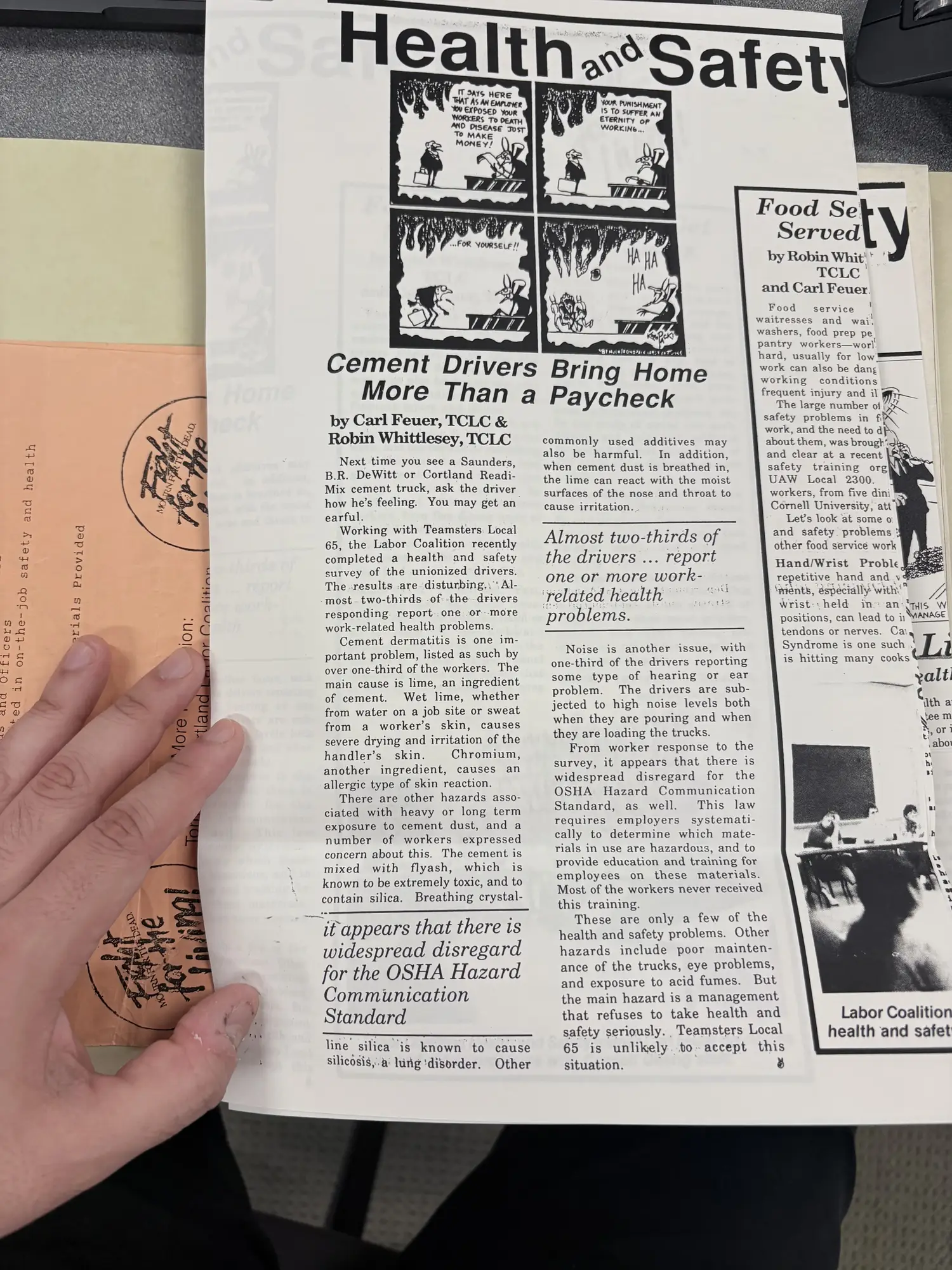
“Cement Drivers Bring Home More Than a Paycheck”
[c. 1990–1991]Approximate date
A Health and Safety page article on a survey with Teamsters Local 65 of drivers for two Cortland-area cement companies, describing cement dermatitis, dust, and other hazards they face.
Clipped from a labor newspaper page; the Coalition's annual reports say The Working Press carried a regular Health and Safety page.
Download or cite this itemPages
 (open zoom view)
Read the page text (machine-read, mostly readable)
This text was generated automatically from the photograph and has not been corrected. The image is the authoritative record.
oe)
4H >
a uu q
toad +
D1 pe
2 J
SO we
o ‘oy

Cement Drivers Bring Home

More Than a

by Carl Feuer, TCLC &
Robin Whittlesey, TCLC

Next time you see a Saunders,
B.R. DeWitt or Cortland Readi-
Mix cement truck, ask the driver
how he’s feeling. You may get an
earful.

Working with Teamsters. Local
65, the Labor Coalition recently
completed a health and safety
survey of the unionized drivers.
The «results are disturbing.,‘ Al-
most two-thirds -of. the drivers
responding. report one or more
work-related health problems.

Cement dermatitis is one im-
portant problem, listed as such by
over one-third of the workers. The
main cause is lime, an ingredient
of cement. Wet lime, whether
from water on a job site or sweat
from a worker’s skin, causes
severe drying and irritation of the
handler’s skin. Chromium,
another ingredient, causes an
allergic type of skin reaction.

There are other hazards asso-
ciated with heavy or long term
exposure to cement dust, and a
number of workers expressed
concern about this. The cement is
mixed with flyash, which is
known to be extremely toxic, and to
contain silica. Breathing crystal-

it appears that there is
widespread disregard
for the OSHA Hazard
Communication
Standard

line” silica is known to cause
silicosis, lung ‘disorder. Other

by Robin Whit'' '

TCLE}
and Carl Feuer.
Food service

waitresses and wai!
washers, food prep pe
pantry workers—worl
hard, usually for bw ==
work can also be dang
working conditions
frequent injury and il #fFy}—_
The large number ot Re
safety problems in fi
work, and the need to apy
about them, was brough’
and clear at a recent
safety training org
UAW Local 2300.
workers, from five dini
Cornell University, att’
Let’s look at some o
and safety. problems 3
other food service work

Hand/Wrist Proble |
repetitive hand and vy
\adents, especially: with”
wrist: held in
positions, can lead to ii

SBI Mute [tous tre uHet ps Toet

Paycheck

commonly used additives may
also be harmful. In addition,
when cement dust is breathed in,
the lime can react with the moist
surfaces of the nose and throat to
cause irritation.

Almost two-thirds of
the drivers ... report
one or more work-
related health
problems.

asl

an: ZA
THIS W
ANAGE

tendons or nerves. Caiy q
Syndrome is one such . ] 1
is hitting many cooks A

Noise is another issue, with
one-third of the drivers reporting

some type of hearing or ear yalt!
problem. The drivers are sub- TES ¢
jected to high noise levels both ‘ith a
when they are pouring and when yeem
they are loading the trucks. he or i
abo

From worker response to the
survey, it appears that there is
widespread disregard for the
OSHA Hazard Communication
Standard, as well. This law
requires employers systemati-
cally to determine which mate-
rials in use are hazardous, and to
provide education and training for
employees on these materials.
Most of the workers never received
this training.

These are only a few of the
health and safety problems. Other
hazards include poor mainten-
ance of the trucks, eye problems,
and exposure to acid fumes. But
the main hazard is a management

that refuses to take health and
safety seriously. Teamsters Local
65 is unlikely.to-accept this

situation. &

Labor Coalition
health and safet
See something wrong, or recognize a person or event? Send a correction. If you hold rights in this item or think it should not be public, write to the same address.