Report, 6 pages
Health and Safety Program annual report, 1990–1991
[1991]Date inferred
The program's year: back injury prevention clinics with CSEA Local 605, the Ithaca school district employees, APWU Local 1151, and UAW Local 2300; work with union health and safety committees at Monarch Machine Tool, Pall Trinity, and Brewer-Titchener; workshops and conferences; the FYI newsletter for office workers; information and referral; the first Workers Memorial Day events after Charlie Streeter's death on the job; and help for Ithaca College office workers made ill at work.
Download or cite this itemPages
 (open zoom view)
Read the page text (machine-read, mostly readable)
This text was generated automatically from the photograph and has not been corrected. The image is the authoritative record.
tar? ,

TOMPKINS/CORTLAND LABOR COALITION

109 West State Street, Ithaca, New York 14850 Ph. (607) 277-5670

BOCES Employees
Association

BOCES Teachers Association
Bricklayers Local 17
Carpenters Local 603

Civil Service Employees
Association Local 561

Civil Service Employees
Association Local 605

Civil Service Employees
Association Local 849

Civil Service Employees
Association Local 855

Cornell Security
Employees Union

Cortland United Teachers
Electrical Workers Local 43
Electrical Workers Local 79

Electrical Workers Local 241
Electrical Workers Local 961
Fire Fighters Local 1737
Fire Fighters Local 2737

Ithaca Paraprofessionals
Association

Ithaca School District
Employees Association

Ithaca Teachers Association
Laborers Local 589
Machinists Local 1607
Machinists Local 1608
Musicians Local 132
National Writers Union

Operating Engineers
Local 71 &71A

Operating Engineers
Local 545

Painters Local 178
Plumbers Local 267
Postal Workers Local 1151

ublic Employees Federation
Local 251

Service Employees
Local 200A

Sheetmetal Workers
Local 112

TCCC Faculty Association
Teamsters Local 65

United Auto Workers
Local 802

United Auto Workers
Local 1326

United Auto Workers
Local 1774

United Auto Workers
Local 2300

United Food and
* Commercial Workers
Local 1

United Steel Workers of
America Local 12460

United University
Professions

TOMPKINS/CORTLAND LABOR COAL!TION
HEALTH AND SAFETY PROGRAM
NOSU=aie Ss 1

ANNUAL REPORT,

Back Injury Prevention Clinics

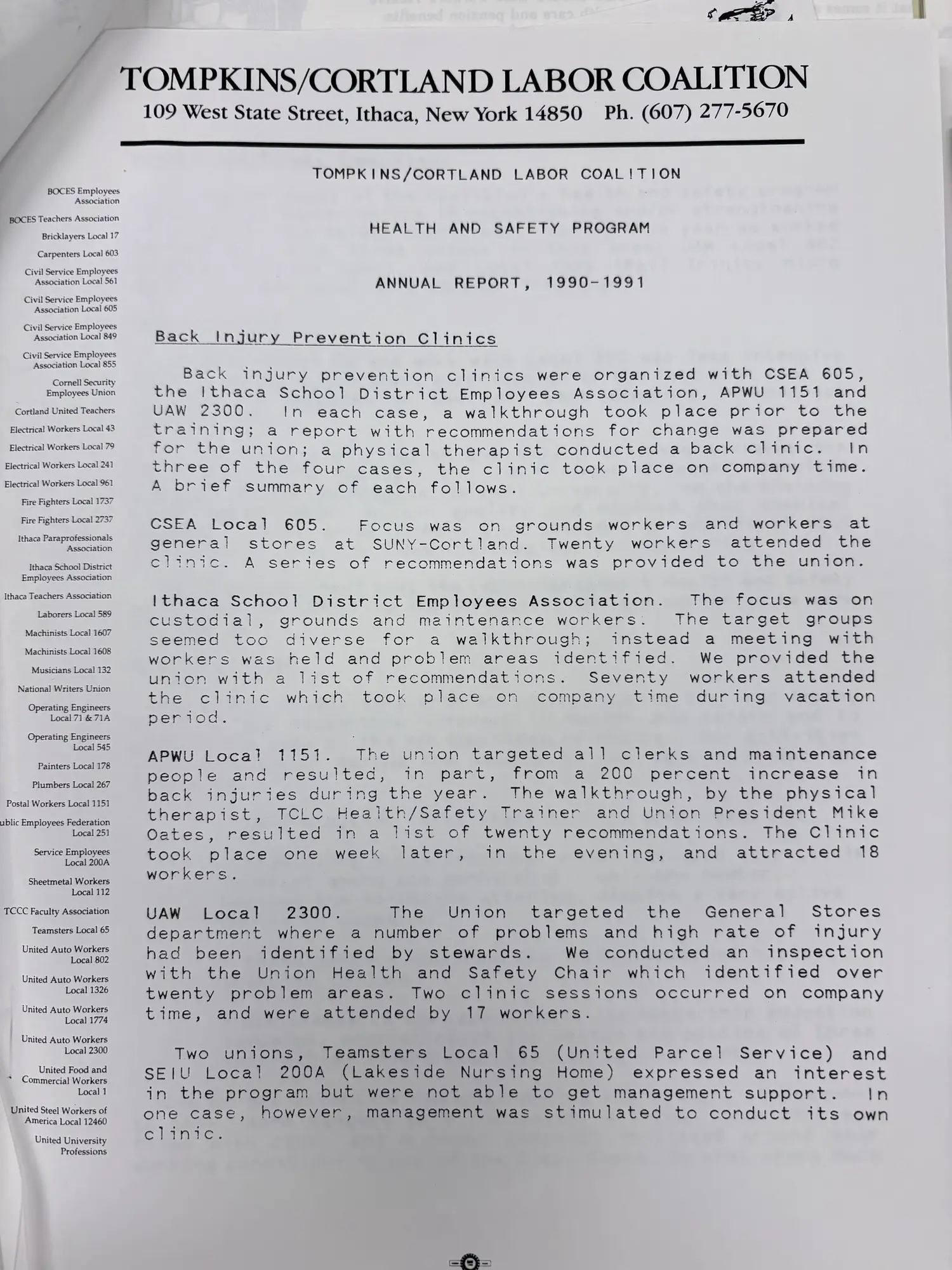
Back injury prevention clinics were organized with CSEA 605,
the Ithaca School District Employees Association, APWU 1151 and
UAW 2300. In each case, a walkthrough took place prior to the
training; a report with recommendations for change was prepared
for the union; a physical therapist conducted a back clinic. In
three of the four cases, the clinic took place on company time.
A brief summary of each follows.

CSEA Local 605. Focus was on grounds workers and workers at
general stores at SUNY-Cortland. Twenty workers attended the
clinic. A series of recommendations was provided to the union.

Ithaca School District Employees Association. The focus was on
custodial, grounds and maintenance workers. Tne target groups
seemed too diverse for a walkthrough; instead a meeting with
workers was held and problem areas identified. We provided the
union with a list of recommendations. Seventy workers attended

the clinic which took place on company time during vacation
period.
APWU Local 1151. The union targeted all clerks and maintenance

from a 200 percent increase in
The walkthrough, by the physical
therapist, TCLC, Health/Safety [raimer and Union President Mike
Oates, resulted in a list of twenty recommendations. The Clinic
took place one week later, in the evening, and attracted 18

workers.

people and resulted, in part,
back injuries during the year.

UAW Local 2300. The Union targeted the General Stores
department where a number of problems and high rate of injury
had been identified by stewards. We conducted an inspection
with the Union Health and Safety Chair which identified over
twenty problem areas. Two clinic sessions occurred on company
time, and were attended by 17 workers.

Two unions, Teamsters Local 65 (United Parcel Service) and
SEIU Local 200A (Lakeside Nursing Home) expressed an interest
in the program but were not able to get management support. In
one case, however, management was stimulated to conduct its own

C liamice
 (open zoom view)
Read the page text (machine-read, mostly readable)
This text was generated automatically from the photograph and has not been corrected. The image is the authoritative record.
Health and Safety Committees

_ An ongoing focus of the Coalition's health and safety program
1s to assist member unions in establishing and/or strengthening
Union Health and Safety Committees. During this year we worked
Particularly with three unions in this area: UAW Local 802
(Monarch Machine Tool), UAW Local 1326 (Pall Trinity Micro
Corp.) and UAW Local 1774 (Brewer Titchener).

UAW Local 802

Our assistance to and work with Local 802 was less intensive
than in the previous year, a reflection of the fact that most of

the Local's energies in the Fall were absorbed in contract
negotiations.

We did organize a health and safety training workshop for
Local S02 Gn the Spring. Dr. Jim Platner, Director, Chemical
Hazard Information Program, Cornell University, led the training
which concentrated on air quality and machine shop chemical
hazards. Three union members also attended an additional TcLc
training in June, on industrial hygiene air monitoring.

Union members feel that the Labor-Management Health and Safety
Committee is responsive and effective, and are satisfied to work
Pamough at.

UAW Local 1326

We worked extensively with this Local during the year trying
to stimulate membership interest in health and safety and to
Support the work of the H/S Committee co-chairs. Our activities
With this, local duringethe coursesiotethe year included the
following:

Bepateid Ca pation neatmaleast cq x h/s comm. meetings

- organizing a h/s training, which elicited very little
interest among the membership - only one member,
besides the co-chairs attended, despite a very active
publicity campaign

~ three members attended the TCLC industrial hygiene
teaini noe ne dune

- assistance to the committee in its membership education
campaign, consisting of the design and posting of three
information flyers over the course of 4 months

One of the co-chairs resigned during the winter. Subsequent
to this, more members were recruited, a formal complaint was
filed with OSHA, and a major campaign initiated around poor
working conditions in one of the Clean Rooms, an area where more
 (open zoom view)
Read the page text (machine-read, mostly readable)
This text was generated automatically from the photograph and has not been corrected. The image is the authoritative record.
than 60 of the 300 plus workforce works.

UAW Local 1774

; Local 1774 represents about 200 workers in an older drop
orge plant, recently taken over by Cooper Industries. A newly
formed health and safety committee had requested our assistance,

and we began working with it for the LIPSt ime during this
fiscal year.

During the course of the year, we:

helped the local develop, distribute and analyze a
health and safety survey;

assisted and provided training for committee members on
a number of occasions;

developed an OSHA inspection form for the committee to
use;

organized a training workshop on air quality and chemical

hazards in the forge industry with Dr. Jim Platner as
trainer and 25 workers in attendance.

Workshops and Conferences

UAW Local 2300, Food Service workers (August) - 17 workers from
five dining units on the Cornell University campus participated.
The workshop focused on identifying the health and safety
hazards these workers face and Jcomsidering how they and the
union could deal with them. in addition, various hazards,
particularly hand/wrist problems were deait with in some detail.

CSEA Local 605, Office Workers (January) - 25 workers at SUNY-
Cortland attended this workshop presented by Nona McQuay of the
Chemical] Hazard Information Program. The main topics covered
were ergonomics and air quality.

UAW Local 1774, Forge Industry workers (March) - 25 workers at
Brewer-Titchener attended this training conducted by Jim
Platner. lt focused on air quality and chemical hazards in the
forge industry.

Hazards of Pesticides in the Workplace (March) - 30 attended
this half-day training conference put on by the NY Coalition for
Alternatives to Pesticides, in conjunction with the TCLC.

UAW Local 802, Machine Tool workers (April) - 8 workers attended
this training condueteceepy= Jim Platner focusing on diesel
exhaust, coolants and other hazards affecting machine tool
 (open zoom view)
Read the page text (machine-read, mostly readable)
This text was generated automatically from the photograph and has not been corrected. The image is the authoritative record.
workers.

Air Quality Monitor

ing: Playing Ind trial i i
17 workers atkene g ustrial Hygiene to Win (June)
ein ed th Ws oS,
Greg Siwinsk, ineUstr sete training conference facilitated by

; Hygieni é
Health Clinical Center ygienist with the CNY Occupational

FY!, A Health and Safety Newsletter for Office Workers was
published on a quarterly basis, with circulation rising to more
Sasa. vUy by the Final issue. The newsletter has been
extremely well received; we are frequently contacted by
individuals wanting to be added to the mailing list and have
gotten positive feedback from those already receiving it.

Though staff contribute the bulk of the effort in producing
FY! (primarily collecting information, writing and layout), a
number of other office workers and supporters participate as
well. We hope to elicit greater involvement from these people.

information and Referral

DimamG the course of the year, the Health/Safety trainers

dealt with approximately 76 unsolicited requests for
information, ranging from workers compensation issues £6
concerns about specific chemicals in the workplace. We were

Siieeto satisfy most of these requests, either over the phone
or by sending literature. Our resource center continues to grow,
and is more than adequate for most requests for information.

One request for assistance, involving air quality problems at
South Hill School in Ithaca, necessitated more extensive
involvement. Staff helped draft a health survey which was

distributed to parents and teachers and attended a staff-parent
meeting.

The Working Press continued to feature a "Health and Safety
Page" with articles and other items pertinent to worker safety.

Workers Memorial Day

This year was the first that the Labor Coalition decided to
commemorate Workers Memorial Day with a series of events.

Charlie Streeter'’s tragic death in November energized much of
our activity around this day, Sunday April 28th.

1) We co-sponsored a benefit brunch Sunday morning at Moosewood
Restaurant. This was a joint labor-environment event with the
bulk of the proceeds going toward the third statewide labor and
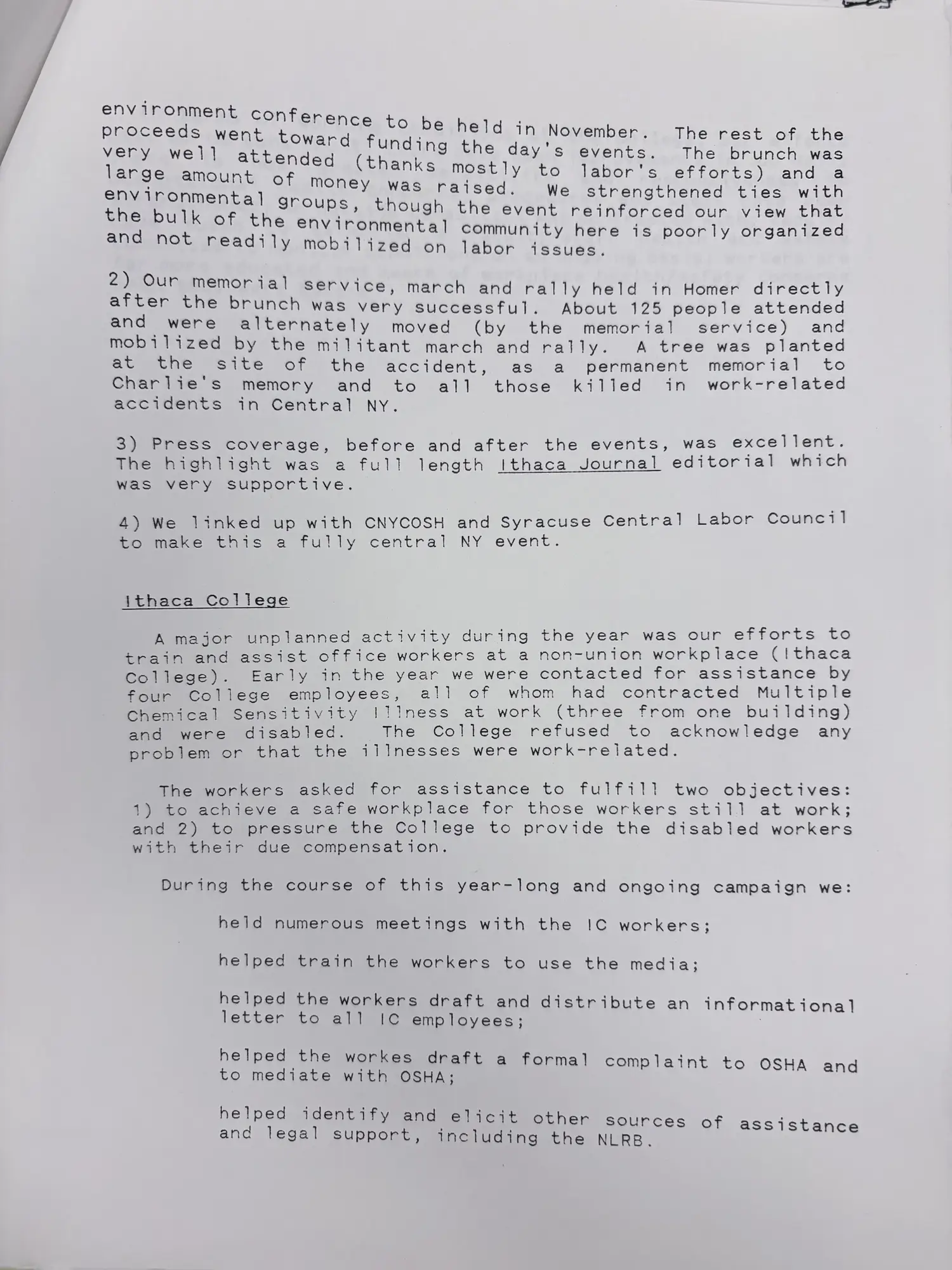 (open zoom view)
Read the page text (machine-read, mostly readable)
This text was generated automatically from the photograph and has not been corrected. The image is the authoritative record.
env ironme

onee eee See ebence to be held in November. The rest of the

vere WW ward funding the day's events. The brunch was
KS attended (thanks mostly to

large amount of mone

labor's efforts) and a
: Y was raised. We strengthened ties with

eh eonmental groups, thougt .
the bulk of the Ben EA ugh the event reinforced our view that

ronmental community here is poorly organized
and not readily mobilized on labor issues.

2) Our memorial service, march and rally held in Homer directly
after the brunch was very successful. About 125 people attended
and were alternately moved (by the memorial service) and
mobilized by the militant march and rally. A tree was planted
atvetme Site of the accident, as a permanent memorial to

Charlie's memory and to all those killed in work-related
accidents in Central NY.

3) Press coverage, before and after the events, was excellent.

The highlight was a full length Ithaca Journal editorial which
was very supportive.

4) We linked up with CNYCOSH and Syracuse Central Labor Council
Pommeake cars a fully central NY event.

ithaca College

A major unplanned activity during the year was our efforts to
train and assist office workers at a non-union workplace (ithaca
Gollege). Early in the year we were contacted for assistance by
four College employees, all of whom had contracted Multiple
Chemical Sensitivity |!]]ness at work (three from one building)
and were disabled. The College refused to acknowledge any
problem or that the illnesses were work-related.

The workers asked for assistance to fulfill two objectives:
1) to achieve a safe workplace for those workers stil. at work;

and 2) to pressure the College to provide the disabled workers
with their due compensation.

During the course of this year-long and ongoing campaign we:

held numerous meetings with the IC workers;

helped train the workers to use the media;

helped the workers draft and distribute an

informational
letter to all IC employees;

helped the workes draft a formal complaint to OSHA and
to mediate with OSHA;

helped identify and elicit other sources of assistance
and legal support, including the NLRB.
 (open zoom view)
Read the page text (machine-read, mostly readable)
This text was generated automatically from the photograph and has not been corrected. The image is the authoritative record.
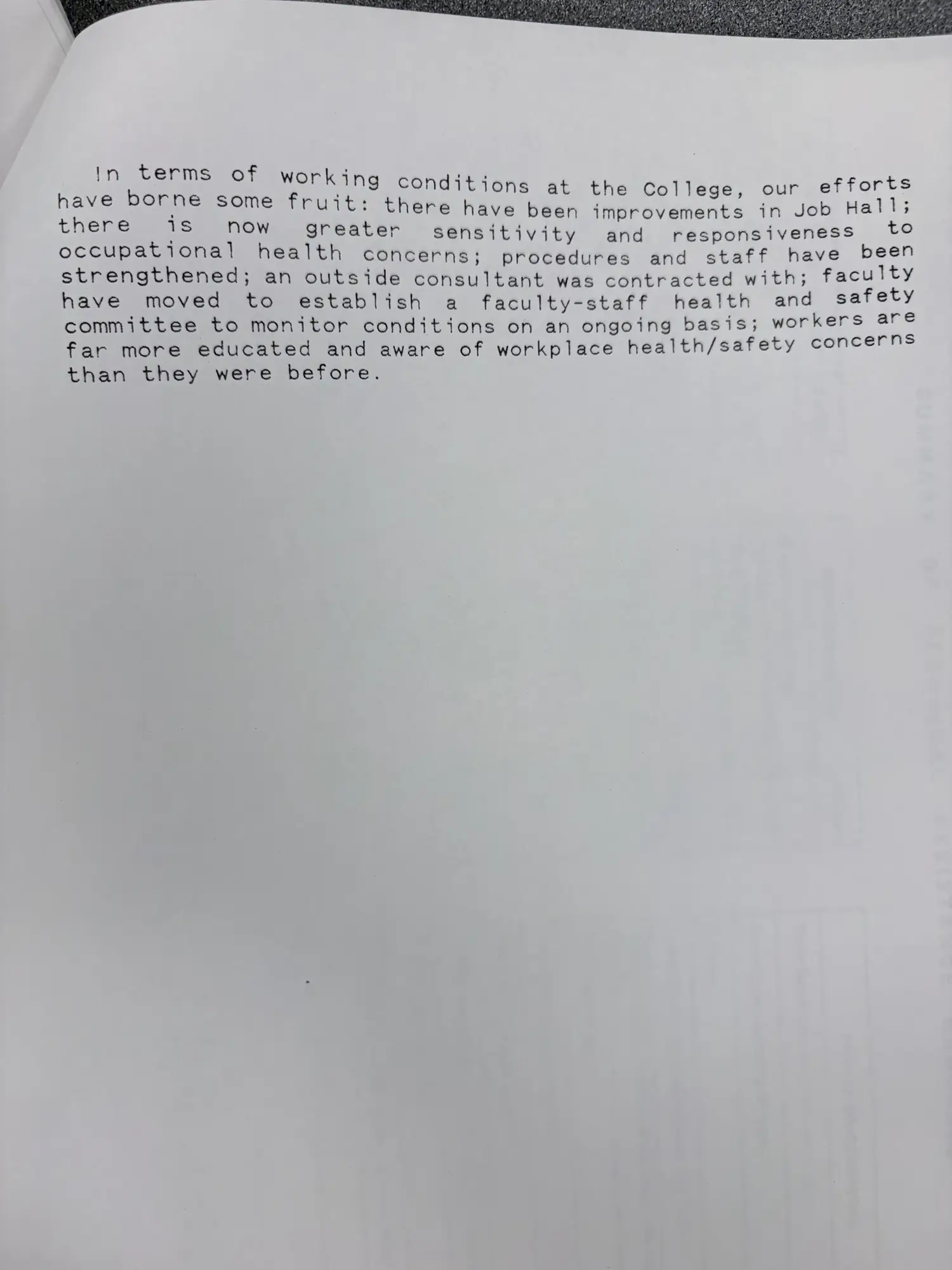
In terms of workin
have borne some fruit:
thepe eas

occupational

9 conditions at the College, our efforts
there have been improvements in Job Hall;
now greater

sensitivity and responsiveness to
health concerns; procedures and staff have been
strengthened; an outside consultant was contracted with; faculty
have moved to establish a faculty-staff health and safety
committee to monitor conditions on an ongoing basis; workers are

far more educated and aware of workplace health/safety concerns
than they were before.
See something wrong, or recognize a person or event? Send a correction. If you hold rights in this item or think it should not be public, write to the same address.