Minutes, 2 pages
Notes from the coalition's February 1986 gathering
[February 1986]Date inferred
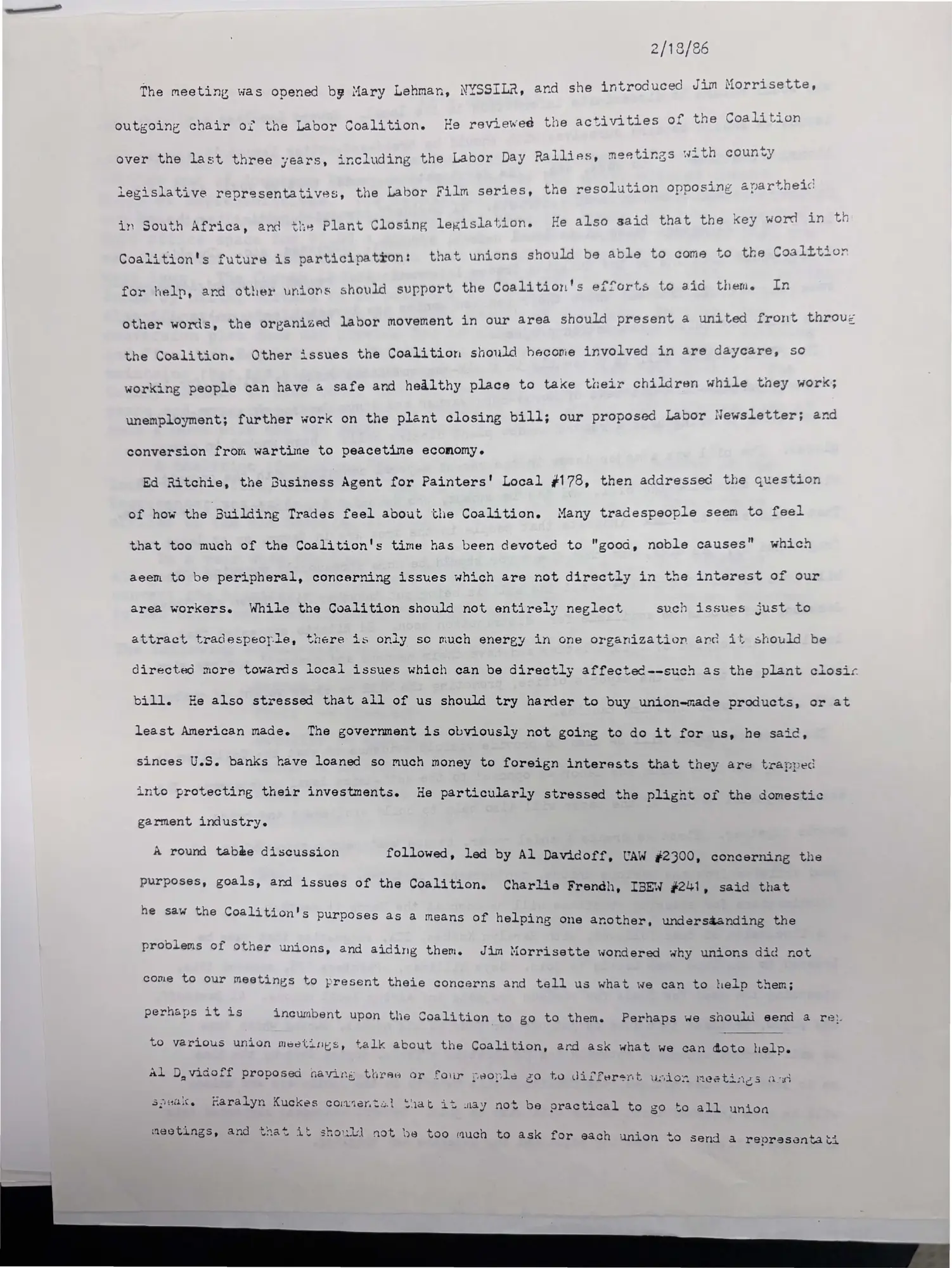
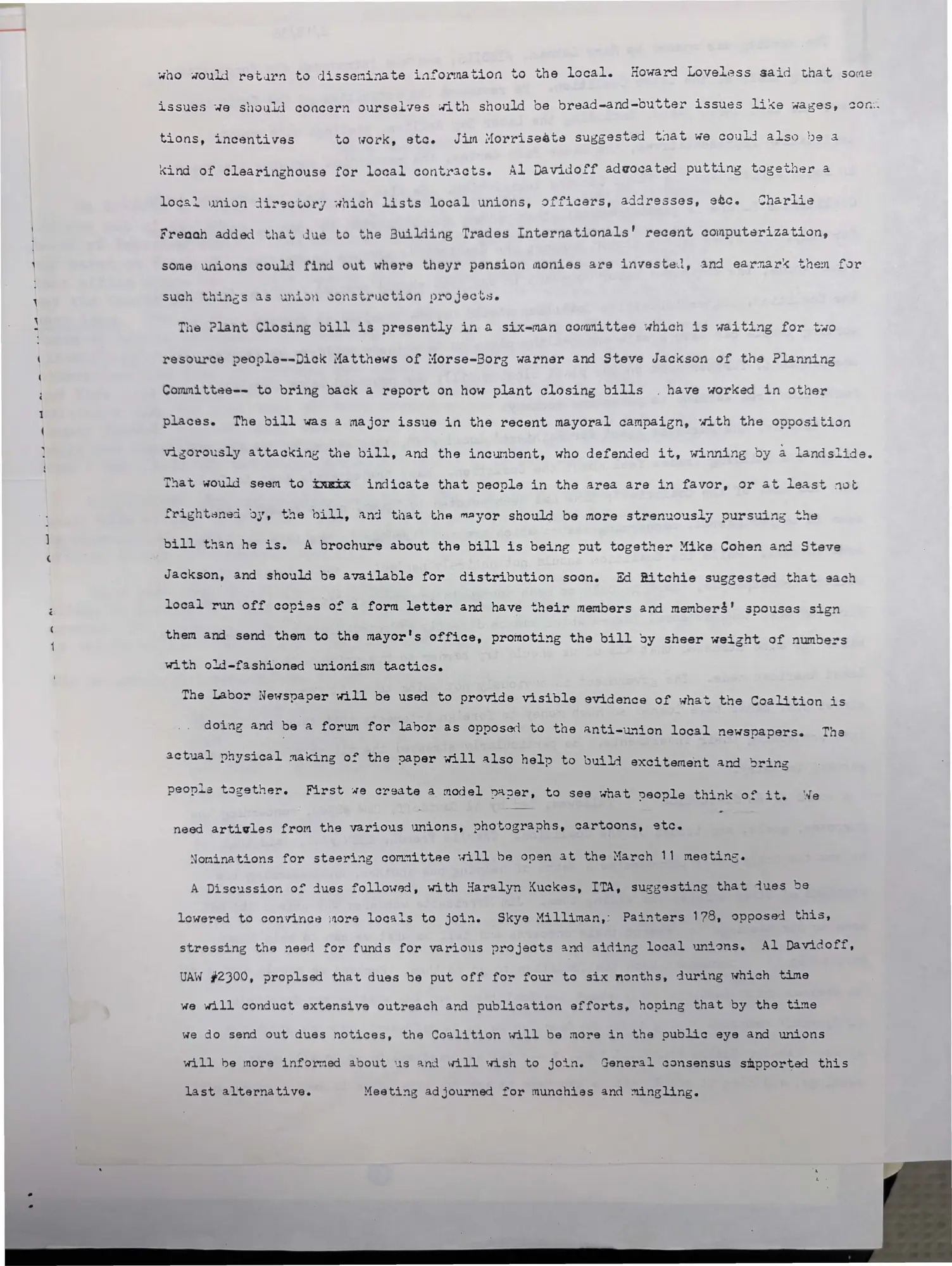
Mary Lehman of NYSSILR opens the meeting. Outgoing chair Jim Morrissette reviews three years of activity, and speakers discuss the Building Trades, a union directory, the plant closing bill, the labor newspaper, and how to strengthen participation.
Download or cite this itemPages
 (open zoom view)
Read the page text (machine-read, mostly readable)
This text was generated automatically from the photograph and has not been corrected. The image is the authoritative record.
The meeting was opened by Mary Lehman, NYSSILR, and she introduced Jim Morrisette,

outgoing chair of the Labor Coalition. He reviewed the activities of tne vo VGiqegt

j : : ates ee ty
over the last three years, including the Labor Day Rallies, meetings w2tn coun)

. ‘ 4 3 aa : Pe 5744 ing anartheid
legislative representatives, the Labor Film series, the resolution opposing é@parthei

, ‘ glee in th
in South Africa, and the Plant Closing legislation. He also said that the key pord 47

718)

Coalition's future is participatron:

that unions should be able to come to the Coalition

: By i is & 4 23 1
for help, and other unions should support the Coalition's efforts to aid them. In

other words, the organized labor movement in our area should present a united front throuz

the Coalition. Other issues the Coalition should hecorie involved in are dayeare, so

working people can have 4 safe and hedlthy place to take tueir children while they work;

unemployment; further work on the plant closing bill; our proposed Labor Newsletter; and

conversion from wartime to peacetime ecomomy.

Ed Ritchie, the Business Agent for Painters’ Local #178, then addressed the question

of how the Building Trades feel about the Coalition. Many tradespeople seem to feel

that too much of the Coalition's time has been devoted to "good, noble causes" which

aeem to be peripheral, concerning issues which are not directly in the interest of our

area workers. While the Coalition should not entirely neglect such issues just to
attract tradespeople, there is oniy so much energy in one organization and it should be
directed more towards local issues which can be directly affected--such as the plant closic
bill. He also stressed that ail of us should try harder to buy union-made

products, or at
least American made.

The government is obviously not going to do it for us, he said,

sinces U.S. banks have loaned so much money to foreign interests that they are trapped

into protecting their investments. He particularly stressed the plignt of the domestic
garment industry.

A round tab@e discussion followed, led by Al Davidoff, UAW #2300, concerning the
purposes, goals, and issues of the Coalition. Charlie Frendh, IBEW #241, said that

he saw the Coalition's purposes as a means of helping one another, undersaanding the

problems of other unions, and aiding them. Jim Morrisette wondered why unions did not

come to our meetings to present theie concerns and tell us what we can to help them;

erhaps it i 4 5 HA a ‘
perhaps it is incumbent upon the Coalition to go to them. Perhaps we should eend a re:

to various union meetings, talk about the Coalition, ard ask what we can doto help.
Al D,vicoff proposed naving three or four people zo

sre ess
SHAK

to different union meetings ace

maralyn Kuckes comiental tiat it way not be

practical to go to all union
meetings, and th

at it should not be too much to ask

for each union to send a reprasentati
 (open zoom view)
Read the page text (machine-read, mostly readable)
This text was generated automatically from the photograph and has not been corrected. The image is the authoritative record.
who would retarn to disseminate information to the local. Howard Loveless said that some

issues we should concern ourselves with should be bread-and-butter issues lixe wages, con:
tions, incentives to work, etc. Jim Morrisedte suggested taat we could also be a

«ind of clearinghouse for local contracts. Al Davidoff adwocated putting together a

local union directory which lists local unions, officers, addresses, etc. Charlie

Frenah added that due to the Building Trades Internationals’ recent computerization,

some unions could find out where theyr pansion monies are investe!, and earnar« them for

such things as union construction projects.
The Plant Closing bill is presently in a six-man committee which is waiting for two

resource people--Dick Matthews of Morse-Borg warner and Steve Jackson of the Planning

Committee-- to bring back a report on how plant closing bills . have worked in other

places. The dill was a major issue in the recent mayoral campaign, with the opposition
vigorously attacking the bill, and the incumbent, who defended it, winning by a landslide.
That would seem to imix indicate that people in the area are in favor, or at least rot
frightsned oy, the bill, and that the mayor should be more strenuously pursuing the
bill than he is. A brochure about the bill is being put together Mike Cohen and Steve

Jackson, and should be available for distribution soon. Ed Ritchie suggested that each

local run off copies of a form letter and have their members and member$' spouses sign

them and send them to the mayor's office, promoting the bill sy sheer weizht of numbers
with old-fashioned unionism tactics.

The Labor Newspaper will be used to provide visible evidence of what the Coalition is

doing and be a forum for labor as opposed to the anti-union local newspapers. The
actual physical making of the vaper will also help to build excitement and bring

people together, First we create a model nanver, to see what people think of it.

need artivgles from the various unions, photographs, cartoons, etc.
Nominations for staering committee will be open at the March 11 meeting.

A Discussion of dues followed, with Haralyn Kuckes, ITA, suggesting that dues be

lowered to convince more locals to join. Skye Milliman, Painters 178, opposed this,

stressing the need for funds for various projects and aiding local mions. Al Davidoff,

UAW #2300, proplsed that dues be put off for four to six months, during which time
we will conduct extensive outreach and publication efforts, hoping that by the time

we do send out dues notices, the Coalition will be more in the public eye and unions

will be more informed about us and will wish to join. General consensus shpported this
last alternative.

Meeting adjourned for munchies and mingling.
See something wrong, or recognize a person or event? Send a correction. If you hold rights in this item or think it should not be public, write to the same address.