Newsletter, 2 pages
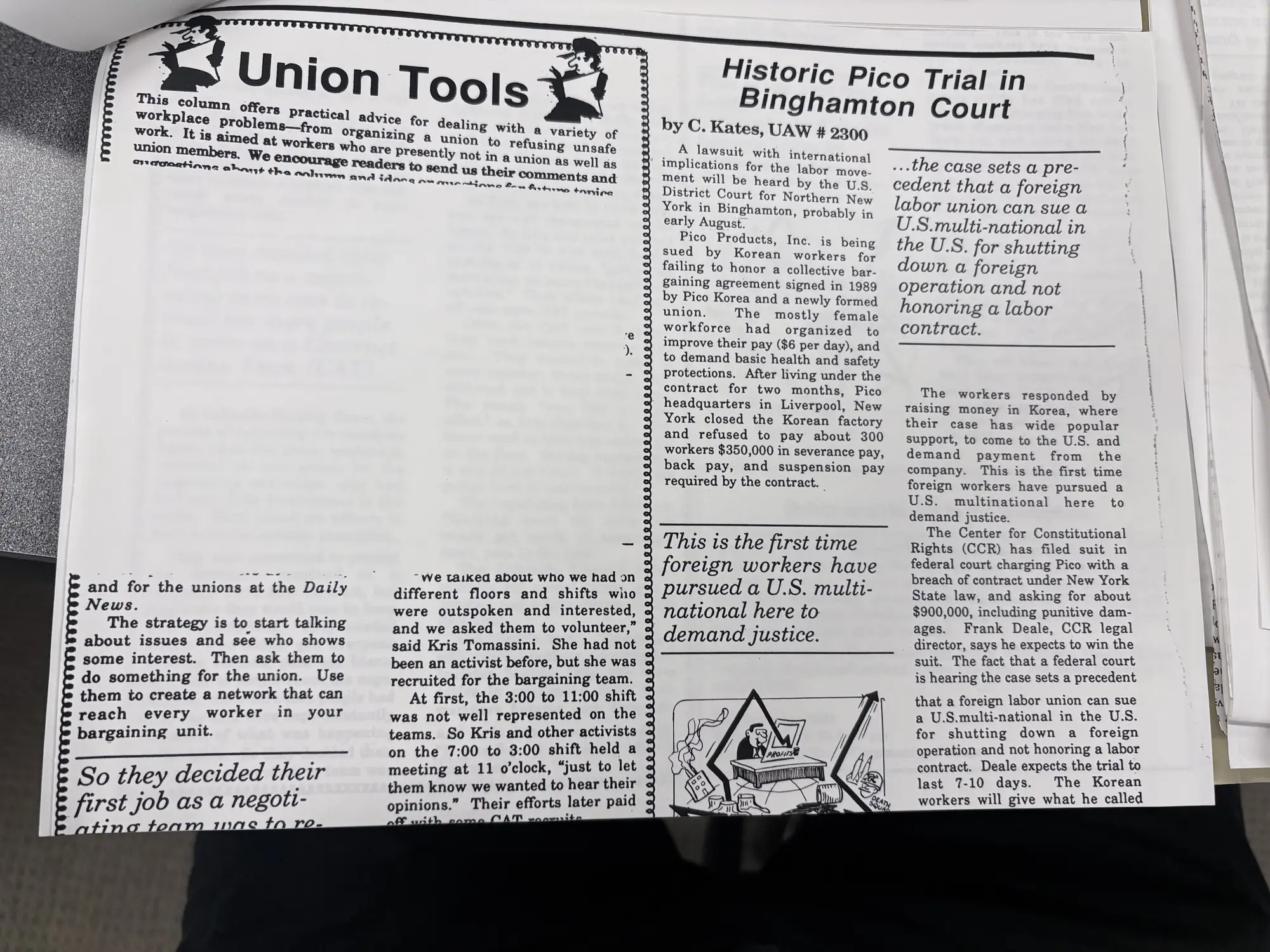
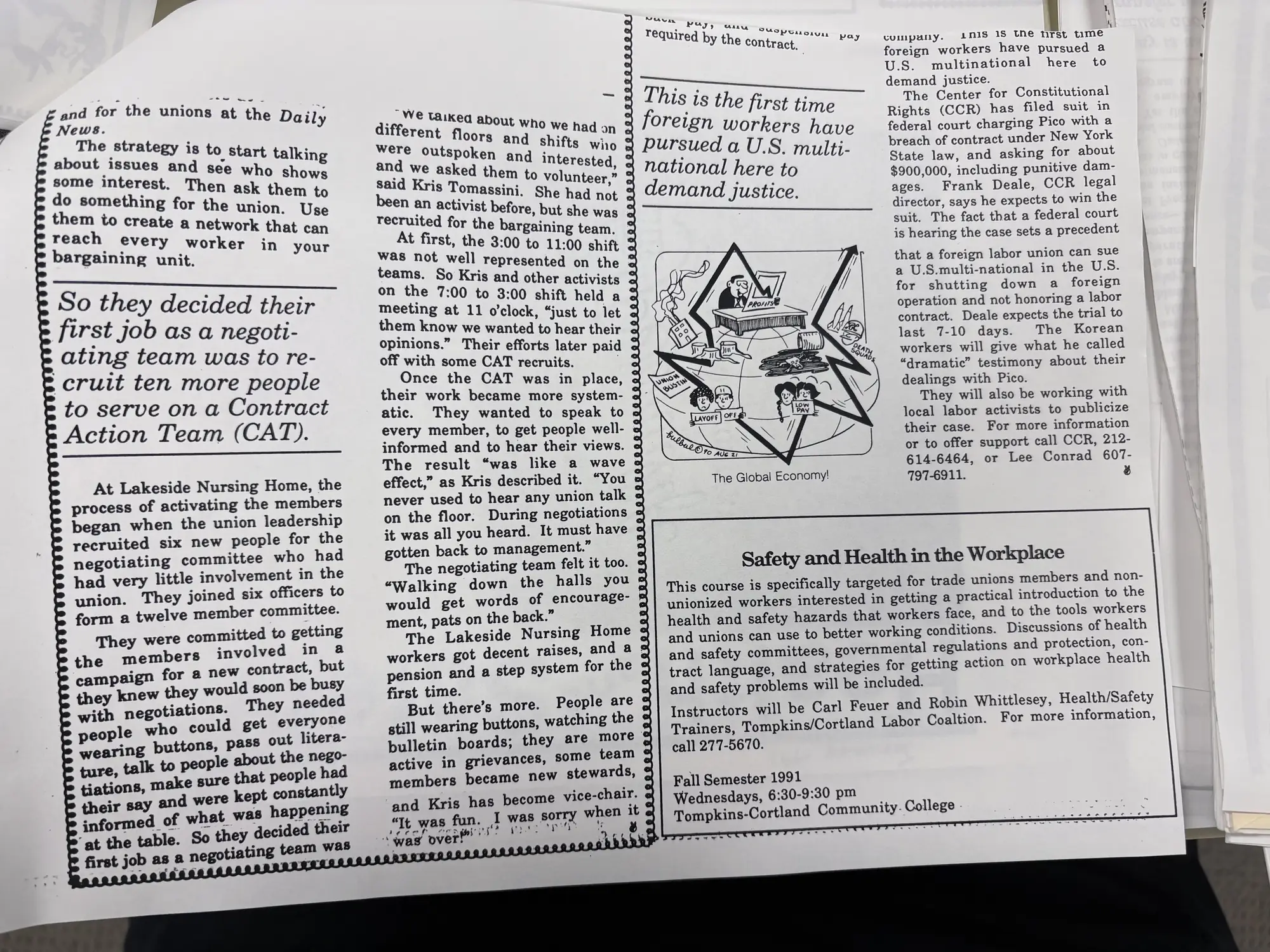
“Union Tools” and “Historic Pico Trial in Binghamton Court”
[1991]Date inferred
A labor newspaper spread: “Union Tools” describes how union leaders at Lakeside Nursing Home recruited members to a Contract Action Team; C. Kates of UAW Local 2300 reports on Korean workers' suit in federal court in Binghamton against Pico Products for failing to honor their 1989 union contract; a box announces the fall 1991 “Safety and Health in the Workplace” course at Tompkins Cortland Community College.
Two photographs show different parts of the same spread. A third photograph is not shown.
Download or cite this itemPages
 (open zoom view)
Read the page text (machine-read, mostly readable)
This text was generated automatically from the photograph and has not been corrected. The image is the authoritative record.
onemnationa abeny er

and for the unions at the Daily
News.

The strategy is to start talking
about issues and see who shows
some interest. Then ask them to
do something for the union. Use
them to create a network that can
reach every worker in your
bargaining unit.

So they decided their
first job as a negott-

no ton moc to ro-

wt tha anhimn ans

“we taiked about who we had on «
different floors and shifts wiio »
were outspoken and interested, «
and we asked them to volunteer,”
said Kris Tomassini. She had not «
been an activist before, but she was o

recruited for the bargaining team.

At first, the 3:00 to 11:00 shift <
was not well represented on the

teams. So Kris and other activists
on the 7:00 to 3:00 shift held a
meeting at 11 o'clock, “just to let
them know we wanted to hear their
opinions.” Their efforts later paid

fei int

by C., Kates, UAW # 2300

A lawsuit with international
Plications for the labor move-
ment will be heard by the U.S
District Court for Northern New
York in Binghamton, Probably in

early August.

Pico Products, Inc. is being
sued by Korean workers for
failing to honor a collective bar-
gaining agreement signed in 1989
by Pico Korea and a newly formed
union. The mostly female
workforce had organized to
improve their pay ($6 per day), and
to demand basic health and safety
protections. After living under the
contract for two months, Pico
headquarters in Liverpool, New
York closed the Korean factory
and refused to pay about 300
workers $350,000 in severance pay,
back pay, and suspension pay
required by the contract.

This is the first time
foreign workers have
pursued a U.S. multi-
national here to
demand justice.

Nee SM
eC faivecss y
So \ aja vy)

aN a, a sig

i ray = sx i

ye, Le

Historic Pico Trial in
Binghamton Court

...the case sets a pre-
cedent that a foreign
labor union can sue a
U.S.multi-national in
the U.S. for shutting
down a foreign
operation and not
honoring a labor
contract.

The workers responded by
raising money in Korea, where
their case has wide popular
support, to come to the U.S. and
demand payment from the
company. This is the first time
foreign workers have pursued a
U.S. multinational here to
demand justice.

The Center for Constitutional
Rights (CCR) has filed suit in
federal court charging Pico with a
breach of contract under New York
State law, and asking for about
$900,000, including punitive dam-
ages. Frank Deale, CCR legal
director, says he expects to win the
suit. The fact that a federal court
is hearing the case sets a precedent

that a foreign labor union can sue
a U.S.multi-national in the U.S.
for shutting down a foreign
operation and not honoring a labor
contract. Deale expects the trial to
last 7-10 days. The Korean
workers will give what he called
 (open zoom view)
Read the page text (machine-read, mostly readable)
This text was generated automatically from the photograph and has not been corrected. The image is the authoritative record.
and for the unions at t ily
and f the Daily
The strategy is to
: sta i
about issues and see Siotinn
ne interest. Then ask ines
‘ : something for the union. Use
em to create a network that can

seraet every worker in your
argaining unit.

So they decided their

first job as a negoti-

ating team was fo re-
cruit ten more people
to serve on a Contract
Action Team (CAT).

At Lakeside Nursing Home, the
process of activating the members
began when the union leadership
recruited six new people for the
negotiating committee who had
had very little involvement in the
union. They joined six officers to
form a twelve member committee.

They were committed to getting
the members involved in a
campaign for a new contract, but
they knew they would soon be busy
with negotiations. They needed
people who could get everyone
wearing buttons, pass out litera-
ture, talk to people about the nego-
tiations, make sure that people had
their say and were kept constantly
informed of what was happening
“at the table. So they decided their
first job as a negotiating team was

afrah. GF hdlelt yA
Gag over)” |

; “We taike
different floors an

were outspoken an

been an activist before
recruited for the bargaining team.

cegeiehke the 3:00 to 11:00 shift 2
sae Sreeercsonted on the ¢
i am ° Kris and other activists 2

1e 7:00 to 3:00 shift held a &
Meeting at 11 o'clock, “just to let <
them know we wanted to hear their ©
opinions.” Their efforts later paid ¢

off with some CAT recruits.

Once the CAT was in place, «
their work became more system- 4°
They wanted to speak to e
every member, to get people well- «
informed and to hear their views. «
The result “was like a wave
effect,” as Kris described it. “You =
never used to hear any union talk ¢
on the floor. During negotiations C
it was all you heard. It must have °

atic.

gotten back to management.”

The negotiating team felt it too. :
“Walking down the halls you »
would get words of encourage: &

ment, pats on the back.”

The Lakeside Nursing Home :
workers got decent raises, and a ©
pension and a step system for the e

first time.
But there’s more.

“Tt was fun. J was sorry when it

d about Ae we had on
shifts wiio purs

ver et Aina wis eda U.S. multi-

SNe sked them to volunteer,” -

8 Tomassini. She had not

but she was &

People are ¢
still wearing buttons, watching the ©
bulletin boards; they are more ©
active in grievances, some team ©
members became new stewards, ¢

and Kris has become vice-chair. «

Nua
POY, an

on Seerettay cuicre
quired by the contract =

This is the first time
oreign workers have

national here to
demand justice.

Ke y al 4 y

) Ya C
way Be NS
SPD NS Lay!
oP gam / \\
Simm) Fen Dr;
WSS o 9 eee IS i
Travor’) OFF

The Global Economy!

call 277-5670.

Fall Semester 1991
Wednesdays, 6:30-9:30 pm

Safety and Health in the Workplace

This course is specifically targeted for tra
unionized workers interested in getting a practical introduction to the
health and safety hazards that workers face, and to the tools workers
ditions. Discussions of health
ations and protection, con-

place health

and unions can use to better working con
and safety committees, governmental regul
tract language, and strategies for getting action on work
and safety problems will be included.

Instructors will be Carl Feuer and Robin Wh
Trainers, Tompkins/Cortland Labor Coaltion.

cumpany. unis 1S tne tirst time :
foreign workers have pursued a
U.S. multinational here to
demand justice.

The Center for Constitutional
Rights (CCR) has filed suit in
federal court charging Pico with a
breach of contract under New York
State law, and asking for about
$900,000, including punitive dam-
ages. Frank Deale, CCR legal
director, says he expects to win the
suit. The fact that a federal court
is hearing the case sets a precedent

that a foreign labor union can sue
a U.S.multi-national in the U.S.
for shutting down a foreign
operation and not honoring a labor
contract. Deale expects the trial to
last 7-10 days. The Korean
workers will give what he called
“dramatic” testimony about their
dealings with Pico.

They will also be working with
local labor activists to publicize
their case. For more information
or to offer support call CCR, 212-
614-6464, or Lee Conrad 607-
797-6911. t)

Tompkins-Cortland Community. College -

de unions members and non-

ittlesey, Health/Safety
For more information,
See something wrong, or recognize a person or event? Send a correction. If you hold rights in this item or think it should not be public, write to the same address.