Newsletter, 2 pages
“OSHA Standards May Be Hazardous to Your Health”
[July 1991]Date inferred
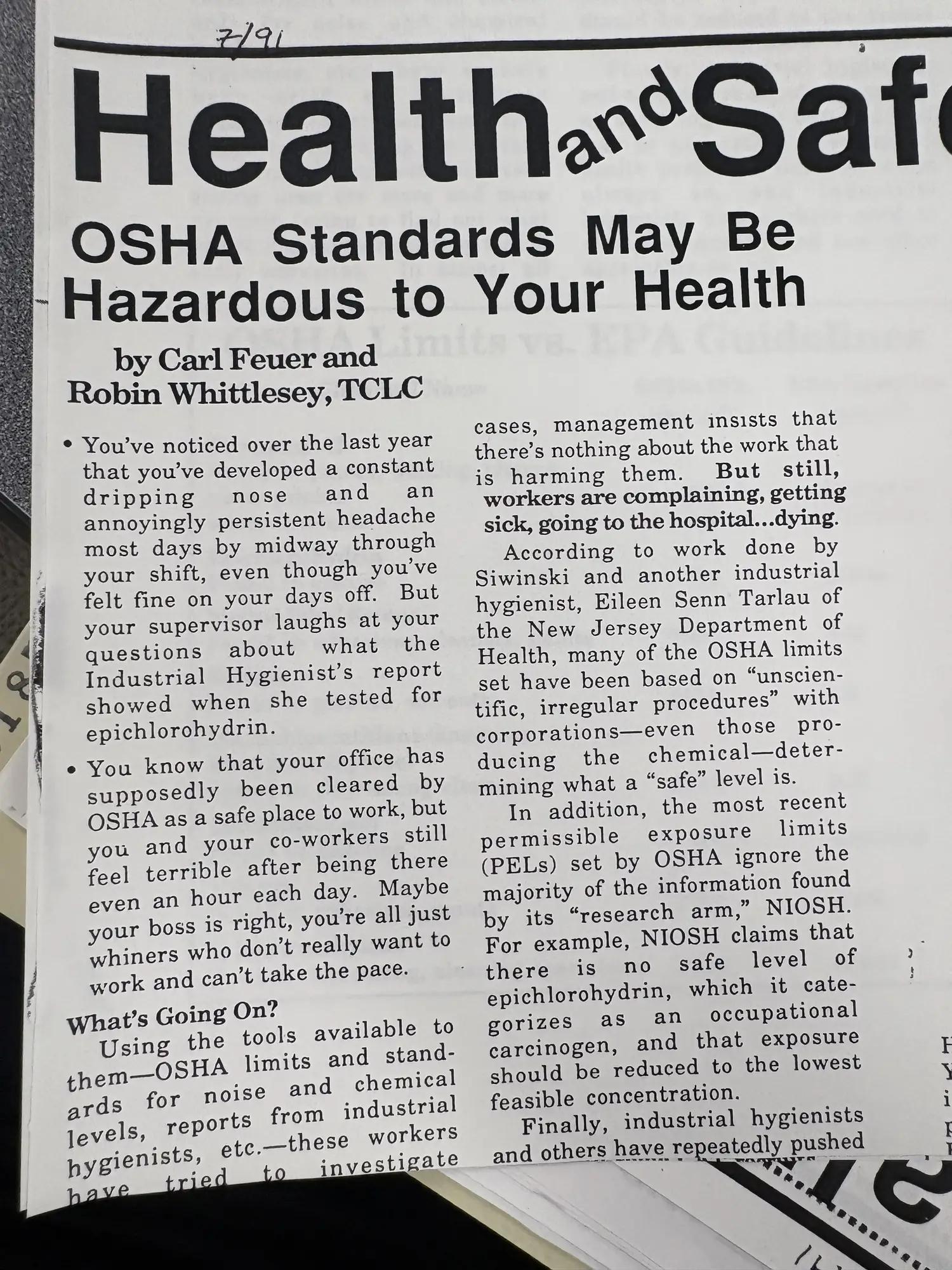
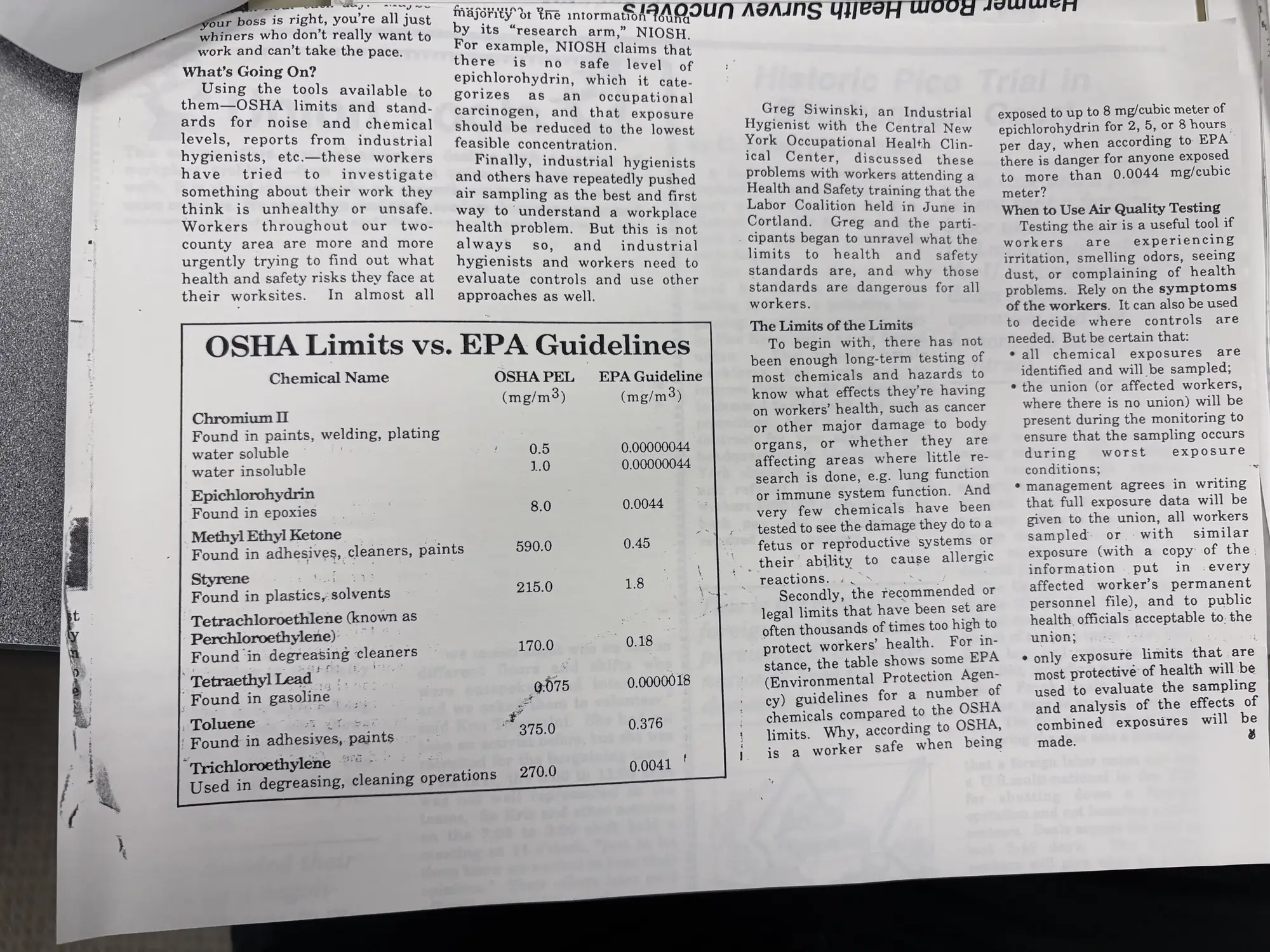
A Health and Safety page article arguing that many OSHA exposure limits are outdated and too high, comparing them with NIOSH and EPA guidance, with a table comparing OSHA limits and EPA guidelines for common industrial chemicals.
The date is handwritten on the page.
Download or cite this itemPages
 (open zoom view)
Read the page text (machine-read, mostly readable)
This text was generated automatically from the photograph and has not been corrected. The image is the authoritative record.
+ ee

by Carl Feuer and
Robin Whittlesey, TCLC

¢ You’ve noticed over the last year
that you’ve developed a constant
dripping mose and an
annoyingly persistent headache
most days by midway through
your shift, even though you’ve
felt fine on your days off. But
your supervisor laughs at your
questions about what the
Industrial Hygienist’s report
showed when she tested for
epichlorohydrin.

e You know that your office has
supposedly been cleared by
OSHA as a safe place to work, but

ou and your co-workers still
feel terrible after being there
even an hour each day. Maybe
your boss is right, youre all just
whiners who don’t really want to
work and can’t take the pace.
what’s Going On?
Using the tools available to
them—OSHA limits and stand-
ards for noise and ohemies
jevels, reports oe nea
ienl etc.—these
pygienists, a :

vestigate

Health.“Saf

|» OSHA Standards May Be
|; Hazardous to Your Health

cases, Management insists that
there’s nothing about the work that
is harming them. But still,
workers are complaining, getting
sick, going to the hospital...dying.

According to work done by
Siwinski and another industrial
hygienist, Eileen Senn Tarlau of
the New Jersey Department of
Health, many of the OSHA limits
set have been based on “unscien-
tific, irregular procedures” with
corporations—even those pro-
ducing the chemical—deter-
mining what a “safe” level is.

In addition, the most recent
permissible exposure limits
(PELs) set by OSHA ignore the
majority of the information found
by its “research arm,” NIOSH.
For example, NIOSH claims that
therewiis mo sate level of
epichlorohydrin, which it cate-
gorizes as @n occupational
carcinogen, and that exposure
should be reduced to the lowest
feasible concentration.

Finally, industrial hygienists
and others have repeatedly pushed
 (open zoom view)
Read the page text (machine-read, mostly readable)
This text was generated automatically from the photograph and has not been corrected. The image is the authoritative record.
What’s Going On?
Using the tools

levels,

have tried to

their worksites.

Used in degreasing,

ir boss is right, you're all just
whiners who don’t really want to
work and can’t take the pace.

them—OSHA limits and stand-
ards for noise and
reports from
hygienists, etc.—these workers

something about their work they
think is unhealthy or unsafe.
Workers throughout our two-
county area are more and more
urgently trying to find out what
health and safety risks they face at
In almost all

OSHA Limits vs. EPA Guidelines

re nes

by its “research arm,” NIOSH
For example, NIOSH claims that
there is no safe level of
epichlorohydrin, which it cate-
gorizes as an occupational
carcinogen, and that ex
should be reduced to the ‘1o@bsy
feasible concentration.

Finally, industrial hygienists
and others have repeatedly pushed
air sampling as the best and first
way to understand a workplace
health problem. But this is not
always so, and_ industrial
hygienists and workers need to
evaluate controls and use other
approaches as well.

available to

chemical
industrial

investigate

Chemical Name OSHAPEL EPA Guideline
(mg/m3) (mg/m3)
Chromium II
Found in paints, welding, plating
water soluble : 0.5 0.00000044
water insoluble 1.0 0.00000044
Epichlorohydrin
Found in epoxies 8.0 0.0044
Methyl] Ethyl Ketone Z
Found in adhesives, cleaners, paints 590.0 0.45
Styrene ane : \
Found in plastics,-solvents 215.0 18 ve
Tetrachloroethlene (known as :
Perchloroethylene) Sas
Found in degreasing cleaners 170.0 ;
‘‘TetraethylLead) Be
: Found in gasoline 80 0.0000018
. Toluene  eiaees? ea
’ Found in adhesives, paints 375.0 0.376
“qTyichloroethylene ~*~ © es
cleaning operations 270.0 0.0041

Greg Siwinski, an Industrial
Hygienist with the Central New
York Occupational Health Clin-
ical Center, discussed these
problems with workers attending a
Health and Safety training that the
Labor Coalition held in June in
Cortland. Greg and the parti-

. cipants began to unravel what the

limits to health and safety
standards are, and why those
standards are dangerous for all
workers.

The Limits of the Limits

To begin with, there has not
been enough long-term testing of
most chemicals and hazards to
know what effects they’re having
on workers’ health, such as cancer
or other major damage to body
organs, or whether they are
affecting areas where little re-
search is done, e.g. lung function
or immune system function. And
very few chemicals have been
tested to see the damage they do toa
fetus or reproductive systems or

_their ability to cause allergic

TCACLIONS a = ;

Secondly, the recommended or
legal limits that have been set are
often thousands of times too high to
protect workers’ health. For in-
stance, the table shows some EPA
(Environmental Protection Agen-
cy) guidelines for a number of
chemicals compared to the OSHA
limits. Why, according to OSHA,
is a worker safe when being

MEPS dt We intormagotAQIUN AGAING YYEIH WOCG Aor |

exposed to up to 8 mg/cubic meter of
epichlorohydrin for 2, 5, or 8 hours _
per day, when according to EPA
there is danger for anyone exposed
to more than 0.0044 mg/cubic
meter?
When to Use Air Quality Testing
Testing the air is a useful tool if
workers are experiencing
irritation, smelling odors, seeing
dust, or complaining of health
problems. Rely on the symptoms
of the workers. It can also be used
to decide where controls are
needed. But be certain that:
* all chemical exposures are
identified and will be sampled;
* the union (or affected workers,
where there is no union) will be
present during the monitoring to
ensure that the sampling occurs
during worst exposure
conditions; ~
management agrees in writing
that full exposure data will be
given to the union, all workers
sampled. or -with similar
exposure (with a copy of the
information put in -every
affected worker’s permanent
personnel file), and to public
health officials acceptable to. the
union; 5
only exposure limits that are
most protective of health will be
used to evaluate the sampling
and analysis of the effects of
combined exposures will be
made. tC)
See something wrong, or recognize a person or event? Send a correction. If you hold rights in this item or think it should not be public, write to the same address.